Category Archives: Fiction & Essays

Author Commentary: Two Fathers

I originally wrote this piece in an effort to create an ultra-short of 150 words or less. I don’t recall what prompted it, but somehow I got to thinking of my biological father and the very few memories I have of him, which, interestingly enough, taken all together, come out to about 150 words!

The second segment is about the father of the best friend I had from the time I was four or five until we moved to a different town when I was twelve. In the hundreds of times I visited my friend’s house – which was just across the street from ours – I don’t believe I actually saw the man more than a dozen times, and never once in all those years did he speak to me. Of course, most of the time he was busy working his butt off to support their five children, and there was no doubt that he loved his family very much. But as a kid all I was cognizant of was the fear.

I wrote another segment of this piece about my “main” stepfather – that’s the one I had the longest – but I didn’t really care for the way it turned out so I omitted it. I’m still not sure if I should have included it after all. It certainly would have put a different spin on the piece as a whole, because it was a fairly flattering portrayal of a man who, without being anyone’s biological father, was nonetheless the best father I ever had. Except that in the end, when the marriage dissolves, the stepdad moves away and is never heard from again, and my intent was to make the story evocative rather than melancholy. And at bottom, I think it makes for a better “vignette” without coming to such a resounding conclusion, and that’s what Vine Leaves does best.     
 

That’s Life Fast Fiction Quarterly Publication and Author Commentary: Funeral for Charlie

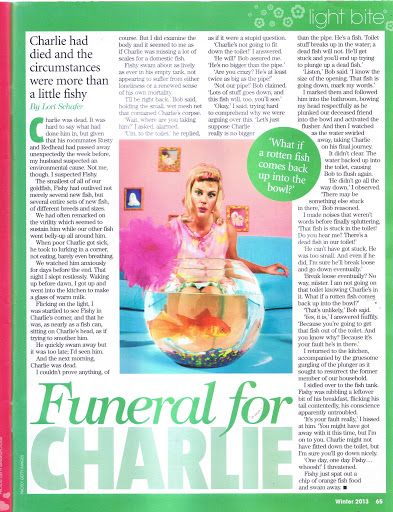
I absolutely love this story. I think it’s one of the funniest things I’ve ever written and I’m eternally grateful to Australia’s that’s Life! Fast Fiction Quarterly for publishing it in their Winter 2013 issue. Unfortunately, they had to edit out some of my best lines for length and content, and I didn’t think the published version was quite as good as the original. I did, however, think the picture and blurb they posted with it were hysterical. As the rights have now reverted to me, for the curious, here is the full original story:

FUNERAL FOR CHARLIE

Charlie was dead. It was hard to say what had done him in, but given that his roommates Rusty and Redhead had passed away unexpectedly the week before, my husband suspected environmental causes. Not me, though. I suspected Fishy.

The teeniest of all of our goldfish, Fishy had outlived not merely several new fish, but several entire sets of new fish, of a variety of breeds and sizes. We had often remarked on the unquenchable virility which seemed to sustain his minute form while our other fish went belly-up all around him. When poor Charlie got sick, he took to lurking in a corner of the tank, scarcely flapping his large fins, not moving, not eating; barely even breathing. We had watched him anxiously for days before the end. That night I had slept restlessly. Waking up long before dawn and failing to fall back into sleep, I finally got up and went into the kitchen to fix a glass of warm milk. Flicking on the light by the fish tank, I was startled to discover that Fishy had taken up residence in Charlie’s corner, and was, as nearly as a fish can, sitting on Charlie’s head as if trying to smother him. He quickly swam away but it was too late; I had already seen him. And the next morning, Charlie was dead.

I couldn’t prove anything, of course. But I did examine the body pretty carefully when Bob brought it sadly to the surface in the fraying green net, and it seemed to me as if Charlie was missing an awful lot of scales for a domestic goldfish. There were also some detectable gouges on his underside, almost as if he had been fighting. But it was pretty hard to pin anything on Fishy. He swam about as enthusiastically as ever in his empty tank, now entirely bereft of playmates, but not appearing to suffer from either loneliness or a renewed sense of his own mortality. And if he looked with fond or melancholy recollection at the plastic bridge that Charlie used to like to hide behind, or the fake coral that his brothers had favored, it never showed in his face.

“I’ll be right back,” Bob said, holding his hand under the wet mesh to prevent drips from falling all over the floor.

“Wait, where are you taking him?” I asked, alarmed.

“Um, to the toilet?” he replied, as if it were a stupid question.

“Charlie’s not going to fit down the toilet!” I answered indignantly.

“Sure he will!” Bob assured me. “He’s no bigger than a turd.”

“Are you crazy?!! He’s at least twice as big around as a turd!”

“Not my turds!” Bob answered proudly. “And if those will go down the toilet, this goldfish will, too, you’ll see.”

“Okay,” I said, trying hard to comprehend why we were arguing over this, “Okay, let’s just suppose that Charlie really is no bigger than a turd. He’s still not a turd, he’s a fish. A turd breaks up in the water; a dead fish will not. He will get stuck halfway down the pipe and you will be stuck trying to plunge up dead fish.”

“Listen, sweetheart,” Bob said, his tone bearing none of the affection implied by the term, “I’ve fixed plenty of toilets in my day, and I know how big the opening in the pipe is. That fish is going down, mark my words.”

I marked them and followed him into the bathroom. I bowed my head as he plunked our deceased friend respectfully into the deep. I listened quietly as he somberly activated the flusher. And then I watched as the water swirled away, taking Charlie on one final miraculous journey to the home of his ancient ancestors, to the ocean the abrupt end of his short life had precluded him from ever going to see. And then I flushed again for good measure.

It didn’t take. The water backed up into the toilet, causing Bob to flush again, full red in the face this time.

“He didn’t go all the way down,” I observed.

“There’s probably something else stuck in there,” Bob reasoned.

I made hissing noises that can’t be translated into words before finally spluttering, “That fish is stuck in the toilet! Do you hear me?! Stuck in the toilet. There is a dead fish in our toilet!”

“He can’t have gotten stuck; he was too small. And even if he did, I’m sure he’ll break loose and go down eventually.”

“Break loose? Break loose eventually? No way, uh-unh, mister. I am not peeing on that toilet knowing that Charlie’s in it. And we don’t even know where he got stuck. What if a rotten fish comes popping back up into the bowl?”

“That’s unlikely,” Bob assured me.

“Darn right it is,” I answered huffily. “Because you’re going to get that fish out of the toilet no matter what you have to do. And you know why? Because it’s your fault he’s in there.”

I resolutely returned to the kitchen, accompanied by the comforting cadence of Bob’s creative cursing and the gruesome gurgling of the plunger as it sought to resurrect the unfortunate former member of our household from his watery grave. I sidled nonchalantly over to the fish tank. Fishy was still nibbling a leftover bit of his solitary breakfast, flicking his tail-fin contentedly, his conscience apparently as untroubled as the calm unruffled waters which now surrounded him.

“I know it isn’t really Bob’s fault,” I conceded, now that he was out of earshot. “It’s yours. You may have gotten away with it this time, but now I’m on to you. And you know what else? Charlie might not have fit down the toilet, but there’s no question in my mind that you’ll go down quite nicely. One day, one day, Fishy… whoosh!!” I threatened.

Fishy just spat out his chip of orange fish food and swam carelessly away.

***

I have to offer full credit to boyfriend “Bob” on this one for unintentionally providing most of his own dialogue. In spite of all of the evidence to the contrary, he persisted in refusing ever to admit that Charlie just didn’t fit down that pipe.

We did, however, mutually agree to stop buying fish after that.

***

“Funeral for Charlie” is one of the stories featured in my autobiographical short story and essay collection Stories from My Memory-Shelf: Fiction and Essays from My Past (only $0.99 Kindle, $5.99 paperback). To learn more about it, please visit the book’s webpage or subscribe to my newsletter.
That's Life Fast Fiction Quarterly Publication and Author Commentary: Funeral for Charlie

Avalon Literary Review Publication and Author Commentary: Past and Present

“Past and Present” – 3rd Place winner in Avalon Literary Review’s Summer Flash Fiction Contest

This piece is based almost word for word on one of my own childhood memories. I discovered a strange scar between my thumb and forefinger when I was about eight and my mom told me how I had severed an artery with a pair of kindergarten scissors and nearly died. And at that point I realized that I did sort of remember that – that is, I remembered up until the moment of the cut. I was handmaking wrapping paper for a Christmas present – drawings on lined school paper – and somehow cut my hand open. My mom had already left for work, but she’d forgotten something and came back upstairs to find me “lying in a pool of blood.” That mental image has really stuck with me all these years.

Anyway, I tried in this piece to put a more positive spin on the memory. As an adult, I understand now that all a parent would see was the blood; the sight of your daughter dying in the kitchen. To the child, however, it was all about the present.

Romance Flash Publication and Author Commentary: The Sublet

My flash fiction romance “The Sublet” has been published in Romance Flash:

http://romanceflash.com/stories/75-the-sublet

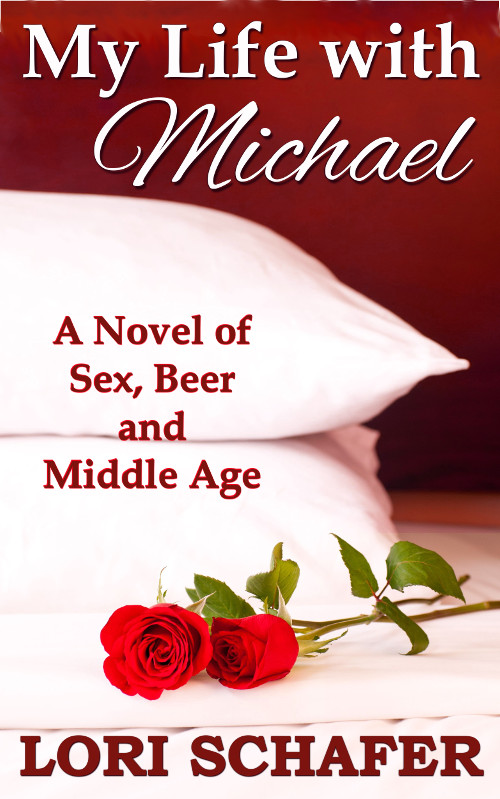
This story is actually a modified excerpt from my forthcoming novel My Life with Michael: A Story of Sex and Beer for the Middle-Aged. They say that publishing excerpts from your novels is good strategy, and maybe it is. But don’t kid yourself into thinking it saves time because you’re recycling something you’ve already written. If anything, it takes longer than writing a story from scratch. First, you have to build a frame story around a segment that was intended to be a much longer work. Second, you have to make it self-contained, which means adding and getting rid of stuff that no longer fits in the revised version. And finally, you have to adjust the length to make it work for the market for which you’re shooting, and in the case of flash fiction, this can be daunting indeed.

I like the frame story I chose here, which is completely unrelated to the plot of my book. The idea that people are no longer forced to stay in a particular place for work and are thus free to move around as much as they like intrigued me. Perhaps I get that from my days as a professional eBay seller, when I routinely traveled several months of the year and worked on the road. In the modern world the scenario is perfectly plausible, and for people without roots or strings tying them down to one location, the thought of simply packing your suitcase and moving on whenever you felt like it might have some appeal. On the other hand, it would definitely interfere with your love life. Suddenly, instead of just hanging out to see what happens with your new relationship, you have to consciously decide – do you stay or move on when your time’s supposed to be up?

Fortunately, this particular section of my book didn’t require a tremendous effort in order to make it self-contained, which is one of the reasons I chose it. Except for at the beginning, there weren’t a lot of references to events that happened earlier, and those were fairly simple to excise. Trying to get the word count down to under a thousand was awful, though. I started out with seventeen hundred, and after I’d whittled it down as much as I thought I possibly could, I still had twelve hundred words. After I took out the final two hundred, I was afraid the story didn’t make sense as a story anymore, so I set it aside for a while so I could read it with fresh eyes. I guess it must have worked, though, because the good people at Romance Flash decided to publish it. I only hope the readers like it, too!

7b7fd-romanceflashlogo

You can download more FREE excerpts from My Life with Michael from your favorite eBook retailer. Please visit the book’s webpage for more information.

My Life with Michael eBook

eRomance Publication and Author Commentary: Anything Can Happen

This was another modified excerpt from my as-yet-unpublished novel My Life with Michael: A Story of Sex and Beer for the Middle-Aged. It made a good short story, I thought. Chock full of frustration and foiled desire. I originally created the excerpt for a Free Flash Fiction contest on the theme of Unrequited Love. It didn’t place, but it wasn’t quite on theme either. Is there such a thing as half-requited love?
In any case, this longer version definitely worked better as a story. It’s strange, though; I seem to have a penchant for main characters who perpetually make asses of themselves. I am absolutely certain that there is nothing in the least bit autobiographical about that.    

Separate Worlds Publication: Squirrel Revolution

I actually had the idea that sparked this story a number of years ago. I don’t recall how I came up with it exactly, but one day I started thinking about the evolutionary process and how it relates to the impact of man on the environment. There’s no doubt that humans are greatly, if not solely, responsible for the extinction of a large number of species, hunting and habitat destruction being two of the primary means by which animal and plant life have gravely diminished in a world in which humans have become predominant. However, if there’s one thing that evolutionary theory teaches us, it’s that life is incredibly adaptable. Remember learning in school about the changes that took place in the moth population during the Industrial Revolution in England? Within a very short space of time the predominantly white moth population became a predominantly black one – because moths had a greater chance of survival when they were better able to blend in with their new, sootier environment. And they reproduce quickly enough to put those physical adaptations in place in the blink of a human eye.

So it seems reasonable to suppose that similar changes would occur in other species whose environments have been severely impacted by human activities. Indeed, it may be those species that are best able to adapt to a human-dominated landscape which will continue to thrive into the next century. The ant. The cockroach. The pigeon. The squirrel.  
  
I actually think it would make for an interesting scientific study, if anyone were sufficiently motivated to do it, to monitor the world’s population of squirrels and track whether they’ve adopted physical or cognitive adaptations in response to alterations in their environment. We think we know how squirrels behave. We see them running halfway across the street and then suddenly scurrying back when they see a car coming, which is how they get hit half the time. But what about the ones we don’t see, the ones who are too smart or too nimble to get caught in traffic? What if there really is something else going on behind the scenes…? Look out! It’s a Squirrel Revolution!

Free Flash Online Publication: The Flashing Type Issue #2

My story “Rest Stop” has been included in Free Flash Fiction’s second anthology, The Flashing Type: Issue #2:

http://www.freeflashfiction.com/index.php/goodies/kindle-anthologies/

http://www.amazon.com/The-Flashing-Type-Issue-ebook/dp/B00DSEDFFW/ref=sr_1_1?s=digital-text&ie=UTF8&qid=1373151504&sr=1-1

“Scars” An Exploration of the Map of My Body

My essay “Scars” has been published in Ducts Webzine of Personal Stories:

http://www.ducts.org/content/scars/

This piece began with a single phrase that one day randomly insinuated itself into my conscious mind. “The map of my body.” It’s not so illogical when you think about it. The body really is a landscape all its own, complete with hills and valleys, rivers and woodlands, plains and caves. It’s subject to the same physical upheavals: quakes, tremors, winds, storms, and, for the less fortunate ones among us, active volcanoes spewing noxious elements. Much like the modern human landscape, roads run through it in every direction and across countless crossroads; around each peninsula and over every mountain, as if the body itself is a vast network of highways and intersections. And in the midst of this wandering journey, if you care to take it, every so often you find a historical landmark, a sign, if you will, of some noteworthy event that took place on that very spot.

Of course, the body doesn’t have any of those giant brown placards telling you what happened in some otherwise unremarkable field or forest lining the highway, and without that, the landmark is no more meaningful to most than any other scrap of land. Only one who is intimately acquainted with the history of a particular place can look out over the fresh green growth carpeting a battle-scarred land and see in his mind where the cannons once stood or the blood once spilled. Only the expert can envision the scene of the carnage without assistance or direction. And who is more expert than one who lived through it?    

We flock to them, the physical places where great events happened. We read the signs and try to imagine the precise square foot in which Custer fell or Washington froze, as if standing ourselves upon the spot in which it happened can make it somehow more authentic and real; can bring us somehow closer to the events of the past. And it does. By fixing history in space, it also fixes it in time; assigns it a permanent place in our collective consciousness. A landmark cannot fade into history like words in a textbook; so long as someone is interested enough to proclaim its continued existence, it is, and will remain, undeniably, everlastingly real.

And so with our scars. A scar is a story, a memorial to tragedy or triumph. It matters little whether the event that precipitated it was momentous or meaningless; it stakes a claim in our memory because we carry a physical reminder of it always. It is indelibly carved into the landscapes of our bodies, a point at which something significant enough occurred to leave a mark, a mark that we can use to trace history. Not the history of a world or a nation, but a history fully as complex and grand: that of a person.

* * *

“Scars” is one of the essays featured in my autobiographical short story and essay collection Stories from My Memory-Shelf: Fiction and Essays from My Past (only $0.99 Kindle, $5.99 paperback). To learn more about it, please visit the book’s webpage or subscribe to my newsletter.

ducts_title_main_logo_part1

eRomance Publication and Author Commentary: Careful

http://www.fictionmagazines.com/shop/romance/eromance-vol-01-no-05/

This story is actually an excerpt from my first novel, My Life with Michael: A Story of Sex and Beer for the Middle-Aged, currently out on query. The piece has been heavily modified to make it self-contained, but the theme is essentially the same as that of my book: how aging changes our view of sex and romance and the people with whom we want to share those things.

It’s a cute story, I think; one of my sweeter pieces. Many of my romantic short stories carry an undertone of heartache (it’s only my erotica that’s funny), and it amuses me to have written something so light and fluffy, almost as if I were becoming sentimental myself in my old age. Shh, don’t tell anyone!

Anyway, “Careful” is about a newish couple in their mid-forties and how the two of them relate to one another when the male character suffers a back injury. My favorite line from this story? This one:   
“So he let me help him out of his shoes and shirt and pants, and then I wiggled myself into the lacy pink chemise that delicately covered up my sagging this and drooping that while he scooted awkwardly up into the bed and under the covers.”
Paints quite the romantic picture, doesn’t it? :)

Every Day Poets Publication and Commentary: Strange Bedfellow

http://www.everydaypoets.com/strange-bedfellow-by-lori-schafer/

I actually wrote this poem back in my mid-twenties, which, believe me, was more than a few years ago, so it’s pretty amazing I still had it lying around. I’d been through a few boyfriends by then and had really started thinking about what it was that I find attractive in a man. I guess I already knew that I wasn’t unduly impressed by appearances – I mean, I’ve never understood why I should get all hot and bothered by chiseled features or a cleft chin – but it was only then that I started to understand what it was that I did find appealing in members of the opposite sex. And the answers, frankly, rather surprised me. Because it turned out that, like the rest of us, I’m inexplicably drawn to certain physical characteristics. They’re just not, perhaps, the typical ones.

Glasses, for instance. Warm, expressive eyes are a must for me in a man, but there’s no question that I prefer them framed by a pair of lenses. Don’t ask me why; I can’t even begin to guess. Brunettes over blondes, although I did have a huge crush on a redhead a while back, so who knows? I love an afro on a black man, but big hair on a white guy leaves me cold. I’m not partial to beards but I’m not offended by them either; mainly I just like the feel of not-quite-clean-shaven cheeks. Muscles are fine as long as they don’t get in the way of a nice round beer belly, and I never ever want to lay my head back against a set of six-pack abs. I feel safe enveloped in the long arms of a tall man, but I like seeing eye-to-eye with a short one, too. Thin may be pretty, and healthy, too, of course, but given my choice, I prefer a substantial man, one whose weight you can really feel on your body. And when I think about the wide variety of qualities I find appealing in men, it becomes clear to me how it all boils down. There’s something attractive in everyone. Sometimes you just have to look a little harder to see it.

Nobody really understands all of the nuances of what goes into physical attraction. How can you look at someone you know would not be considered attractive by most people and still think they’re the hottest thing walking? The bottom line is, when it comes to choosing a mate, what I really want is a man who looks nice, who looks kind; someone I’ll be happy to go to bed with every night and wake up with every morning; a man who’s a comfort to look at and to feel by my side. And maybe that’s not a feature you can pinpoint with characteristics and measurements; maybe it really is a quality that comes from within.