Tag Archives: schizophrenia

In Which I Make My First Attempt at Crowdfunding – and Other Tales of Terror

So today I have launched my first IndieGoGo campaign. (Yes, I know they don’t actually capitalize the Gs, but I really feel that they should. I think they’d raise more money for their vacations if they had the beat, but maybe they prefer to keep their lips sealed about it).

But, of course, IndieGoGo is not about spelling or proper capitalization or even 80s female rockers – those subjects about which we writers know so much – but about selling ourselves, about which we know so little.

I have ideas. At least a dozen very solid, potentially even achievable ideas regarding my books and my writing. I just don’t have the time, money, or capacity to make them happen.

It’s been a very strange time for me. A few years ago I was a confident and healthy young woman with my whole life ahead of me. Suddenly I’m a middle-aged lady who has no idea what she’s going to do for money during whatever life remains. It is not a pleasant feeling.

My year of disability runs out in June, which means I will have no income except for what I make from my book and eBay sales, neither of which is enough to shake even a short, skinny twig at. The irony is that I’m even more incapable of working now than I was a year ago, what with the frozen shoulder and all.

Oh, right, did I forget to mention that? Well, after several weeks of physical therapy following my shoulder dislocation, I still hadn’t made much progress with my range of motion – I had maybe forty-five degrees in a couple of directions, and close to zero in others. When I next saw the orthopedist, he diagnosed frozen shoulder, which is a condition in which calcium deposits build up around the joint following an injury. It’s more likely for this to develop when the shoulder isn’t moving – like when you’re in a sling for six weeks. Oh, yeah, and it’s also more common if you have other joint problems to begin with – which makes me wonder whether immobilizing my arm for so long was really the best course of treatment for a person like me. Because now instead of a six-to-twelve week recovery, it’s going to be six months to a year, during which I and my physical therapist attempt to break all the crap that’s grown in my arm. After which I may still need surgery. So nice to have something to look forward to in the new year!

But on the plus side, I am improving. I can wear most articles of clothing now – although I put on a dress last week and almost get stuck inside it. I can even drive a little – as long as I don’t have to make that big reach for reverse. I’m a long way from risking the freeway, but at least I can get myself to the grocery store and even the ice rink. Man, it feels good to skate again, and I feel so much better for the exercise. I put on eight pounds in the first two weeks following my injury, which wouldn’t be that big of a deal except that with my condition, every pound is a big deal.

That’s the up side. On the other end of things, boy, am I f***ed. There wasn’t a heck of a lot I could do for work when it was mostly my hands that were messed up, and there’s even less now. I can think of a few career positions that wouldn’t be agonizing – except that I might prefer to starve to death rather than spend the next twenty or thirty years doing them.

But that’s a problem for another day. In the meantime, I have a lot of ideas for my book – really cool ideas that I think could actually prove to be socially beneficial. But all of them involve investing money I don’t dare to spend on projects that may pay off in pennies rather than dollars, and not very many of those. This must be how it feels to be retired and on a fixed income. Draining your small amount of capital is somehow far more daunting when you know you can’t just go back to work.

Hence, the IndieGoGo campaign. I have several of these in mind for various projects I have in progress, but this one is the first, and so far, my favorite.

You see, a couple of weeks ago I got a five-star review from a psychiatrist who suggested that my memoir ought to be on the reading lists of high schools and colleges. Now I had already had the idea of trying to get speaking engagements at the high school level because, even though I wouldn’t expect to get much (if anything) out of that financially, I think that in today’s environment, in which mental illness has come to the forefront of social consciousness, students might appreciate hearing my story. Well, of course, not being able to get around killed that idea, and will likely make it impractical for a month or two more. But when I read this review, I thought – wait, that’s even better than what I was thinking. What if I approached a number of teachers and professors – which I would need to do by mail, anyway – and see if they were interested in teaching my book?

The more I pondered this idea, the more I loved it. In fact, it’s the perfect complement to arranging speaking engagements because then the audience will have read my memoir ahead of time. And since I could make bulk orders available quite cheaply (about $5/paperback copy) to anyone who was interested in using it, it would actually make for a very practical supplement in a course on psychology. No, I wouldn’t make much money on it, but at least it would get my name out there and, more importantly, it would get my story out there – and in the fall semester, when I should be up and about again. Will anyone actually take me up on this? No idea. It seems worth a try.

But this is the kind of project that doesn’t just take time, but also money. First I would need to order a large number of printed copies – I’d like about a hundred – and then I would need to pay to ship them. All in all, it would take close to six hundred dollars that I might never get back. Not such a big deal in the old days when I had three jobs – very scary now.

Now I want to make something clear right from the start. I’m going to post something here on my blog each time I run one of these campaigns because it only makes sense to do so. But I do not expect and, in fact, I will feel very uncomfortable if those of you who are my regular readers start contributing to these campaigns. Most of you have bought my book, and that’s enough. If you’d like to help, I’d be delighted if you share on social media or with parties whom you think might be genuinely interested, but let it end there. Nothing will make me want to stop fundraising faster than feeling as though I’ve created a sense of obligation, particularly when I have several other projects in mind.

With that being said, if you get a chance, go and check out my campaign and let me know what you think. I’m particularly interested in your opinions on how I set up the perks, which was tricky because you have to account for things like shipping and IndieGoGo’s fees – not as good a deal as it might be otherwise. In fact, I estimate that if I reach my goal of $750 that I will only net enough to send out eighty copies after the cost of perks. But of course we’ll see how it goes. Or should I say Go-Gos?

http://igg.me/at/letstalkaboutmentalillness

My Mental Illness Memoir Featured on Free Kindle Books and Tips and Bargain Booksy Today!

On Hearing of My Mother’s Death Six Years After It Happened: A Daughter’s Memoir of Mental Illness is featured on both Free Kindle Books and Tips and Bargain Booksy today as part of my $0.99 promotion. If you get a chance, I would appreciate it if you could go in and “Like” the related Facebook posts. Evidently it helps with the algorithm or something – you know how that stuff works ;)


SALE! On Hearing of My Mother’s Death Six Years After It Happened Just $0.99 through February 17th!

On Hearing of My Mother’s Death Six Years After It Happened: A Daughter’s Memoir of Mental Illness is on sale for just $0.99 for Kindle through February 17th. I’m happy to report that the promotions I scheduled seem to be working:

???????????????????????????????

I’ve also temporarily reduced the price of the paperback to $5.99. What a steal! ;)

The Courage to Share Your Story

I have a new guest post up at Wow! Women on Writing:

http://muffin.wow-womenonwriting.com/2015/02/friday-speak-out-courage-to-share-your.html

I think I’m probably in the minority opinion here, but the longer I think about it, the more passionately I feel that I’m right.

7423d-themuffinbanner

“Lori,” Jesse whispers, clutching me tighter. “Lori, I think you’re going insane.”

It is in one of the in-between times, when Mom has decided to let me out for a while. Perhaps she has grown fearful of Social Services. Perhaps she intends to inspect the house from roots to rafters and wants me out of the way. Perhaps she’s simply sick of watching me all day and all night. I don’t know. I know better than to question it.

My friends and I are at a hotel for a school function of some sort. I don’t remember exactly why. Band, or perhaps Key Club? It doesn’t matter. I have reached a point where nothing seems very real anymore.

I am wearing an orange dress my mother bought me. It’s hideous, but I don’t realize that until later. Jesse is with me. He is holding me. I am grateful for that.

We are on one of the upper floors. We are beside a railing. It overlooks the center of the hotel. We are talking. I don’t know what about.

I can see us standing there together. Me in that ugly orange dress with my hair cut short, my face buried in his shoulder. Him with his arms wrapped in a circle around me. I can see it, see it as if I’m above it and not inside it, and in my mind I’ve gotten up onto the railing and I’m teetering there, on the verge of going over, and I don’t know how to stop it; don’t know if I even care anymore about trying to stop it.

“Lori,” Jesse whispers, clutching me tighter. “Lori, I think you’re going insane.”

* * *

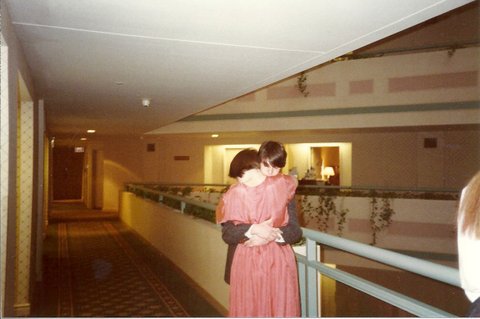
This is an excerpt from my memoir On Hearing of My Mother’s Death Six Years After It Happened: A Daughter’s Memoir of Mental Illness I described in this post how I recently inquired of some of my high school friends whether they had in their possession any photos I might be able to use in assembling my book trailer. Imagine my reaction when my friend Ben – who was always the big picture-taker of the group – responded with this photograph:

image0

Photo courtesy of Ben Sanford

Stunned and happy and heartbroken. To see that moment, captured forever on film, somehow makes it all the more devastating, all the more real. The picture can’t tell what we were saying or thinking. Yet somehow it does. Somehow, it does.

Assembling a Book Trailer – Part I

As some of you saw, last week I posted my first book trailer for On Hearing of My Mother’s Death Six Years After It Happened (I’ve included it again at the end of this post if you missed it). After I posted it, I got a request from one of my followers to explain how I went about making it. Terrific idea, I thought – I’m totally stealing it!

Let me start off by saying that I did not want to do a typical book trailer. Most of the ones that I’ve seen I think are too long or too dull, spending image after image detailing plot points or posing questions the book purports to answer. At the other extreme, you also see Hollywood-style trailers, which are usually very well-done cinematically, but often make me want to see the movie rather than read the book!

The second most influential factor for me was the realization that trailers, like other forms of visual marketing, are very expensive to have made. It’s not the kind of thing a writer will generally want to do for him or herself because it simply isn’t in their realm of expertise. In my case, however, cash proved to be king. I wanted a trailer and I wanted one now – later on, I reasoned, if it seemed worth the expense, I could have one professionally done.

However, given that my knowledge in this area is severely limited, and my experience with digital media slight, I cast aside some of the early daydreams I had had of gorgeous cinematography, professional graphics, and a custom soundtrack to fit the action. Over-shooting my own skill level, I feared, would only result in an inferior product. I might mess up a sausage soufflé – and why attempt one when I know I can make a mean breakfast burrito? It would be better to make a trailer that was technically simpler, but hopefully equally as meaningful.

The second problem was this – I had no idea what the trailer was going to be about. I wanted a trailer that would evoke the mood of my story without attempting to tell it, which meant emphasizing feel over plotline. I also wanted it to be short, yet the moments from my book that I had considered utilizing required camera work that I just wasn’t sure I could effectively accomplish. I began ruminating over the idea of maybe including some images from my hometown – the problem being, of course, that I don’t have any. So I contacted those few high school friends with whom I’ve stayed loosely in touch and asked around to see if anyone had any pictures or videos that might be suitable for me.

My hopes in this quest were very, very low. First there was the issue of quality, because naturally pictures from twenty-some odd years ago were generally not in digital format. Secondly, unless the images were of me specifically – which, in my mind, was not necessarily a selling point! – I would be unable to use any that contained recognizable people because I wouldn’t have model releases for them.

My friend John Lin responded with a handful of photos from his graduation, which was the year before mine. Most of them were, as I suspected, unusable, as they were mostly of him and his family, and the quality, too, left much to be desired. And in any case, I still didn’t know what I would do with them. They weren’t even my pictures. This was not my graduation.

And that’s when it hit me – this was not my graduation.

I have almost no memories of my high school graduation. Most of what I remember about that day was the thrill of knowing that I would be free once it was over. My happiness over unexpectedly meeting my boyfriend after the ceremony, who had graduated a year ahead of me and whom I hadn’t expected to see again before I left for good. The tension of knowing that the car I had bought without my mother knowing was waiting for me on the street behind our house, waiting for me to pack up and leave. I don’t remember anything like what John no doubt remembers – receiving his diploma, being with his friends and family, throwing his cap in the air. Those things were utterly irrelevant to me. Same type of day, entirely different experience.

I flipped through his photos again, saddened somehow by what they had revealed. There was one in particular that showed students streaming down the lawn from our high school building down to the field with a TV crew filming. The photo was blurry – but how perfect for me, because you couldn’t make out any of the students’ faces. It was someone else’s high school graduation. But in another life, it might have been mine.

I went to freestockphotos.biz and began searching for photos. I wanted typical things, people and objects of which most kids would keep pictures. Their homes, their friends, their pets – maybe even their parents.

It took maybe two hours. Again, there was the issue of model releases, which prevented me from using some of the images I might have liked for me and my mother. And since I preferred free photos over paid ones, I had to dig a little deeper into my well of creativity, as I simply couldn’t find suitable photos for some of my initial ideas.

Once I had assembled the photos, the text was easy. And once I found a site that features royalty-free music, the soundtrack was easy, too. I won’t cover the technical aspects of assembling the project here, as this post is long enough already, but I am going to put together a video that will walk those of you who are interested through the whole process from start to finish. The technicalities of this type of sequence aren’t terribly difficult to master, although there are certainly some tricks that can make it easier.

But the big thing for me was coming up with the idea. Once I had the idea, the rest of it fell into place. So if you’re considering making your own trailer, my advice is to ask yourself these three questions:

1) What do you want to express in the trailer? A story, a mood, a character, a state of mind, an event?

2) What style do you want for your trailer? Will that style effectively convey whatever you said you wanted to achieve in your answer to Question 1?

3) Are you technically capable of achieving your vision for your trailer? Does it need to be flashy, or will simple suit you better? Will your fancy trailer look stupid if you can’t pull it off, or will your plain trailer be too dull even if you assemble it well?

One last important thing to consider is where you will be promoting your trailer. For me, my main outlets are WordPress and Twitter, both of which consist of audiences that are fairly forgiving. There’s a certain amount of leniency people are willing to grant if your ceramic ashtray is homemade – and for some that may even increase its charm. But if you’re looking to win competitions or be featured on fancy promotional websites, then you might want to consider making an investment in a professional product. Don’t, however, get stuck on the idea that many writers seem to, which is thinking that you can only have one trailer. For the amount of time and money they take to put together, you can make as many as you like, of whatever styles and lengths you like. You are limited only by the size of your own imagination.

This is Not My Trailer

Comments welcome.

I’m Sick of the Sound of My Own Voice – But I Hope You’re Not!

Well, I’ve finally done it! I’ve finished editing the audiobook of On Hearing of My Mother’s Death Six Years After It Happened. I confess it was a much more laborious process than I had originally anticipated, and even now I’m not sure I’m quite going to meet ACX’s specifications. I suspect that I may have to do a bit more digital manipulation and possibly even some re-recording before they give it the go-ahead, but with only three days remaining until my book release, I’m thrilled just to move it to one of my two dozen back burners for a while.

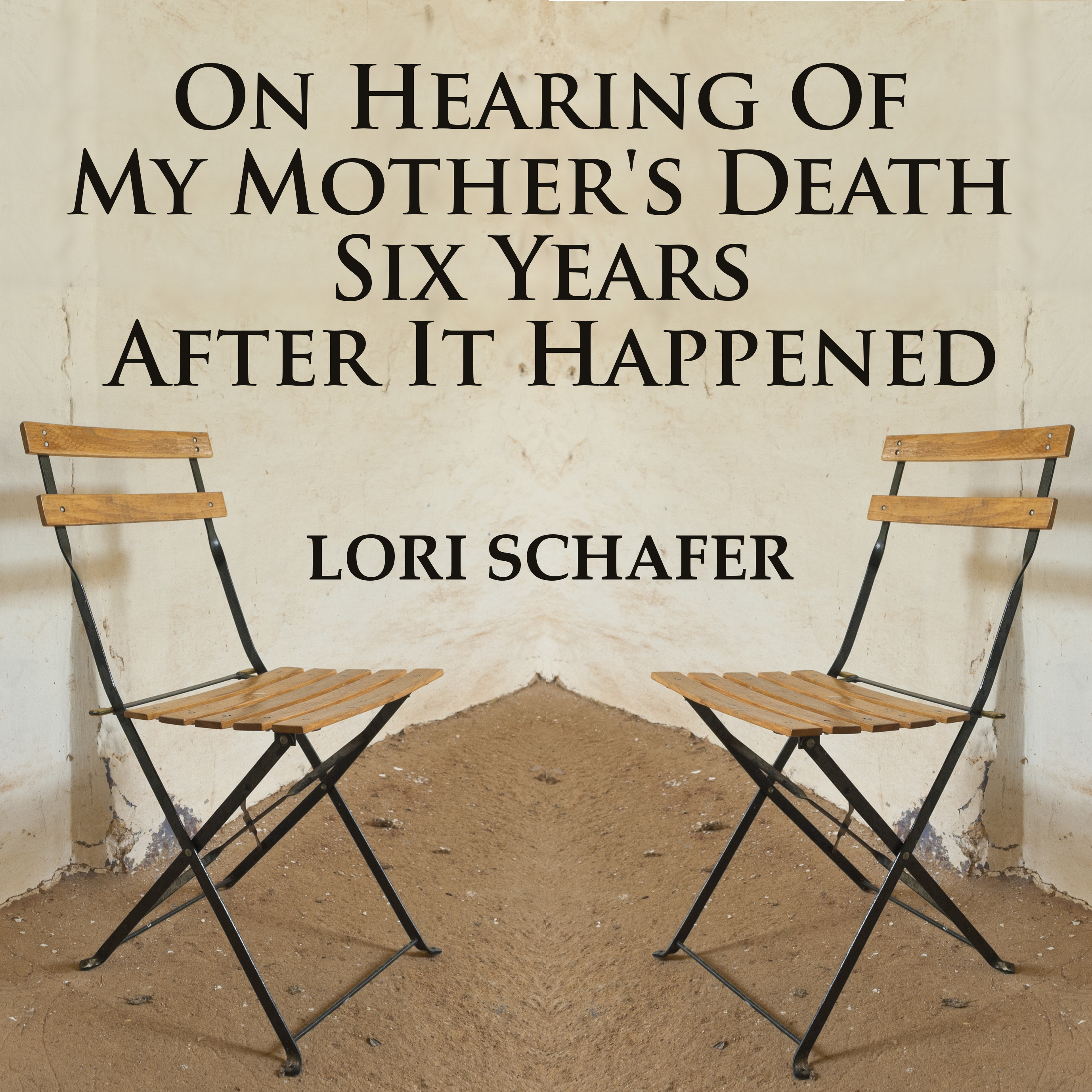
I’ll admit that I was surprised to learn that my book cover would have to be reformatted for the audiobook. I mean, I understand why they want a square cover – presumably to mimic the look of a CD, laserdisc, or vinyl record – but in the current digital age, it doesn’t really seem as if it should matter, particularly when the cover is for browsing purposes only and no one is actually going to receive a physical product. Evidently technology moves faster than consumer preferences over what their book covers, whether audio or eBook, ought to look like. Anyway, here is the adjusted cover. As you can see, although the execution differs, the “empty chair” theme remains:

Mother's Death Audiobook

But more on the audiobook production and publishing process later. For now, here’s the five-minute sample recording I submitted along with the rest of my files. I would really appreciate any feedback you could give me on this, because I’ve just noticed something very strange – when I play it back on the desktop computer on which I did the editing, it sounds pretty clean, but on my laptop there are quite a few annoying clicks and pops, and it also seems a lot quieter. I thought you weren’t even supposed to get degradation on a transfer of a digital recording, so maybe it’s my crappy laptop speakers or my even crappier internet connection.

So what do you think? Could you listen to me read for two and a half hours? At this point, believe me – better you than me!

New Goodreads Review of On Hearing of My Mother’s Death!

Byron Edgington (http://www.byronedgington.com/), author of The Sky Behind Me: A Memoir of Flying and Life, has posted his review of On Hearing of My Mother’s Death Six Years After It Happened on Goodreads. I read it yesterday, and his remarks about the book are so kind that I’m still blushing – in fact, his only complaint is that the book is too short (see my comments following the review):

“Here we have an extended essay/memoir on surviving a parent’s psychosis, inventing a life and then learning of the death of the long-forgotten parent many years after her passing. It’s much too easy to compare such works as Ms Schafer’s to other neglected childhood fare: Jeannette Walls ‘Glass Castle,’ Christina Crawford’s ‘Mommy Dearest’ etc. Too easy, because the parents in those memoirs cannot be easily forgiven; they can only be easily explained. Their cruelty stems from ambition, neglect, the depredations of poor parenting skills. Ms Schafer’s mother, on the other hand, offers a much more subtle, we might say inexplicable source of her wanton neglect and cruel treatment: mental illness and its untreated ravages.

Lori Schafer is an accomplished writer at the apex of her craft. Her images and reflections shimmer on the page: “grilled cheese and tomato…butter-brown bread…’ including good alliteration and excellent use of sentence length variation, she keeps readers moving forward. “The sidewalks were empty. I was empty.” Beautiful stuff.

Transitions are well done, despite many flashbacks and oblique references. Only one time, at an end chapter, and a reference to ‘Lila’ did this reviewer lose the thread, but then it picked up again.

Schafer’s use of a fictional device inside her memoir is very well done. She writes as ‘Gloria,’ to explain the horrors of a childhood in crisis, while giving herself a bit of remove as the writer. It’s an excellent device, and it works very well. It’s also entirely understandable. Much like any child will have an invisible friend, or a security blanket, Schafer has Gloria.

The writer’s voice stays consistent throughout, shifting with subtlety between the teenage, angst-ridden Lori and the determined older Lori living in a car in Berkeley and making her own way. “I was learning,” she writes, scraping for bottles and cans in Berkeley “…like the poor man’s Santa Claus.”

There are a few loose threads: We’re never told what happened to ‘Sandra Johnson.’ Indeed, none of the siblings’ lives are explained. There’s a reference to Schafer’s own concern about being poisoned, a thinly-veiled worry that she might have acquired her mother’s mental illness, but this is not addressed or enlarged. We don’t hear about mom’s own family history, or what may have contributed to her instability, only that ‘Judy Green-Hair’ is a serial marrier. Just open a vein, as they say; readers want more details.

Indeed, one critique of this memoir may be that it’s too darned short, that readers want to know much more about who this writer is: how did that young woman survive all she did? What resources did she uncover in herself? How’s she doing now? Has she finally found ‘a safe place?’

Wordsworth wrote, ‘…the child is father to the man,’ and we must assume he meant mother to the woman as well. If so, at the end of her fine memoir, Lori Schafer pays tribute to that young mother of herself. This is a good, fulfilling memoir. I just wish it was longer, darn it. Four stars, only because it’s too short.”

Byron Edgington, author of The Sky Behind Me: A Memoir of Flying & Life

Although it’s not an unqualified five star review, I’m really very pleased with it because Byron’s feedback actually gave me a great idea. It’s true that there are certain parts of the story into which I do not delve, in particular, regarding my mother’s family history, or what ever happened to my sister. I can’t provide answers to those questions simply because I myself don’t know the answers. My mother’s parents died when I was too young to know them; I don’t remember her sister and was merely acquainted with my uncle. I know very little about my mother’s life before me, and virtually nothing about the rest of her family. Likewise, my sister and I fell out of touch even before I left home, and as to Sandra Johnson, she’s a mystery that will forever remain unsolved.

But at no point do I ever make any of this clear to the reader. Most people, I think, see “family” as constituting a group of people; a set of relations with whom one shares varying levels of affection or bonding. For me, “family” meant Mom. She was it; there really wasn’t anyone else to fall under that heading. So it frankly never occurred to me that I might need to explain why I wasn’t talking about those larger family issues. But, of course, Byron is absolutely right; readers will be curious about those aspects of the story, and even if I have no real answers to give them, I like the idea of explaining why.

And this, of course, is one of the beauties of independent publishing. I’m not bound to someone else’s contract, or to a print run of thousands of copies that are already stacked and waiting in warehouses. So why not add another chapter? Even with my current crazy schedule, I can probably even get that done before the release date, and start fresh with an improved version of the story. A good idea is a good idea – even if it wasn’t my idea!

So thank you, Byron, for taking the time to detail what you thought was missing from my book. Your feedback is greatly appreciated, and I hope you’ll be glad to know that someone is listening.

Goodreads Book Giveaway

On Hearing of My Mother's Death Six Years After It Happened by Lori Schafer

On Hearing of My Mother’s Death Six Years After It Happened

by Lori Schafer

Giveaway ends November 23, 2014.

See the giveaway details
at Goodreads.

Enter to win

Detention: An Excerpt from My Memoir On Hearing of My Mother’s Death Six Years After It Happened

The following is an excerpt from my memoir On Hearing of My Mother’s Death Six Years After It Happened: A Daughter’s Memoir of Mental Illness, now available in paperback and eBook:

Amazon (Universal Link)

Barnes and Noble

Also available in Spanish! Al Oír Sobre la Muerte de Mi Madre Seis Años Después de que Ocurrió

“Steinberg! Schafer! Detention!” Mr. Cooper shouted furiously, his nearly bald pointed head bristling with a temper I had never witnessed before. That possibly no one had ever witnessed before. Normally he disregarded his students entirely and went on, in spite of the constant conversation and ill-concealed catcalls, with his physics lectures as if the classroom were empty, or perhaps irrelevant in the face of so much captivating science. But today we had somehow pierced the thick shield of his academic armor and prodded him into unanticipated and unheard-of disciplinary action. I testily kicked aside the pile of tiny paper airplanes that had grown at my feet during the course of the class and glared at my friend Josh, the one who’d gotten me in trouble. I was a good student; a nerd, most said. I’d never had detention before.

“My mom’s gonna freak,” I whispered nervously.

“Good luck with that,” he said, his face going pale.

“It might be all right. But only because it’s you.”

He grinned his characteristic sideways grin, so full of charm, so full of crap. I never could understand what my mother saw in him. Always strictly polite to his elders, laying it on thick with the ma’ams and sirs which had already gone out of fashion, he was arguably the biggest troublemaker of all of my friends, and definitely the one most likely to try to get me naked. Yet he was the only one she’d still let into the house. Would even leave me alone with him in the bedroom, staying tactfully away from my open door. Almost as if she wanted something to happen.

I gave it to her straight as soon as we emerged from the classroom, before Josh, in spite of his valiant attempt to breeze briskly down the hall with all of the craft and subtlety of one of his paper rockets, had even managed to escape from her sight. “Josh and I were fooling around in class and got detention. I have to come back after school.”

Her lips twitched. I could see the internal conflict boiling within her, picture her cheeks reddening under her makeup as we tiptoed through the crowded corridor, drawing furtive glances from curious students. I didn’t blame them for staring. It wasn’t every day you witnessed an otherwise fairly normal teen-aged girl being escorted to class by a conspicuous and over-dressed middle-aged woman. Kids I didn’t know would pounce on me in the bathroom, nearly dissolving into hilarity at finding me for a moment alone and ripe for ribbing. “Aren’t you the girl whose mother has green hair and comes to school with her?” they would snicker.

“It isn’t really green,” I would argue. “It’s supposed to be blonde; something just went wrong during the coloring.” It was more of a greenish tint than anything. The kind you get from swimming often in a chlorinated pool. Personally, I didn’t think the hair looked anywhere near as stupid as the sunglasses. Wearing mirrored sunglasses indoors is surely not the way to avoid drawing attention to yourself when you’re convinced that your ex-husband and adult daughter are stalking you.

She gritted her teeth, grinding them audibly as if literally chewing over the idea. “Then I guess we’ll have to come back after school,” she muttered bitterly, surrendering to painful necessity.

“Thanks. Otherwise I might get kicked out,” I replied pointedly, hoping she’d catch the implicit threat of it. I’d already missed more than a month that quarter and could, according to school policy, be failed across the board purely on the basis of unexcused absences.

Someone had noticed, taken pity on me. Was it one of the string of psychiatrists my mother had sent me to, each of whom I had at length convinced that I was not the crazy one? Was it one of my teachers, someone who understood that honors students don’t suddenly stop showing up to school for no reason? Was it my guidance counselor, who had been in the office the day my mother had tried to force me to sign the papers saying I was dropping out?

They’d made arrangements, the school board had informed her officiously. One of the teachers – the English teacher I’d had freshman year – had volunteered to take me in, and if she didn’t let me come back, they would force the issue. I’d been touched. I barely remembered Mrs. Silverman; recalled more vividly the handsome, witty boy who’d sat next to me during her class and who had eventually become my first boyfriend. I wondered what it would be like to live with her, her and the other troubled student she’d allegedly taken under her wing. Who would even have imagined that a close-knit suburb could hold two such students?

Even my mother, so bold in the face of imaginary enemies, was unwilling to risk official intervention. She’d let me come back. With conditions. I can’t even guess what she told the principal and the superintendent – whether she in fact convinced them that I might be in some sort of danger, or if they merely thought it best not to chance it, never suspecting that the woman to whom they had admitted entrance was more dangerous by far than any of the nonexistent murderers she feared. But they had permitted it, this insane adult intrusion into the lives of unwitting high school students. As long as she stayed outside the classroom, not in it. Inside, they’d insisted, would be too distracting. But as a goodwill gesture they had commandeered for her a set of her own chairs, one parked outside of each of my classrooms, that she might not grow weary during her dull and lonely vigils. What kind consideration, I’d thought bemusedly. How nice that they’d made an effort to ensure her comfort.

“We’re going home now,” she announced. “You can skip P.E.”

“I still have to come back for detention, Mom,” I reminded her.

“I want to go home for lunch,” she insisted, grabbing me awkwardly by the elbow while I slipped my book-bag over my shoulders.

I didn’t argue. I succumbed to her clutch and followed her silently, listening to the swish of her floor-length skirt as we traversed the corridor towards the parking lot where the student vehicles were stored. We passed the vice-principal, a friendly-faced giant of a man, along the way. I nearly forgot myself and smiled. Following my first string of poorly explained absences, he had tried to be kind to me.

“Schafe!” he’d exclaim when he passed me in the hall, punching me gently on the shoulder with his beefy fist.

“Huff!” I’d answer back, grinning, with the kind of liberty in which only kids who were sorely pitied could safely indulge.

But that was before this, before I’d had a permanent, round-the-clock guardian. Now he didn’t speak; barely even glanced at us as he edged cautiously away, retreating as far as possible against the wall, as if afraid to pass too close or too suddenly. The way everyone did. I didn’t blame them for that, either. They were right to do it.

We reached the double-doors that opened onto the parking lot, barred gates of freedom before which I would have cowed had I been alone, but she approached them boldly, as if it were her inalienable right to pass unhampered through the forbidden exit. It was a closed campus, but the hall monitors stepped politely aside to let us by as they always did, even if they didn’t know about us. Parent with child. Free pass; no questions asked. Submission to parental authority was automatic, guaranteed. Indisputable.

An overcast sky was gradually divesting itself of lukewarm spring rain, sending tiny rivulets of rainwater along the curves of my skull and down the back of my neck like the tickling tendrils of an unseen vine. I’d cast the hood of my raincoat aside, as I always did now. I didn’t like the way it restricted my peripheral vision. Our windshield was spattered thickly with raindrops, but she didn’t turn on the wipers; drove instead in half-invisibility, whether in an effort to conceal or be concealed, I couldn’t say. She had covered her badly transformed hair with a plastic rain-bonnet, of an old-fashioned design I’d never seen before and haven’t seen since. It reminded me of the handkerchief with which she’d attempted to cover up her previously long and curly chestnut hair that night we’d run away from the house, only a week before my stepfather, utterly bewildered at the sudden turn of events, agreed to move out. It hadn’t done much to alter her appearance. I was noting carefully now the effectiveness of her various disguises. Preparing myself for when I needed one.

She fixed us sandwiches, grilled cheese and tomato, the butter-browned bread and melted cheddar infusing our kitchen with a near-heavenly scent. I hesitated before biting into mine, unsure if the meal would be suddenly snatched away, as my breakfast had been, on suspicion of it being poisoned while her back was turned. And unsure also, if one of these days it would be she who had done the poisoning. But she sat down and ate with me, apparently satisfied with the attentiveness of her own preparation, and I took that to mean that my lunch was safe. I wondered whether my dinner would be.

At two-thirty I packed up my homework and reminded her that we needed to go. “In a minute,” she said vaguely, sitting taut and erect on the sofa in the hip-hugging jeans she’d changed into and snapping briskly through the pages of a woman’s magazine. By a quarter to three I was nervous.

“We’re going to be late,” I said.

“We’re not going,” she yawned with affected nonchalance, rising casually from her seat to check the lock on the front door.

“I have to go, Mom.” Inside I was panicking. “I can’t let Josh sit for detention by himself.”

Even the mention of her favorite didn’t move her. “Then you shouldn’t have gotten detention,” she answered blithely, nodding to herself in undoubting affirmation.

I inhaled so sharply that my lungs burned with the force of it. Rose slowly from the table where I’d been studying. Deliberately donned my lavender raincoat, my hands shaking, sweat forming along my hairline like condensation over a steaming pot. Chose my words carefully, not wanting to suggest more than I meant.

“I am going to school.”

I nudged past her to the door, placed my hand on the knob, and gave it a yank. She yanked back, all of her considerable might concentrated on the bones of my wrists, dislodging my grip from the door and sending me crashing through the sheetrock, leaving a nearly woman-sized hole in the wall.

“What do you want from me?!” she yelled nonsensically, as if I were a disobedient child having a fit of temper.

“I want my life back!” I shouted, conscious of the melodrama of it, my pathetic cry, but aware, too, that there was no elegant way to express what I wanted. And no hope of making her understand it even if I found the words with which to explain it.

She didn’t answer, but swung me forcibly around again, causing me to hit the opposite wall of the foyer sideways, leaving a smaller, skinnier trench in the sheetrock. And then grabbed me by one hand, dragged me out to the car, and threw me inside as if I were an uncooperative luggage bag that had been carefully packed but still refused to clamp shut.

I swallowed, rubbing my wrist, relief flowing through me like the midsummer rainshower that so briefly releases the nearly constant tension of northeastern summer skies. I could still make an appearance at detention, might still be able to graduate on time and get out of this hellhole once and for all. She backed blindly out of the driveway and took off, far faster than usual. But not in the direction of my school. Towards the border, the state line.

“I could take you away,” she’d told me once, smugly, after the first time I’d made a break for it and had to be hauled forcibly home. “Take you to the airport and fly you anywhere I want to; somewhere no one will ever find you. And I am your mother and there is absolutely nothing that anyone could do to stop me.” She’d smiled complacently, humming cheerfully under her breath. Pleased with her cleverness, the infallibility of her plan, her power.

I held hard to my seat and harder to my fear. I focused on it, drew strength from it. I didn’t speak. In silence I awaited an opportunity, a happenstance, a careless moment, while she screeched around wet, sandy curves, slamming me sideways, partly restrained by the seatbelt that was intended to ensure my safety but which was hemming me in, trapping me in the car with her like a circus animal in a travelling cage.

“You want a life?” she snarled unexpectedly as we approached a glaring red stop sign, barely tapping the brakes. “I’ll kill us both!”

But my left hand was already on the latch of the belt strapping me into the vehicle; my right hovered by the door handle. I felt her fingers snatching at the vinyl of my jacket as I jumped and rolled uncontrollably out onto the pavement. I heard her cursing violently behind me as the car shuddered to a noisy halt. The backyard backwoods of New England sprawled out before me and I sprinted into them, clawed my way through branches and brambles and pricker-bushes, and came at last to a tall wire fence that I climbed awkwardly, my full-grown feet too large for its twisted footholds, and then jumped, catching my jeans on its pointed peak and tearing them nearly the length of the seam, scraping bits of the soft flesh underneath.

I stopped. Listened. No sound of pursuit came to my ears. I stopped breathing. Listened again. Scanned the sky and tried to judge my direction from the clouds hiding the sun. Took a tentative step, my footfall crackling the underbrush. Listened again and heard nothing. Looked and saw nothing, nothing but trees and bushes and pine needles and the slivered remnants of last autumn’s leaves finally freed from the cover of snow.

And then began trudging the miles through the woods back to town.

I didn’t make it to detention. I covered my ripped pants with my jacket and dragged my torn, tired body back through the deserted hallways of the school, leaving dirty footprints on the freshly polished floors and fingerprints on the classroom doorknob that rattled uselessly in my battered hands. Josh told me later that Mr. Cooper hadn’t shown up, either. Apparently he’d forgotten all about assigning us detention. Had viewed it, perhaps, as a temporary, meaningless distraction from an important lesson in physics.

* * *

“Detention” is an excerpt from my memoir On Hearing of My Mother’s Death Six Years After It Happened: A Daughter’s Memoir of Mental Illness, now available in paperback and eBook.

Amazon (Universal Link)

Barnes and Noble

Also available in Spanish! Al Oír Sobre la Muerte de Mi Madre Seis Años Después de que Ocurrió

“Detention” is also available as a FREE eBook:

Amazon.com

Barnesandnoble.com

Itunes.com

Lulu.com