Category Archives: Not-Always-So-Popular Culture

Grand Opening! Shadow Puppet Brewing Company in Livermore, California!

Just in time for San Francisco Beer Week, I am proud to announce the grand opening of Shadow Puppet Brewing Company in Livermore, California, happening TODAY from 11 am to 11 pm. Shadow Puppet is currently one of four craft breweries in the city of Livermore, which is well on its way to becoming a destination for beer drinkers as well as for wine tasters. Shadow Puppet features an amazing variety of beers, and a beautiful, family-friendly tasting room.

The brewery is family-owned and operated by founder Brian Blackburn and by Brewmaster and Master Builder Craig Danielson. Ordinarily I would say you can recognize Craig by the big beard, but since it’s a brewery, half the guys in there will have one ;) Here’s a picture instead:

Shadow Puppet Brewing Co. Livermore

Shadow Puppet Brewing Co. brewmaster Craig Danielson, left, and owner Brian Blackburn, right, pose for a photograph at their brewery in Livermore, Calif., on Friday, Jan. 27, 2017. (Anda Chu/Bay Area News Group -East Bay Times, February 2, 2017. )

Craig loves to talk beer, so feel free to accost him with your questions and comments.

The Grand Opening event promises to be a great time, with the ribbon-cutting taking place at 11:30, a live band from 3:30 to 6:30, and a massive selection of 14 beers on tap, including a just-released Golden Sour Ale. If you can’t make the opening, don’t worry – the taproom is open Thursday through Sunday; visit the brewery’s website for the current menu and hours: www.shadowpuppetbrewing.com.

Hope to see you there!


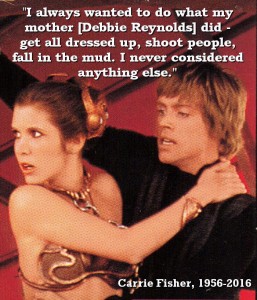
Farewell to Carrie Fisher, One of the True Icons of My Generation

“I was street smart, but unfortunately the street was Rodeo Drive.”

On her father’s gossipy 1999 autobiography: “I’m going to have my DNA fumigated.”

“I always wanted to do what my mother did – get all dressed up, shoot people, fall in the mud. I never considered anything else.”

“You can’t find true affection in Hollywood because everyone does the fake affection so well.”

“Females get hired along procreative lines. After 40, we’re kind of cooked.”

On merchandising for Star Wars: “I signed my likeness away. Every time I look in the mirror, I have to send Lucas a couple of bucks.”

“My father (Eddie Fisher) was a short Jewish man. My husband (Paul Simon) was a short Jewish man. Go figure.”

Describing working with Harrison Ford on the original Star Wars, Episode IV – A New Hope (1977): “Mark was 24, I was 19 and he [Harrison] was 33. He was like the big man on campus. You looked at him and you said to yourself, ‘He’s going to be a star.’ “

Explaining why gaffer’s tape was sometimes used under her Princess Leia costume in Star Wars, Episode IV – A New Hope (1977): “As we all know, there is no underwear in space.”

“Acting engenders and harbors qualities that are best left way behind in adolescence. People-pleasing, going on those interviews and jamming your whole personality into getting the job, ingratiating yourself to people you wouldn’t f***ing spit on if they were on fire.”

 Describing the filming of Star Wars, Episode V – The Empire Strikes Back (1980): “Mark [Hamill] was off on Dagobah while Harrison [Ford] and I were getting drunk in Cloud City.”

“I think of my body as a side effect of my mind.”

On success: “There is no point at which you can say, ‘Well, I’m successful now. I might as well take a nap.’ “

On time: “Instant gratification takes too long.”

On experience: “Maturity: A stoic response to endless reality.”

[When asked if the character Princess Leia was the dark side of the force in her professional career] “Oh, no. It was fun! I was young. People want it to be a problem for me. No. Those are great movies. Why shouldn’t I be proud of being in that? The dark side? You ever see Hollywood Vice Squad (1986) or The Star Wars Holiday Special (1978)? How about Under the Rainbow (1981)? Was Star Wars the dark side? There’s so much competition for that one.”

[About what her father, Eddie Fisher, did to help Elizabeth Taylor after her husband Michael Todd’s death] “He rushed to her side, gradually moving to her front… He consoled her with flowers and, ultimately, he consoled her with his penis.”

[on the sale of Lucasfilm to Disney] “I’m now a Disney Princess!”

carrie-fisher-1

Quotes courtesy of IMDB.com. Photo from the 1995 video release of Return of the Jedi.

Before You Throw My Heart Back on the Floor…

I guess “Last Christmas” would be more appropriate, but this was my favorite George Michael tune.


Go back

Your message has been sent

Warning
Warning
Warning
Warning
Warning

Warning.


charlie-brown

Go back

Your message has been sent

Warning
Warning
Warning
Warning
Warning

Warning.

Wishing You and Yours a Very Grinchy Christmas!

I mean that in the good way… after he stops being all evil and stuff ;)


Go back

Your message has been sent

Warning
Warning
Warning
Warning
Warning

Warning.

Here’s What’s on Top of My Christmas Tree – What’s on Yours?


That’s right – I have my very own Abominable Snow Monster! For years now he’s been coming by once a year in order to place a star on top of my tree. Is it wrong that this is my favorite part of Christmas? I’m neither very sentimental nor very religious, but somehow seeing the Abominable hovering at the top of my tree fills me with… well, I guess you’d have to call it Christmas spirit. So what’s on the top of your Christmas tree?

Go back

Your message has been sent

Warning
Warning
Warning
Warning
Warning

Warning.

Do They Know It’s Christmas?

My favorite Christmas song – it moves me every time. Sadly, it’s still relevant thirty years later.


Go back

Your message has been sent

Warning
Warning
Warning
Warning
Warning

Warning.

Rudolph the Red-Nosed Reindeer: A Critical Analysis

Last week I decided to find a new home for my fake Christmas tree. Formerly it resided in an awkward and difficult-to-navigate corner of the basement, and I’ve finally relocated it to the upstairs closet with the rest of the Christmas stuff. Logically I know I ought to just get rid of the stupid thing. It’s a pain to put up, the branches are all bent way out of shape, a chunk of the topper is missing, and it’s still wearing tinsel from 2006. Yet somehow I’m never able to do it. It always surprises me how attached I am to that tree, even though I know full well the reason why – it’s because it’s exactly like the one my family had when I was growing up. I’m ordinarily not the nostalgic type, but to me that big ol’ fake tree with its pretty, colorful blinking lights is what makes Christmas Christmas. That and my one other indispensable holiday tradition – 1970s Christmas specials!

Yes, it’s true – Christmas was never more meaningful than it was during that wondrous era in which we celebrated the most important holiday of a child’s year not by going to church, not by singing carols, not by hitting the mall at midnight on the day after Thanksgiving, but by plopping our butts down in front of a nineteen-inch black-and-white at eight pm on Saturday nights in December and losing ourselves in these classic tales of childish wonder. Rudolph the Red-Nosed Reindeer, the story of an outcast who saves Christmas. Santa Claus is Coming to Town, the story of an outcast who invents Christmas as we know it today. How the Grinch Almost Stole Christmas, the story of an outcast who… Wait, I’m starting to sense a pattern here.

Now, I am not going to confess that I still watch these specials every year, and sometimes more than once, even with no children in sight. I will decline to admit that I have all of my favorites on both video and DVD, or that the one day of the year in which even I will almost certainly tear up is when I witness The Grinch having his big change of heart. I will, however, be happy to share my thoughts on that most thought-provoking of Claymation creations – the story of Rudolph.

Yes, because there’s more to the Rudolph the Red-Nosed Reindeer than the patently obvious lesson about the worth and value of misfits. This 1964 Rankin and Bass drama is chock full of enough subtext to satisfy the most diehard of film enthusiasts, and it is still, nearly fifty years later, remarkably evocative of the socially progressive era in which it was born. Let’s look at how.


1. The authority figures are jerks. There’s the nasty coach, who, after Rudolph’s secret is revealed, informs the other children snidely: “From now on, we won’t let Rudolph play in any more reindeer games, right? Right.” Look at Rudolph’s dad, Donner, who forces him to wear a fake nose, which is not only uncomfortable, but wholly undermines Rudolph’s budding self-esteem. “You’ll like it and wear it!” he commands. “There are more important things than comfort. Self-respect!” Consider Clarice’s father, who reaffirms Rudolph’s worthlessness by rejecting Rudolph on sight: “No doe of mine is going to be seen with a… with a red-nosed reindeer!” And how about the mean elf-boss, who yells at Hermey and then (illegally) refuses to give him his break until he finishes his work?

And then there’s the big man himself, Santa Claus. Not content with merely trashing the new elf song his pint-sized slaves have spent weeks writing and rehearsing, he quickly turns his temper to the subject of Rudolph. “You should be ashamed of yourself,” he tells Donner. For what, we wonder? For siring a red-nosed son? “What a pity – he had a nice take-off, too.” In other words, Santa is so closed-minded that he can’t even consider the possibility of putting someone who’s a little different on his team, no matter how good he is or how much potential he has. It’s the attitude of guys like him that gave rise to the idea of Equal Opportunity Employment.

The message is as clear as a bright red bulb on a foggy winter night. Don’t trust anyone over thirty!

2. The one authority figure who isn’t a jerk is King Moonracer, that good-looking lion. Although he speaks smoothly and with conviction, he is unfortunately an idiot. Every evening he circles the entire earth, collecting toys that no little girl or boy loves, and bringing them to his Island of Misfit Toys. Yet practically the first thing he says to Rudolph on meeting him is, “When one day you return to Christmastown, would you tell Santa about our misfit toys? I’m sure he could find children who would be happy with them.”

Okay, Your Highness, you may seem majestic with your wings and your crown and your cool castle and all, but you need better advisers. You’re telling me that you circle the entire earth every night seeking abandoned toys, but you never once thought to stop off at the North Pole and talk to Santa yourself? Heck, I mean, it’s not even that far – no farther than one can travel by ice floe, at any rate. The misfits may be all right, but the ruler of the misfits… Well, he obviously isn’t roaring with a full mane.

I’m not quite certain about the intended lesson here, though. Is it merely a dig at autocratic rule, or are we being taught that monarchy consists largely of pointless exercises in futility? In either case, it’s none too flattering to the man in charge – and in the end, it’s the brash young upstart who actually solves the problem of the misfit toys.

3. There’s a hint of underlying feminism. When Rudolph goes missing, Donner naturally decides to go out looking for him. “Mrs. Donner wanted to go along, too,” narrator Burl Ives assures us. “No! This is man’s work!” Donner blusters in response. But the days of mindless obedience to one’s husband are passing. “No sooner did the man of the house leave than Mrs. Donner and Clarice decided to go out on their own…” It’s also interesting that all of them – male and females alike – wind up in the cave of the Abominable Snow Monster. The buck, it seems, really was no better equipped to take care of himself than the ladies.

Notice, too, that the women aren’t jerks like the men are, perhaps because they have no actual authority. Why, that Clarice is downright sweet. She doesn’t laugh along with the others; rather, she compels Rudolph to keep his promise to walk her home. She sings to the unfortunate misfit to ease his dejection and pain. She even defends his “deformity,” declaring, “I think it’s a handsome nose! Much better than that silly false one you were wearing.” She’s kind of a forward gal, too. The way she whispers “I think you’re cute!” into Rudolph’s ear just before takeoff practice, the way she nuzzles noses with him on their first date – this is not a doe who is suffering from sexual repression.

Strong, independent, free-thinking females – you can practically see women’s lib being born right in front of your eyes.

4. It’s about coming-of-age. Because there’s no need for Rudolph to actually get rid of his red nose. He just needs to learn to control it. Am I right? The young Rudolph’s “blinkin’ beak” goes off at random, shocking nearby observers with both the shining light and the horrible high-pitched whine that accompanies it. Indeed, his secret is discovered during one such unexpected episode – and worse, he and his friends are almost caught by The Abominable during another. But by the end, Rudolph is flicking that thing on and off on command, and that’s the point at which it becomes useful – even desirable – to Santa and the others.

“Control! Control! You must learn control!” Yoda scolds Luke Skywalker, another youngster with unique and special powers. And what about Harry Potter? There’s a story that’s all about learning self-control. Misfit or no, Rudolph, too, must gain mastery over his body and his emotions before he can become a productive member of society.

And that, of course, is the quintessence of growing up.

5. It’s about the growing acceptance of babies born out of wedlock. Surprising, but quite possibly true. Have you ever noticed that Hermey has rounded ears? Strange, isn’t it? Not only is he the only elf who doesn’t like to make toys, he’s also the only one with round ears. Indeed, except for his stature and classy powder-blue attire, he might not be an elf at all. He might even be – gasp – a human!

Of course, among elves, the outcast would naturally be human; the anti-Vulcan, if you will. But why did Rankin and Bass decide not to give Hermey pointy ears? Why did they decide to make him a misfit not just by personality, but also by physical characteristic?

The answer seems obvious. Hermey is – as such children used to be called – illegitimate. Because if Santa and the Missus are the only humans in Christmastown, then where did Hermey get those rounded ears? Hmm, maybe Santa’s a jerk in more ways than we thought; taking advantage of an employee – oh, no, wait. There’s also Yukon Cornelius. Maybe he popped into town one day and decided to pop in on some cute girl-elf’s cottage. Oh, wow. What if Hermey was, in fact, Yukon Cornelius’ son? Think about it – they reunite, escape death, hang out, solve problems together… I may have to compose my very first piece of fan fiction.

There’s no question that the ranks of single mothers grew in the sixties – all that free love was bound to have consequences, after all – and perhaps, in a time in which the term “bastard” still prevailed, Rudolph gently reminded us not to judge the child by the actions of its parents. It’s a lesson that we’ve evidently learned, because look at us today – even our most respected celebrities are having babies without ever getting married, and without having to apologize for it, either. And their children, too, are no longer scorned or held down by society because of their birth; they are quite as likely to succeed in life, perhaps to become celebrities in their own right, or even, if they’re very lucky and study hard, dentists.


Programs like Rudolph the Red-Nosed Reindeer are arguably the reason why children of my generation grew up the way we did. Consider the lessons it teaches. Question authority, especially when authority is wrong. Make your own decisions. Judge people by their actions, not by their appearance or their circumstances. Respect those who are different from you. It’s liberal thinking in its broadest, least political sense, and it was born in an era of idealism, in which people really thought it was possible to change the world; in which they truly believed that one person could make a difference.

Rudolph lights the way.

***

Want to share the story of Rudolph? This essay is also available as an eBook on the following sites:

Amazon

Itunes

Barnes and Noble

Kobo

Lulu

rudolph-2015


Go back

Your message has been sent

Warning
Warning
Warning
Warning
Warning

Warning.

On Viewing Hans Richter’s Rhythmus 21

I’d never really thought much about Avant-Garde cinema – I guess it didn’t particularly appeal to me, and I never felt any special desire or calling to study it or seek it out. Oh, I saw the standards they show in the introductory film classes, like Un Chien Andalou, which can’t help but be fascinating, and other classics of the early years such as Ballet Mécanique and Berlin, eine Symphonie der Großstadt. But they never made me feel anything; they were simply there, strings of images, assuredly attached together with some meaning, some relevance which lay unfortunately beyond my ken. Perhaps therein lies the truth behind my lack of interest; the fear that perhaps I simply didn’t – or possibly couldn’t – understand. The musical, the rhythmical, which are so often central, I uncovered with ease, but the cinematic remained out of reach. And why music, why rhythm? Simply to create an experience? What was the purpose for which these works were made? What were the questions to which these films were an answer?

And so it is with some trepidation that I am introduced to Hans Richter’s Rhythmus 21. I learn a little about art, a little about Richter and his connection to Eggling; I learn that despite the title the film was not made until 1926. Is this significant, perhaps a clue? I am asked to watch. I comply. I see boxes. Not even real boxes; something more like cardboard cut-outs which resemble on screen the wooden blocks I used to play with as a child. Even to my amateur eyes it appears crude; not primitive, but simplistic. Shapes simply move across the screen – left and right, screen forward and screen back. I am reminded of Meliès who so long ago created the impression of camera movement by moving his moon closer to the camera. Why do it here? I search mentally, desperately, through every narrative analogy I know. Perhaps that is my mistake, for still it lacks significance, still it means nothing.

The movements are mechanical; most of the shapes square or rectangular. I think of the machine in Germany in the twenties; I think of Metropolis. I think of modernity and industrialization, but there is no image of the machine such as we see in Ballet Mécanique, no pistons pumping or metal grinding, detached from the guidance of human hands. A greater abstraction? For the human is missing here as well. And the movement is non-productive, too; makes no pretense of utility; portrays only useless linear shapes on a dulled screen. But the pattern is perhaps not entirely linear. There is a third dimension; it exists coming toward and moving away from the onlooker. In this way it almost seems to become a part of the viewer, an extension, perhaps, of the viewing eye or body…

And then I do have a vision, a perception; I see something in it to which I have been blind. There is a meaning – and it may not be the “right” one, but that hardly matters, because it’s mine. I have given it to the film; have endowed it with life, for me, and perhaps for me alone, but at least I have not walked away with nothing. In the last segment of the film, the screen is occupied by two blocks: one small, the other larger, both rectangular. They move in alternation, forward and back, so that they seem to grow and shrink, in a peculiar rhythm, to a beat which I recognize, for it moves within me as well, within all of us. It is the beating of the human heart. And perhaps it was the progression, the slow coming to life of LIFE in those mechanical wooden squares, that constituted the Rhythmus of 21. And perhaps the question the film sought to answer was how to find that heartbeat residing within the abstracted concrete forms of modern life.

Rudolph the Red-Nosed Reindeer: A Critical Analysis

Last week I decided to find a new home for my fake Christmas tree. Formerly it resided in an awkward and difficult-to-navigate corner of the basement, and I’ve finally relocated it to the upstairs closet with the rest of the Christmas stuff. Logically I know I ought to just get rid of the stupid thing. It’s a pain to put up, the branches are all bent way out of shape, a chunk of the topper is missing, and it’s still wearing tinsel from 2006. Yet somehow I’m never able to do it. It always surprises me how attached I am to that tree, even though I know full well the reason why – it’s because it’s exactly like the one my family had when I was growing up. I’m ordinarily not the nostalgic type, but to me that big ol’ fake tree with its pretty, colorful blinking lights is what makes Christmas Christmas. That and my one other indispensable holiday tradition – 1970s Christmas specials!

Yes, it’s true – Christmas was never more meaningful than it was during that wondrous era in which we celebrated the most important holiday of a child’s year not by going to church, not by singing carols, not by hitting the mall at midnight on the day after Thanksgiving, but by plopping our butts down in front of a nineteen-inch black-and-white at eight pm on Saturday nights in December and losing ourselves in these classic tales of childish wonder. Rudolph the Red-Nosed Reindeer, the story of an outcast who saves Christmas. Santa Claus is Coming to Town, the story of an outcast who invents Christmas as we know it today. How the Grinch Almost Stole Christmas, the story of an outcast who… Wait, I’m starting to sense a pattern here.

Now, I am not going to confess that I still watch these specials every year, and sometimes more than once, even with no children in sight. I will decline to admit that I have all of my favorites on both video and DVD, or that the one day of the year in which even I will almost certainly tear up is when I witness The Grinch having his big change of heart. I will, however, be happy to share my thoughts on that most thought-provoking of Claymation creations – the story of Rudolph.

Yes, because there’s more to the Rudolph the Red-Nosed Reindeer than the patently obvious lesson about the worth and value of misfits. This 1964 Rankin and Bass drama is chock full of enough subtext to satisfy the most diehard of film enthusiasts, and it is still, nearly fifty years later, remarkably evocative of the socially progressive era in which it was born. Let’s look at how.

1. The authority figures are jerks. There’s the nasty coach, who, after Rudolph’s secret is revealed, informs the other children snidely: “From now on, we won’t let Rudolph play in any more reindeer games, right? Right.” Look at Rudolph’s dad, Donner, who forces him to wear a fake nose, which is not only uncomfortable, but wholly undermines Rudolph’s budding self-esteem. “You’ll like it and wear it!” he commands. “There are more important things than comfort. Self-respect!” Consider Clarice’s father, who reaffirms Rudolph’s worthlessness by rejecting Rudolph on sight: “No doe of mine is going to be seen with a… with a red-nosed reindeer!” And how about the mean elf-boss, who yells at Hermey and then (illegally) refuses to give him his break until he finishes his work?

And then there’s the big man himself, Santa Claus. Not content with merely trashing the new elf song his pint-sized slaves have spent weeks writing and rehearsing, he quickly turns his temper to the subject of Rudolph. “You should be ashamed of yourself,” he tells Donner. For what, we wonder? For siring a red-nosed son? “What a pity – he had a nice take-off, too.” In other words, Santa is so closed-minded that he can’t even consider the possibility of putting someone who’s a little different on his team, no matter how good he is or how much potential he has. It’s the attitude of guys like him that gave rise to the idea of Equal Opportunity Employment.

The message is as clear as a bright red bulb on a foggy winter night. Don’t trust anyone over thirty!

2. The one authority figure who isn’t a jerk is King Moonracer, that good-looking lion. Although he speaks smoothly and with conviction, he is unfortunately an idiot. Every evening he circles the entire earth, collecting toys that no little girl or boy loves, and bringing them to his Island of Misfit Toys. Yet practically the first thing he says to Rudolph on meeting him is, “When one day you return to Christmastown, would you tell Santa about our misfit toys? I’m sure he could find children who would be happy with them.”

Okay, Your Highness, you may seem majestic with your wings and your crown and your cool castle and all, but you need better advisers. You’re telling me that you circle the entire earth every night seeking abandoned toys, but you never once thought to stop off at the North Pole and talk to Santa yourself? Heck, I mean, it’s not even that far – no farther than one can travel by ice floe, at any rate. The misfits may be all right, but the ruler of the misfits… Well, he obviously isn’t roaring with a full mane.

I’m not quite certain about the intended lesson here, though. Is it merely a dig at autocratic rule, or are we being taught that monarchy consists largely of pointless exercises in futility? In either case, it’s none too flattering to the man in charge – and in the end, it’s the brash young upstart who actually solves the problem of the misfit toys.

3. There’s a hint of underlying feminism. When Rudolph goes missing, Donner naturally decides to go out looking for him. “Mrs. Donner wanted to go along, too,” narrator Burl Ives assures us. “No! This is man’s work!” Donner blusters in response. But the days of mindless obedience to one’s husband are passing. “No sooner did the man of the house leave than Mrs. Donner and Clarice decided to go out on their own…” It’s also interesting that all of them – male and females alike – wind up in the cave of the Abominable Snow Monster. The buck, it seems, really was no better equipped to take care of himself than the ladies.

Notice, too, that the women aren’t jerks like the men are, perhaps because they have no actual authority. Why, that Clarice is downright sweet. She doesn’t laugh along with the others; rather, she compels Rudolph to keep his promise to walk her home. She sings to the unfortunate misfit to ease his dejection and pain. She even defends his “deformity,” declaring, “I think it’s a handsome nose! Much better than that silly false one you were wearing.” She’s kind of a forward gal, too. The way she whispers “I think you’re cute!” into Rudolph’s ear just before takeoff practice, the way she nuzzles noses with him on their first date – this is not a doe who is suffering from sexual repression.

Strong, independent, free-thinking females – you can practically see women’s lib being born right in front of your eyes.

4. It’s about coming-of-age. Because there’s no need for Rudolph to actually get rid of his red nose. He just needs to learn to control it. Am I right? The young Rudolph’s “blinkin’ beak” goes off at random, shocking nearby observers with both the shining light and the horrible high-pitched whine that accompanies it. Indeed, his secret is discovered during one such unexpected episode – and worse, he and his friends are almost caught by The Abominable during another. But by the end, Rudolph is flicking that thing on and off on command, and that’s the point at which it becomes useful – even desirable – to Santa and the others.

“Control! Control! You must learn control!” Yoda scolds Luke Skywalker, another youngster with unique and special powers. And what about Harry Potter? There’s a story that’s all about learning self-control. Misfit or no, Rudolph, too, must gain mastery over his body and his emotions before he can become a productive member of society.

And that, of course, is the quintessence of growing up.

5. It’s about the growing acceptance of babies born out of wedlock. Surprising, but quite possibly true. Have you ever noticed that Hermey has rounded ears? Strange, isn’t it? Not only is he the only elf who doesn’t like to make toys, he’s also the only one with round ears. Indeed, except for his stature and classy powder-blue attire, he might not be an elf at all. He might even be – gasp – a human!

Of course, among elves, the outcast would naturally be human; the anti-Vulcan, if you will. But why did Rankin and Bass decide not to give Hermey pointy ears? Why did they decide to make him a misfit not just by personality, but also by physical characteristic?

The answer seems obvious. Hermey is – as such children used to be called – illegitimate. Because if Santa and the Missus are the only humans in Christmastown, then where did Hermey get those rounded ears? Hmm, maybe Santa’s a jerk in more ways than we thought; taking advantage of an employee – oh, no, wait. There’s also Yukon Cornelius. Maybe he popped into town one day and decided to pop in on some cute girl-elf’s cottage. Oh, wow. What if Hermey was, in fact, Yukon Cornelius’ son? Think about it – they reunite, escape death, hang out, solve problems together… I may have to compose my very first piece of fan fiction.

There’s no question that the ranks of single mothers grew in the sixties – all that free love was bound to have consequences, after all – and perhaps, in a time in which the term “bastard” still prevailed, Rudolph gently reminded us not to judge the child by the actions of its parents. It’s a lesson that we’ve evidently learned, because look at us today – even our most respected celebrities are having babies without ever getting married, and without having to apologize for it, either. And their children, too, are no longer scorned or held down by society because of their birth; they are quite as likely to succeed in life, perhaps to become celebrities in their own right, or even, if they’re very lucky and study hard, dentists.


Programs like Rudolph the Red-Nosed Reindeer are arguably the reason why children of my generation grew up the way we did. Consider the lessons it teaches. Question authority, especially when authority is wrong. Make your own decisions. Judge people by their actions, not by their appearance or their circumstances. Respect those who are different from you. It’s liberal thinking in its broadest, least political sense, and it was born in an era of idealism, in which people really thought it was possible to change the world; in which they truly believed that one person could make a difference.

Rudolph lights the way.

Like to party? Hop along the Hump Day Blog Hop on Julie Valerie’s Book Blog. Click here to return to the Hump Day Blog Hop.

Rudolph Blog Post