Category Archives: Fiction & Essays

Oh, the Angst! Oh, the Idealism! My College Application Essay on “Freedom”

I found this recently in a filing cabinet. I wrote it when I was seventeen – can you tell? ;)

I am posting it for Opinionated Man’s HarsH ReaLiTy challenge: http://aopinionatedman.com/2014/05/25/harsh-reality-challenge-got-an-opinion/. Enjoy!

***

“Freedom’s just another word for nothing left to lose… It ain’t nothin’ honey, if it ain’t free.” – Me and Bobby McGee

Freedom is choice. There are always choices, even the choice of death. Force need never override the strength of one’s will or belief; it is a matter of importance, priority. Which is better, submission and self-treachery, or death with honor and truth? Who is “right,” the terrorist who murders others for freedom, or the kamikaze who kills himself for the freedom of others? I say neither. That’s not what liberation is meant to be.

Freedom is lack of fear, lack of the chains that bind our human hands to the rocks that lie trapped in the walls of Platonian caves miles beneath the earth’s surface. Within true freedom hide the gods, the gods of the souls of man. I might be an anarchist, but I do not believe in the laws of today. They are unreal; they must become unnecessary, natural, unforced, unimposed by the fears of the powerful. Liberty needs no rules nor restrictions. The frightened ones gasp – visions of murder, theft, rape, etc. consume their reason. Because detachment from authority alone cannot defeat crime; people must learn also to lose their own limitations. For it is secret fear and enforced convention that create violence; revenge on the species is the only release for the constrained mind. I may be an idealist, but I believe that only “good” is born of freedom; growth and achievement are its offspring. But detachment from the impositions of authority is not the whole; people must also let go of themselves.

Freedom is a necessity for the survival of everyone, everything. Bondage suffocates the spirit. Freedom is self-awareness. With understanding, the “unknown” shrivels, our fear of it vanquished. Magic is performed when fear is surpassed and chances and risks are taken and tried. In great art and poetry exist no boundaries, no need for limitations on expression, no repression. Freedom is total experience with all levels of reality, experimentation with its parameters. Yet physicaly, the drives for food, drink, sex, etc., must not be denied in the interests of metaphysical consciousness. The body permeates and reflects all of our existence and cannot be ignored; self-control must not force even the unusual impulsion into the cracked mold of confused convention.

Personal liberty is the solution to and elimination of the trials of the “civilized” world; in fact, it is the only goal worth the struggle. I could be ignorant, but I believe that society does not even recognize true freedom. Sadly, only those with “nothing left to lose” may attempt it, for rejection, humiliation, and scorn follow on the heels of real absolution. People will not accept what they fear.

So that’s me. That’s what I think; that’s what’s important to me. I could have taken this space to write about my class rank, or my College Board scores, or my extracurricular activities. All of which mean something. But humanity is humanity because of knowledge, and my thoughts are what distinguish me from every other primate. And I think – no, I know that freedom is life, and I cherish every second of it I have ever discovered. The nation, the world, the universe, is waiting to live and be free. And the whole of my being is devoted to the cause.

janisjoplin

“Funeral for Charlie” on Story Shack Magazine

My humorous short-short “Funeral for Charlie” is now up on Story Shack Magazine:

http://thestoryshack.com/short-stories/comedy/funeral-for-charlie/

For those of you who are unfamiliar with Story Shack Magazine, it’s a daily flash fiction site operating under a very cool premise. If they accept your story, they will team you up with an illustrator to do an original drawing for it!

This time I was fortunate enough to receive custom artwork by artist Daniele Murtas (http://dmurtas.blogspot.com/). Hope you enjoy it!

illustration-funeral-for-charlie-940x540

“I watched as the water swirled away, taking Charlie on one final miraculous journey to the home of his ancient ancestors, to the ocean the abrupt end of his short life had precluded him from ever going to see…”

***

“Funeral for Charlie” is one of the stories featured in my autobiographical short story and essay collection Stories from My Memory-Shelf: Fiction and Essays from My Past (only $2.99 Kindle, $6.99 paperback). To learn more about it, please visit the book’s webpage or subscribe to my newsletter.

Out! in That’s Life Fast Fiction Quarterly

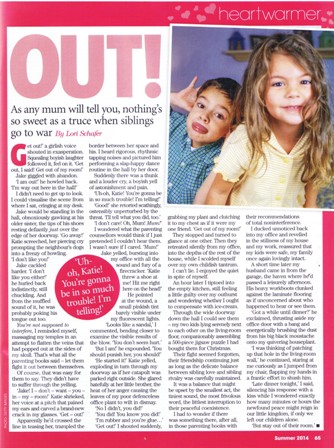
“Out!” appeared in the Summer 2014 (Australian summer) issue of That’s Life Fast Fiction Quarterly. Tell me what you think!

OUT!

“GET OUT!” a girlish voice shouted in exasperation, unbelievably audible even from across the house, possibly even from across the town. Squealing boyish laughter followed it; fed on it.

“Get out, I said!! Get out of my room!!”

Jake laughed again, louder, nearly giggling with gleeful abandon. “I am out!” he howled back at her triumphantly. “I’m way out here in the hall!”

I didn’t need to get up to look; I could visualize the scene from where I sat cringing at the desk in my office. Jake standing grinning in the hall, gawking at his year-older sister through her open door, the tips of his sneakers defiantly resting just over the edge of her lintel.

“Go away!” Katie yelled, her piercing cry prompting the neighbor’s hounds into a frenzy of agonized howling. “I don’t like you!”

Jake only cackled harder, his small fists slapping like drumsticks against the hollow-sounding sheetrock.

“I mean it!! I don’t like you!”

“I don’ wike you eiver!” he hurled back indistinctly, still chuckling. From the muffled sound of it, probably poking his tongue out at her.

You’re not supposed to interfere, I reminded myself forcibly, massaging my temples in a futile attempt to flatten the thick, bulging veins that had popped out palpably from the sides of my skull. That’s what the parenting books said; let them fight it out amongst themselves. Easy for them to say, I grumbled internally. They didn’t have to suffer through the screeching.

“JAKE!” Katie shrieked suddenly, her voice rising to a pitch that pained my ears and carved a new crack in my glasses. “I – don’t – want – you – in – my – room!” she erupted, nearly breathless with childish fury and indignation. “Get – out!!” Apparently he’d crossed the line in teasing her; trampled the border between her space and his.

“What?!” he yelled back with mock innocence. “I’m not doing anything!” I heard rigorous, rhythmic tapping noises and pictured him performing a slap-happy dance-routine in the hall by her door.

Suddenly there was a loud thunk and a louder cry, a boyish yell of astonishment and pain.

“Uh-oh, Katie!! You’re gonna be in so much trouble! I’m telling!”

“Good!” she retorted scathingly, ostensibly unperturbed by the formidable threat. “I’ll tell what you did, too.”

“I don’t care! Oh no, I don’t! Oh, Mom! Mo-om!”

I wondered what the parenting counselors would think if I pretended I didn’t hear it. I wasn’t sure if I cared.

“Mom!” Jake yelled, bursting into my office with all of the sound and fury of a string of firecrackers going off unexpectedly in the middle of May. “Katie threw a shoe at me! Hit me right here on the head!” He pointed cheerfully at the nasty wound, a small pinkish tint barely visible beneath my fluorescent lights.

“Looks more like a sandal,” I contended calmly, bending closer to examine the visible results of the near-fatal blow. “You don’t seem hurt.”

“But I am!” he expounded happily. “You should punish her; yes, you should!”

“He started it!” Katie yelled, exploding in turn through my doorway as if her catapult was parked right outside. She glared hatefully at her little brother, the hotness of her anger causing the freshly watered leaves of my poor defenseless office plant to wilt in dismay.

“No, I didn’t, you did!”

“Yes, you did, you know you did!”

“I know you are, but what am I?!”

“I’m rubber and you’re glue…”

“GET OUT!!” I shouted suddenly, snatching up my plant and clutching it to my chest as if it were my one true friend. “Get out of my room!!”

They stopped. Turned to glance thoughtfully at one other and hushed. Retreated silently from my office, sadly into the unknown depths of the rest of the house, while I scolded myself over my own childish temper tantrum.

I can’t lie. I enjoyed the quiet in spite of myself.

An hour later I tiptoed gingerly into the empty kitchen, still feeling a little guilty over my impatient outburst and considering whether I ought to compensate with everyone’s favorite dinner and maybe ice cream to boot. Through the wide doorway down the hall I could see them: my two kids lying serenely next to each other on the living room floor, companionably assembling a five-hundred-piece jigsaw puzzle I’d gotten them for Christmas. Their argument as long forgotten as Mom’s unusual fit of anger, their renewed friendship ensured as long as the delicate balance between sibling love and sibling rivalry was carefully maintained. A balance that might be upset by the smallest act, the tiniest sound, the most frivolous word, the most meager interruption to their peaceful co-existence. Maybe they had something there, after all, those parenting books with their recommendations of non-interference.

I ducked unnoticed back into my office; returned to the smooth stillness of my walls and my work, reassured that my children were safe, my family once again loving and intact. A short time later my husband came in from the garage, the blissfully quiet haven in which he’d passed his leisurely afternoon, his work-boots clunking hard against the laminate flooring as if entirely unconcerned about who heard or observed them. “We got a while until dinner?” he boomed, thrusting aside the door of my office with a bang and energetically brushing the dust from his big black mustache onto my still-quivering houseplant. “I was thinking of patching that hole in the living room wall,” he continued, staring at me curiously as I leapt from my rocking, rolling chair, waving my hands incomprehensibly in a frantic effort to shush him.

“Late dinner tonight,” I whispered, silencing his half-uttered response with a kiss while I wondered how many minutes or hours the newfound peace might reign in our little kingdom if only we left our children alone. “But stay out of their room.”

Out2

How Many Times Do I Have to Rewrite This %$^&# Thing?! The “Yellow Wagon” Saga

My flash fiction story “Yellow Wagon” has been published in Every Day Fiction:

http://www.everydayfiction.com/yellow-wagon-by-lori-schafer/

What a journey this story has taken! The final published version of this piece at the link above ended up being twice the length of the original (reproduced following this essay). The editors at Every Day Fiction were possibly interested in publishing it, except that they didn’t like the idea of “misleading” the reader about the wagon, which is precisely what the original version did. In fact, that was the essence of the story. In addition, they thought the premise itself was unbelievable because I had made Debra a first-grader and the argument was that no parent would permit a child that young to walk to school by herself.

Naturally, this threw me for a loop, because, of course, the child in the story was me, and I was not a first-grader but a kindergartner when it happened. Where I grew up in small-town New England, lots of kids walked to school by themselves. There was no such thing as blue-collar flex time so you could drive your kids to school – and many parents took the bus to work because they didn’t have a car, anyway. However, I was certainly willing to grant that we live in a different time, and that perhaps the premise would seem implausible to modern readers, so I re-wrote it to include details that would make it obvious that the story took place in an earlier era.

They still didn’t like it. The issue remained of Debra not appearing to recognize the wagon, which naturally made little sense in their interpretation of the story. I frankly had no idea what to do about this, because my intention for the piece was entirely at odds with their reading of it. I had been attempting to convey the thoughts and emotions of a little girl who has been given a great new responsibility and is trying very hard to behave herself as her mother would wish. It’s not that she doesn’t recognize the wagon – she merely pretends not to because she doesn’t want her mother to think she’s only being careful because she knows she’s being watched. The whole story development – where she keeps looking anxiously over her shoulder to see if the wagon is still following, how she exaggerates her caution in crossing the street, even her final sprint at the end when the pressure becomes too much for her – centers around this concept. What I thought was clever about it was not the fact that it draws the reader down a false path, but that if you reach the end and look back on it, it turns out that the story details were true and accurate all along. The tension was real – except its source was not the wagon, but the feelings of the little girl.

Anyway, they asked for another rewrite, and suggested that I make the story more about Debra and her mother. I’ll admit that this caused me considerable consternation. On the one hand, it was a challenge, and I’m certainly not one to run from a battle. On the other hand, I had no particular interest in writing the story that way. It just didn’t feel like me. It took me longer to transform this simple vignette into heartwarming family fiction than the original story took to write! I’m not disappointed in the way it turned out, although it is a bit on the sentimental side. But I do still believe the original version has its charms – although I’m willing to concede that I may be the only one who thinks so!

It was, however, an interesting lesson. First, because sometimes it’s easy to forget that what I think is obvious as a writer doesn’t necessarily come across to a reader the way I intended it. Editors are usually right, and if these ones weren’t getting it, chances are pretty good lots of other people would have misread my original story, too. And second, because it was my first real experience writing to someone else’s specifications. I mean, sure, I’ve had to write papers on topics that haven’t particularly interested me – but no one has ever told me how to write them. And ultimately, I feel that this is something I should be able to do, even if I don’t enjoy it very much. As wonderful as it is to exercise total control over my fiction, a writer who knows their craft should have the capacity to create work that someone else defines. So I suppose you might say that I, too, took a journey of transformation – and it’s to be hoped that I came out a better writer at the end of it.

YELLOW WAGON (Original Version)

“Right on Orange, left on Revere,” Debra repeated to herself for the dozenth time, kicking away the crisp dead leaves that snapped at her feet like so many untrained puppies. First grade wasn’t like kindergarten; the teachers got mad if you were late. Her mom would be mad, too, if she got lost along the way.

She reached the end of her street and hung a hard right, ignoring the noise of the engine she heard revving behind her. It was only a block more to the light, and when she reached it she stopped dead, waiting cautiously for the green, both feet planted firmly on the sidewalk, not even touching the curb. When her turn came she looked both ways, repeating and exaggerating the motion, and catching in consequence a glimpse of a yellow station wagon with wood paneling that had drawn to a seemingly casual halt on the side of the road behind her.

She crossed hurriedly, shifting the schoolbag in her left hand while gripping the lunchbox more tightly in her right, swinging both in steady rhythm as she walked. Halfway down the block she knelt suddenly and fiddled with her shoelaces. Peeking over her shoulder as she bent forward, she spotted it again, the yellow wagon, which had rounded the corner after her and was still following at a respectful distance.

With grim determination she pressed on, on towards the schoolyard, now only a few blocks away. She could hear the cries of the kids on the playground, see the bright orange sash of the crossing-guard directing traffic, smell the exhaust of the ancient school buses that brought the children who lived on the far side of town. And then suddenly she was on the last block and she was running, running towards the final intersection, the one guarded by the gentle white-haired man with the threatening crimson sign, and then she had flown across it and was vanishing safely into the thick crowd of students and teachers. She turned, breathless, and witnessed the yellow wagon retreating cautiously down the street, crawling silently away as if at last losing interest in the subject of its persistent pursuit.

She remained alert that afternoon; negotiated the crosswalks with care and kept watch for the stealthy wagon, but discerned no sign of it. She sighed with relief as she at last climbed the steps of the porch on which her mother stood happily waving her home.

“How was your day, sweetheart?” she inquired cheerfully. “Were you scared walking to school by yourself?”

“Nope,” Debra replied without hesitation.

“Did you remember to look both ways and cross with the light?”

“Yes, Mom,” she said, smiling, confident that her mother already knew the answer to that question.

“So you’ll be all right walking, then, if I take the car to my new job tomorrow?”

“Of course,” Debra answered. She glanced appreciatively at it, the familiar yellow station wagon with the wood paneling, parked, as always, comfortably in front of their house.

* * *

“Yellow Wagon” is one of the stories featured in my autobiographical short story and essay collection Stories from My Memory-Shelf: Fiction and Essays from My Past. To learn more about it, please visit the book’s webpage or subscribe to my newsletter.

Autumn Leaves on Sidewalk

“Yellow Wagon” on Every Day Fiction

Yellow Wagon

http://www.everydayfiction.com/yellow-wagon-by-lori-schafer/

My family flash fiction piece “Yellow Wagon” has been published on Every Day Fiction!

April Holiday: The Story That Failed

http://www.everydayfiction.com/april-holiday-by-lori-schafer/

I’m resurrecting this story in honor of Tax Day. The truth, however, is that it’s a perfect example of a story that failed.

This was only my third online publication, and only my fifth publishing credit overall, my first two having taken place way back in the twentieth century. “Baby and Me,” my first story for Every Day Fiction (published in February 2013) had gone over quite well in spite of its cynical subject matter, receiving nothing but glowing reviews and an average rating of 3.9. In addition, at the beginning of April I received a series of acceptance letters that would have swelled the head of any aspiring writer – seven acceptances in seven days. I’ll probably never have a week like that again!

Anyway, so I guess I was feeling pretty good about myself and my skills as a writer – and then “April Holiday” came out. It’s the story of the aftermath of Tax Day at an accounting firm, written as if it takes place at the scene of a disaster. The language was heavy and overdone; I wanted it to read dramatically, even though it’s clearly kind of a silly piece. I thought I succeeded, and maybe I did. There was only one problem. People hated it.

Here was the first comment:

“After struggling through a jungle of adverbs and adjectives, I didn’t really get the point.”

This from one of EDF’s top commenters and a respected writer in his own right; I knew when I read that that the rest of the day wasn’t going to go well.

At least I was right about that.

The story wasn’t rated well, and most of the rest of the comments were critical, particularly of my use of modifiers. Worse, I feared, people must think it was stupid; pointless, according to Mr. F. That hurt.

What was even more irritating was reading other comments later on, and finding remarks like this:

“As I read it I thought it was well-written but must admit to re-reading it after Mr. F’s comment, and then agreeing with the overuse of adverbs and adjectives.”

Now I’m not saying that I didn’t jam this piece chock full of adverbs and adjectives. I definitely did. Across the board, people agreed that it was too much, and I’ve kept that painfully in mind throughout every bit of work I’ve written since. But I also couldn’t help but feel that the story would have fared much better if the first person who reviewed it hadn’t hated it. His remark demonstrably skewed the opinions of the other readers, and to me, this was the most important lesson I learned from this experience. People are influenced by what other people say and think. One bad review can garner more. And if you’re going to put your work out there for people to read and review, there’s simply no way around that.

Depressing, isn’t it? Even now, a year later, I haven’t forgotten how painful that particular publication experience was. I don’t even like to look at the story I thought was so amusing when I wrote it. I did learn something that made me feel better on one score, though. Mr. F, the unwitting spoiler of my April Holiday, isn’t American or even Canadian. In fact, he resides in a country which likely doesn’t even have a Tax Day, which may mean that my story may have been completely outside the realm of his experience. It’s easy to see how that might make one miss the “point” of a story like this, just as I would be unlikely to comprehend a story he wrote spoofing his own local government.

It’s hard not to take other people’s harsh words to heart. Sometimes we need the criticism, even if we don’t like the way it’s thrown at us. But we also shouldn’t try to make it worse or more insulting than it is. Reading and writing are subjective. And so, too, are our emotional responses to other people’s remarks. At the time it felt as if the fragile little writing world I’d built was about to crumble down around me. My foundation is much more solid now, and maybe my walls are sturdy enough to withstand most of the slings and arrows that will be flung my way. They still sting, though, particularly when they’re sharp and oh-so-accurately aimed. But a good fortress grows stronger every time it’s assaulted. And maybe the best way to defend what you’ve built is not to strike back, but to give people fewer reasons to attack you, by creating a strong body of work of which you – and your readers – will always be proud.

Image

“Goat” on Every Day Fiction

My flash fiction piece “Goat” has been published on Every Day Fiction:

http://www.everydayfiction.com/goat-by-lori-schafer/

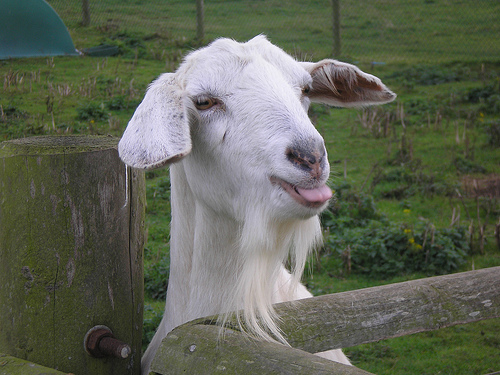
Yep, “Goat” is a true story all right. That was me, the shy, nerdy middle-schooler who couldn’t stomach being the center of attention, yet who suddenly found herself in a bright and unwelcome spotlight thanks to a careless remark by a well-meaning teacher. That was me getting my ponytail yanked by the boy who sat behind me, and suffering the embarrassment of inadvertently drawing a wiener on the blackboard. That was even me once again changing school districts and having to overcome my natural introversion with a whole new crowd of people. How I wished I was still “Goat” then – at least I would have had something to talk about!

What I really enjoy about “Goat” is the way it allowed me to take a humiliating situation and craft it into something positive, and this was true both in the fictional version and in the real-life story. Although I never actually carried that nickname to high school (thank goodness!), oddly enough, the “goat” incident and aftermath proved to be a real turning point for me in terms of my ability to relate to other students, maybe because even at the tender age of thirteen, I was able to have a sense of humor about it. Oh, I would pretend to fume and glare when the other kids made fun, but I never really minded it much. I rarely got the impression that the teasing was mean-spirited. And in any case, it was still way less embarrassing than the time I won that classroom limbo contest. I jumped up and down in celebration for a good minute before another girl came over and whispered in my ear that I’d ripped the seat of my pants making the winning walk under that final stick. And I’d thought that all that cheering was in honor of my victory!

Sigh. Embarrassing moments. We’ve all had our share of incidents we’ll never forget, but wish we could. I know, I know, we should be grateful that we’ve had those experiences, because they’re what’s made us who we are today. But let’s not lose sight of the real value of our lifetimes of humiliation in front of our peers. Inspiration for fiction!

***

“Goat” is one of the stories featured in my autobiographical short story and essay collection Stories from My Memory-Shelf: Fiction and Essays from My Past (only $0.99 Kindle, $5.99 paperback). To learn more about it, please visit the book’s webpage or subscribe to my newsletter.

Goat with Tongue Out

Novel Excerpt: Just the Three of Us

      “Wow, you’re fast!” he said with admiration, gawking at me with wide eyes through a plastic face-shield thick with fog. 

      I turned to look behind me but I was the last player on the bench; this unfamiliar young man with the friendly face appeared to be talking to me.

      “Uh, thank you,” I said, returning my eyes to the ice and uncomfortably shifting my grip on my stick.

      “I mean it,” he assured me. “You are very fast, especially for, you know, a – Hey!”

      The exclamation caught my attention more than the unfinished remark. I turned again and saw another young man sitting beside this one, elbow out as if he’d just used it to nudge his friend into silence.

      “For a what?” I said shrewdly, watching in amusement as my neighbor struggled to solicit a polite response out of an apparently unresponsive brain. “For a woman? Or perhaps you meant for an older woman?” I concluded, putting extra emphasis on the “older.” At thirty-seven I was hardly ancient, but there was no doubt in my mind that these fellows were a good ten years my junior, a fact that gave me the indisputable right to tease them mercilessly.

      His face, already beet-red from the exertion, flushed scarlet. “I wouldn’t say older!” he fibbed unconvincingly. “You’re what, like twenty-eight, twenty-nine?”

      “Don’t mind my friend,” the other fellow said, leaning across him towards me and grinning. “He’s really a nice guy. Sometimes just a bit of a dumbass.”

      “It was a compliment!” the nearer man stuttered before being abruptly rescued from his consternation by the return of the other left wing. He stumbled over the boards and onto the ice and his buddy slid over next to me.

      “I’m Jim,” he said, extending his arm in my direction. “And that’s Sam.”

      “Kathy,” I replied, bumping my glove against his by way of a handshake.

       “I haven’t seen you here before,” he said. But before I could answer, I saw the one of the defensemen hurtling towards the boards and sprang to my feet to take his place. Jim followed hard on my heels to replace the other wing, who had just lurched, panting, over to the bench.

      I hadn’t even noticed them before – possibly because I’d been too busy trying not to embarrass myself my first time on the ice in my latest new town. But now I couldn’t stop watching them skating around in front of me; two of my nameless, faceless teammates had turned into people. Of course, meeting people wasn’t always as great as it sounded, as I’d discovered in the course of my many travels. You don’t worry so much about making a good impression when you’re an unknown member of an anonymous crowd. I pondered that as I forced my legs to an inhuman effort in chasing down the next breakaway when it came. I didn’t want to lose my newly established reputation for speed, after all.

      “Nice job,” Sam said when I flung my body back over the boards a minute later, fresh sweat trickling coolly down my spine.

      “Thanks,” I gasped, plunking my butt down on the bench and taking a deep swig of my water. My partner for the day was still nowhere in sight and I wished he’d hurry up and finish dressing; it was exhausting playing with only three D.

      The guy named Jim leaned over again. “So are you new here?” he said, picking up our conversation right where we’d left off. It’s customary for hockey players to chat in fragmented one-minute intervals.

      “Just moved to town,” I nodded, starting to catch my breath. “I was in a women’s league the last place I lived, but there isn’t one in town here. Thought I’d give this group a try, if it’s not too tough.”

      “You’re tough enough!” Sam exclaimed. “I’ve seen the way you skate.”

      “Trust me, I have no skills,” I countered, pleased in spite of myself. I wasn’t being modest; I was a poor puck-handler and had no shot to speak of, and it had already become apparent that my rather abundant apportionment of feminine muscle wasn’t quite as useful among these men, most of whom were younger and a lot bigger than me. And apart from my speed, I had few real skills as a skater, and already I was struggling a lot harder to keep up than I had in my last league. Ever heard the expression “tripping-over-your-tongue-tired?” That was me.

      “Pshaw!” he answered, dismissing my critical assessment with a wave of his glove. I turned to look more closely at my new acquaintance. Along with that broad, boyish face and welcoming eye went the kind of personality that could use an expression that went out with the previous century without an iota of shame.

       “Pshaw?” Jim echoed, making a motion as if scratching his helmet with his padded glove.

      “Pshaw!” Sam repeated, unabashed.

      “Okay,” Jim said, clearing his throat audibly and leaning towards me again. “So where are you from?”

      “Um, well… New England, originally. Most recently, California,” I answered. “Up north, near San Francisco.”

      Sam laughed. “So what the hell are you doing here? Sick of the beautiful weather?”

      “Something like that,” I chuckled back. I wasn’t about to try to tell my life story to two strangers in the ten seconds before I had to be on the ice again.

      “Well, welcome to Minnesota, eh?” Jim replied in a heavy and decidedly phony accent. I looked askance at him. He had the agreeable look of a young man who hasn’t quite reached his prime; I guessed he would be downright handsome about five years down the line. Slimmer, more serious-looking than Sam, with dark hair and deep brown eyes and a neatly trimmed beard that ran the length of his chin.

      “Yeah, you’re welcome, eh?” Sam agreed.

      “We don’t actually talk like that,” Jim assured me. “It’s just an affectation put on for outsiders, so they’ll think they’re in Canada or something.”

      “You’d better start working on yours, too,” Sam said seriously. “Here, I’ll teach you,” he began, but fortunately I was rescued from a lesson in Northern American linguistics by the return of the entire forward line, which sent my new acquaintances scurrying for their positions.

       My defensive partner finally arrived, plopping his enormous body down next to mine and effectively cutting me off from further conversational efforts with Sam and Jim. I couldn’t decide whether or not I should be sorry about that. But as the game continued, I watched them weaving in tandem along the ice, passing the puck to one another seemingly without effort, to all appearances like two balls on the ends of the same chain. They must have been teammates for a long time, I thought; they made such a good wing pair. I wouldn’t have said that they were great athletes; I mean, they were both obviously competent, but not spectacular in any way. But there was something in the way they played together that made them better, much better than their skill levels alone would have suggested. Almost as if they knew each other so well that one was an extension of the other; two minds and bodies separated only by twenty feet of ice.

      Following the closing handshakes, I was surprised to find them both skating beside me back to the bench.

      “Okay, so we know you’re not a native, but do you drink beer?” Sam inquired, as if it were a beverage endemic only to Milwaukee and cities of similar latitude.

      “Of course!” I answered. I was actually very fond of beer, although I’d found, as I often did, that the styles that were popular in Minnesota weren’t the same as those that dominated other markets.

      “Good,” Jim replied. “We usually go out for a beer after the game, and we think you should come.”

     I was taken aback. They seemed like nice enough fellows and all, but I really saw no point in going overboard with the acquaintance. Sure, I was a little lonely. It’s never easy being the new kid in town, no matter how old you are, and I hadn’t exactly been a ball of social fire in any of the many places I’d lived in the wandering course of my adult life. But really, what besides hockey could I, a relatively mature woman, possibly have in common with two twenty-something-year-olds? Boys, practically, to my mind.

       I guess my lack of enthusiasm showed, because while I hesitated in answering I heard Sam saying, “I don’t think she likes us, Jim.”

      “Well, you shouldn’t have made that comment about her skating like a, ‘you know,’ ” Jim replied, shaking his head dolefully.

      “Please just come have a beer with us!” Sam pleaded. “Otherwise Jim will never let me hear the end of it.”

      “Unless you really don’t like us,” Jim said, narrowing his dark brows at me. I wasn’t short, especially with my skates on, but standing up he still towered a good six inches over me, and I might have been intimidated had he not had such an indisputably gentle face.

      “We wouldn’t blame you much,” Sam chimed in. “We are kind of obnoxious.”

      I looked from one to the other. There was something refreshingly youthful in their earnestness and a part of me was touched. It was sweet, really, the way they’d taken pity on me. After all, I probably seemed as old to them as they seemed young to me.

      “It’s not that,” I answered finally, weighing my words carefully. “I was just surprised that you’re old enough to drink.”

      “Oh-ho, she got you back, Sam!” Jim said with a laugh.

      “Says you!” he shot back. “Jim’s just jealous because I’m more mature.”

      “You’re only six months older than me!” Jim said. “And older does not mean more mature!”

      That was certainly the truth. Here I was in my late thirties, with no husband or children and no particular desire for either yet. In a new city with a new job that I wasn’t even sure I was going to like because I still hadn’t decided what I wanted to be when I grew up. Plus I was living in a one-room apartment with cardboard-box furniture and a mattress on the floor. What did I know about mature? Maybe my mistake all along had been in trying to meet people my own age: settled, adult, grown-up people. I’d be right at home with these guys.

       “Twenty-six is mature!” Sam retorted. “Isn’t it, Kathy?”

      “Hmm, sorry, I can’t remember back that far,” I joked. “It’s been a long decade.”

      We retreated to the locker room to undress. As usual I kept my head down so I could pretend not to notice those few bold fellows who stripped down to their bare asses before changing into clean clothes. Me, I never bothered. I was always way too sweaty after a game to even think about forcing fresh pants on over my sticky thighs. I did wonder, though, how the other players would react if one day I, too, decided to strip down naked and wander around the locker room with all my goods hanging out like it was no big deal.

       That was one way to make an impression, I thought. I’d never been what you’d call beautiful, even when I was younger, but I wasn’t bad to look at, either, especially since hockey had sculpted my once-flabby form into a passably pleasing shape. I hoped that having a decent figure helped to distract the interested observer from my other physical flaws, which weren’t too tough to overlook if you didn’t look too closely. I had very plain brown hair that I wore cut to the shoulders, and kind of a square face that was rescued from dullness by deep dimples, rosy cheeks, and big green eyes that I simply adored. Most days I didn’t mind not being gorgeous. It was much easier to blend into the background when you were average-looking, and I’d spent most of my adulthood trying not to be noticed. And I could still clean up pretty cute when I wanted to, although I knew those days were rapidly drawing to an end. Hmm, I thought as I glanced around the room full of strangers and contemplated the cold and lonely bed waiting for me at my apartment. Maybe I should flaunt it while I still had it.

      I hauled my gear out to my car and then, with some trepidation, headed upstairs to the sports pub. Sam and Jim were waiting for me in the doorway and that relieved me somewhat; I always felt hopelessly awkward walking into a place alone. I nonchalantly looked them over. Unlike me, who was twice my normal size with gear on, they didn’t look that different without it. Sam, I saw now, had golden blond hair that he wore in a buzz-cut all over his rather round head; it added to the general impression of constant cheerfulness that he radiated like sunbeams off of every edge of his person. He had a solid, stocky build and was several inches shorter than Jim. With his fair skin and bright smile, I’d describe him as cute more than handsome; he seemed to ooze a boyish sort of charm that made him appear pleasant and harmless. Jim, by contrast, had a darker, almost olive complexion, and seemed the quieter of the two; something in the set of his jaw suggested a level of reserve his friend seemed to lack. He had a narrow face that went well with his lean form, and seeing him in his street-clothes, I would have sworn he didn’t have an ounce of fat on him; only lithe, long muscles that ran like thick wires over his elongated limbs.

        “Shall we?” Sam said, extending an arm as if to offer it to me with old-fashioned courtesy. When I hesitated, he seemed to think better of the idea and hurriedly retracted it. I pretended not to notice.

      I followed them inside. A few of the other guys from the team were up there and nodded to Sam and Jim. Then I caught them looking bemusedly at me and I blushed. Self-consciously I raised my hands to my head and felt my hair all utterly disheveled into sweaty locks, as it always was after hockey. I’d never gotten in the habit of showering after a game, either. I figured since I was always going straight home afterwards, what was the point in enduring the fungus-ridden locker room shower?

      This is why you don’t have a boyfriend, I thought as I plunked myself down at the small, circular table Sam selected while Jim went up to the bar to buy us a pitcher.

      “So why did you move here, Kathy? Was it for work?” Sam asked as Jim poured our beers and I slipped him a five for my share. He pushed it back across the table with a pleading little wave of his hand. I shoved it back towards him with a bigger, more insistent wave. His eye caught mine and I watched it crinkle in amusement. Then he nodded and, conceding defeat, tucked the bill into his pocket. It was very rare that I lost the battle over going dutch with men. I hadn’t been independent all these years for nothing, after all.

      “Was it for work?” Sam was repeating.

      “Oh! Well, sort of,” I answered, jerking my attention back to the conversation at hand. “Not really.”

      I took a sip of my beer while he stared at me as if expecting me to continue talking. Jim was peering at me keenly through narrow-rimmed glasses he had not been wearing during the game. I liked them. They did something for the shape of his face.

      “No shutting her up, is there?” Sam said at last into the silence.

      “So are you naturally not very talkative, or do you just have a lot to hide?” Jim inquired.

      I chuckled. “A little from Column A…”

      “Well, what do you do? For work, I mean?” Jim said.

       “Oh,” I hedged. “This and that.”

      They looked at one another.

       “Wait right here,” Sam said. “I left my good dental extractor in the car and I think we’re gonna need the big one if we want to get any information out of this girl.” His voice was husky, and a little edgy, as if he spent a lot of time joking around; it rather pleasantly complemented Jim’s deep, gravelly rumble.

      I laughed. “Really, there’s not much to tell. I have a Bachelor’s in Film Studies, which, as you might imagine, is pretty close to worthless.”

      “Film Studies?” Jim interrupted. “That sounds interesting!”

      “It was!” I answered enthusiastically. “Oh, I really enjoyed it. It’s not what people think, criticism and all that, it’s more like a sociological study, looking at the culture behind movies and so on. You do a lot of reading on the history of the time and write a lot of papers – it was really fun. Kind of useless in the real world, though. There wasn’t much I could do with it except get a doctorate and then teach, and I don’t really have the personality for that. It looks good on my resume, though; proves I was smart enough to finish college.”

       “Why’d you choose it, then, if you didn’t want to make a career out of it?” Sam inquired.

      “I dunno,” I answered vaguely. “There wasn’t really anything else I wanted to do, I guess.”

      “Huh,” Jim replied, resting his head on his hand as if seriously considering the meaning of what I had said.

       I gave up attempting to describe what was obviously a foreign concept and hurried on with my speech. “Anyway,” I said, “I haven’t got what you’d call a career. I’ve done all kinds of work: office jobs, waitressing, copyediting… I was even an online retailer of out-of-print videos for a while. Right now I’m working as a bank teller.”

      “Well, that’s cool!” Sam said without much enthusiasm.

      I shrugged. “I like math,” I said. “It’s one of the better jobs I’ve had. I actually did it once before, back in New Jersey, but then I got promoted to New Accounts and I didn’t like it as much. Dealing with people… It can be really irritating, you know. And when I moved to North Carolina, I decided to try something else so I never advanced any further in banking.”

      “Why did you move to North Carolina?” Jim inquired, his eyebrows raised as if he thought it a strange destination.

      I shrugged again and let out an awkward laugh. “No real reason, I guess. Just felt like a change.”

      “How many places have you lived exactly?” Sam asked, furrowing his brow. It forced his forehead into shallow, barely perceptible wrinkles that made mine look like the walls of the Grand Canyon but without all the pretty colors.

      I smoothed my wet hair down over my forehead uneasily. “Oh, I don’t know,” I said. “I guess on average I move every couple of years.”

      “Every couple of years?” Sam replied, astonished, drawing back to peek underneath the table at my lower half. “No moss grows beneath your feet, I see.”

       “I guess we shouldn’t get too attached, eh, Sam?” Jim said.

      “Why so often?” Sam asked me.

      “I can’t stand cleaning,” I said seriously. “It’s easier just to move when the apartment gets dirty.”

***

These are the first ten pages of my latest novel. Comments are welcome!


I’m Going to Be a Featured Author on The Pittsburgh Flash Fiction Gazette Next Month!

Please note: Contains adult content.

http://pittsburghflashfictiongazette.net/lori-schafer-special/

For one week next month, publisher Guy Hogan (@GuyHogan) will feature four of my erotic flash fiction stories on his magazine’s front page, as well as an interview with me. Needless to say, I’m honored. Guy recently redesigned the Gazette so that it looks prettier than ever, and I think it’ll be really neat seeing all my work up there at once, fancy as all get out.

The four stories featured will be:

“To All the Penises I’ve Ever Known”

“Last Date”

“Ballroom Dance”

“Missed Connection”

The first three have been published in the Gazette over the last nine months; the final piece is making its debut with the special.

I’m not going to tell you what I’ll be discussing in my interview, but you’ll definitely be seeing a side of me you haven’t before. Guy originally asked me for my answers to the questions he asked Anna Bayes in his feature Anna Bayes Uncensored. This is how I replied:

Why do women suck c**k and swallow c*m?
Smoking is bad for you. So are corn dogs. C**k is the healthy alternative when you want something long, warm, and tasty in your mouth.
Most women prefer to swallow c*m when they can. It cuts down on both the laundry and the mopping.

Advice on eating p***y?
Try it with a side of ice cream.

For some reason he decided to make my questions harder ;)

I’m not sure exactly when the Gazette will be running my feature, but I’ll be sure to post when it does. Hope to see you there!

“Baby and Me” on Story Shack Magazine

My short-short “Baby and Me” has been published on Story Shack Magazine:

http://thestoryshack.com/2014/02/10/baby-lori-schafer-illustrated-james-brown/

This is a daily flash fiction site along the lines of Every Day Fiction, except that publisher Martin Hooijmans (@thestoryshack) offers an amazing and unique additional feature – an artist to provide an illustration for your story!

How cool is that? What an opportunity for writers and artists who have never even met to collaborate on a project! In addition, I was fortunate enough to be paired with award-winning artist James Brown (@jb_illustrates), whose style, I thought, really went well with my piece:

http://jamesbrownillustration.com/

James’ bio:

Slightly obsessed with picture books, James enjoys writing and illustrating his own. He would love to see ‘Marlon’s Amazing Moustache’ and ‘Mum’s Having a Monster’ on bookshelves so he can dedicate them to his baby daughter, Eliza.

He illustrates for Baby London magazine and Stew Magazine for Curious Kids. James came third in the Illustrate It 2013 picture book competition and is one of five illustrators to win the SCBWI’s Undiscovered Voices 2014 competition.

It’s wonderful, really, what the internet has done for artists, talented folks who might otherwise have been relegated to the status of starving for the sake of art. It’s easy to forget about the people behind all those drawings and photos and images you see every day on the web, but they’re there, toiling away with their pencils and crayons, digital cameras and graphic design software.

And let’s not forget about the publishers who engage artists like James and writers like me to generate all of these millions of pages of content enjoyed by billions of people (and the occasional pet) all around the globe. So kudos to Martin for putting together a very neat website – I wish him the very best of luck with it!

James Brown, jamesbrownillustration.com

James Brown, jamesbrownillustration.com

* * *

“Baby and Me” is one of the stories featured in my autobiographical short story and essay collection Stories from My Memory-Shelf: Fiction and Essays from My Past (only $0.99 Kindle, $5.99 paperback). To learn more about it, please visit the book’s webpage or subscribe to my newsletter.