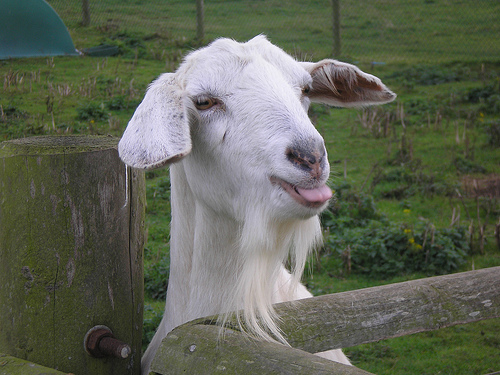
“Goat” on Every Day Fiction

My flash fiction piece “Goat” has been published on Every Day Fiction:

http://www.everydayfiction.com/goat-by-lori-schafer/

Yep, “Goat” is a true story all right. That was me, the shy, nerdy middle-schooler who couldn’t stomach being the center of attention, yet who suddenly found herself in a bright and unwelcome spotlight thanks to a careless remark by a well-meaning teacher. That was me getting my ponytail yanked by the boy who sat behind me, and suffering the embarrassment of inadvertently drawing a wiener on the blackboard. That was even me once again changing school districts and having to overcome my natural introversion with a whole new crowd of people. How I wished I was still “Goat” then – at least I would have had something to talk about!

What I really enjoy about “Goat” is the way it allowed me to take a humiliating situation and craft it into something positive, and this was true both in the fictional version and in the real-life story. Although I never actually carried that nickname to high school (thank goodness!), oddly enough, the “goat” incident and aftermath proved to be a real turning point for me in terms of my ability to relate to other students, maybe because even at the tender age of thirteen, I was able to have a sense of humor about it. Oh, I would pretend to fume and glare when the other kids made fun, but I never really minded it much. I rarely got the impression that the teasing was mean-spirited. And in any case, it was still way less embarrassing than the time I won that classroom limbo contest. I jumped up and down in celebration for a good minute before another girl came over and whispered in my ear that I’d ripped the seat of my pants making the winning walk under that final stick. And I’d thought that all that cheering was in honor of my victory!

Sigh. Embarrassing moments. We’ve all had our share of incidents we’ll never forget, but wish we could. I know, I know, we should be grateful that we’ve had those experiences, because they’re what’s made us who we are today. But let’s not lose sight of the real value of our lifetimes of humiliation in front of our peers. Inspiration for fiction!

***

“Goat” is one of the stories featured in my autobiographical short story and essay collection Stories from My Memory-Shelf: Fiction and Essays from My Past (only $0.99 Kindle, $5.99 paperback). To learn more about it, please visit the book’s webpage or subscribe to my newsletter.

Goat with Tongue Out

Novel Excerpt: Just the Three of Us

      “Wow, you’re fast!” he said with admiration, gawking at me with wide eyes through a plastic face-shield thick with fog. 

      I turned to look behind me but I was the last player on the bench; this unfamiliar young man with the friendly face appeared to be talking to me.

      “Uh, thank you,” I said, returning my eyes to the ice and uncomfortably shifting my grip on my stick.

      “I mean it,” he assured me. “You are very fast, especially for, you know, a – Hey!”

      The exclamation caught my attention more than the unfinished remark. I turned again and saw another young man sitting beside this one, elbow out as if he’d just used it to nudge his friend into silence.

      “For a what?” I said shrewdly, watching in amusement as my neighbor struggled to solicit a polite response out of an apparently unresponsive brain. “For a woman? Or perhaps you meant for an older woman?” I concluded, putting extra emphasis on the “older.” At thirty-seven I was hardly ancient, but there was no doubt in my mind that these fellows were a good ten years my junior, a fact that gave me the indisputable right to tease them mercilessly.

      His face, already beet-red from the exertion, flushed scarlet. “I wouldn’t say older!” he fibbed unconvincingly. “You’re what, like twenty-eight, twenty-nine?”

      “Don’t mind my friend,” the other fellow said, leaning across him towards me and grinning. “He’s really a nice guy. Sometimes just a bit of a dumbass.”

      “It was a compliment!” the nearer man stuttered before being abruptly rescued from his consternation by the return of the other left wing. He stumbled over the boards and onto the ice and his buddy slid over next to me.

      “I’m Jim,” he said, extending his arm in my direction. “And that’s Sam.”

      “Kathy,” I replied, bumping my glove against his by way of a handshake.

       “I haven’t seen you here before,” he said. But before I could answer, I saw the one of the defensemen hurtling towards the boards and sprang to my feet to take his place. Jim followed hard on my heels to replace the other wing, who had just lurched, panting, over to the bench.

      I hadn’t even noticed them before – possibly because I’d been too busy trying not to embarrass myself my first time on the ice in my latest new town. But now I couldn’t stop watching them skating around in front of me; two of my nameless, faceless teammates had turned into people. Of course, meeting people wasn’t always as great as it sounded, as I’d discovered in the course of my many travels. You don’t worry so much about making a good impression when you’re an unknown member of an anonymous crowd. I pondered that as I forced my legs to an inhuman effort in chasing down the next breakaway when it came. I didn’t want to lose my newly established reputation for speed, after all.

      “Nice job,” Sam said when I flung my body back over the boards a minute later, fresh sweat trickling coolly down my spine.

      “Thanks,” I gasped, plunking my butt down on the bench and taking a deep swig of my water. My partner for the day was still nowhere in sight and I wished he’d hurry up and finish dressing; it was exhausting playing with only three D.

      The guy named Jim leaned over again. “So are you new here?” he said, picking up our conversation right where we’d left off. It’s customary for hockey players to chat in fragmented one-minute intervals.

      “Just moved to town,” I nodded, starting to catch my breath. “I was in a women’s league the last place I lived, but there isn’t one in town here. Thought I’d give this group a try, if it’s not too tough.”

      “You’re tough enough!” Sam exclaimed. “I’ve seen the way you skate.”

      “Trust me, I have no skills,” I countered, pleased in spite of myself. I wasn’t being modest; I was a poor puck-handler and had no shot to speak of, and it had already become apparent that my rather abundant apportionment of feminine muscle wasn’t quite as useful among these men, most of whom were younger and a lot bigger than me. And apart from my speed, I had few real skills as a skater, and already I was struggling a lot harder to keep up than I had in my last league. Ever heard the expression “tripping-over-your-tongue-tired?” That was me.

      “Pshaw!” he answered, dismissing my critical assessment with a wave of his glove. I turned to look more closely at my new acquaintance. Along with that broad, boyish face and welcoming eye went the kind of personality that could use an expression that went out with the previous century without an iota of shame.

       “Pshaw?” Jim echoed, making a motion as if scratching his helmet with his padded glove.

      “Pshaw!” Sam repeated, unabashed.

      “Okay,” Jim said, clearing his throat audibly and leaning towards me again. “So where are you from?”

      “Um, well… New England, originally. Most recently, California,” I answered. “Up north, near San Francisco.”

      Sam laughed. “So what the hell are you doing here? Sick of the beautiful weather?”

      “Something like that,” I chuckled back. I wasn’t about to try to tell my life story to two strangers in the ten seconds before I had to be on the ice again.

      “Well, welcome to Minnesota, eh?” Jim replied in a heavy and decidedly phony accent. I looked askance at him. He had the agreeable look of a young man who hasn’t quite reached his prime; I guessed he would be downright handsome about five years down the line. Slimmer, more serious-looking than Sam, with dark hair and deep brown eyes and a neatly trimmed beard that ran the length of his chin.

      “Yeah, you’re welcome, eh?” Sam agreed.

      “We don’t actually talk like that,” Jim assured me. “It’s just an affectation put on for outsiders, so they’ll think they’re in Canada or something.”

      “You’d better start working on yours, too,” Sam said seriously. “Here, I’ll teach you,” he began, but fortunately I was rescued from a lesson in Northern American linguistics by the return of the entire forward line, which sent my new acquaintances scurrying for their positions.

       My defensive partner finally arrived, plopping his enormous body down next to mine and effectively cutting me off from further conversational efforts with Sam and Jim. I couldn’t decide whether or not I should be sorry about that. But as the game continued, I watched them weaving in tandem along the ice, passing the puck to one another seemingly without effort, to all appearances like two balls on the ends of the same chain. They must have been teammates for a long time, I thought; they made such a good wing pair. I wouldn’t have said that they were great athletes; I mean, they were both obviously competent, but not spectacular in any way. But there was something in the way they played together that made them better, much better than their skill levels alone would have suggested. Almost as if they knew each other so well that one was an extension of the other; two minds and bodies separated only by twenty feet of ice.

      Following the closing handshakes, I was surprised to find them both skating beside me back to the bench.

      “Okay, so we know you’re not a native, but do you drink beer?” Sam inquired, as if it were a beverage endemic only to Milwaukee and cities of similar latitude.

      “Of course!” I answered. I was actually very fond of beer, although I’d found, as I often did, that the styles that were popular in Minnesota weren’t the same as those that dominated other markets.

      “Good,” Jim replied. “We usually go out for a beer after the game, and we think you should come.”

     I was taken aback. They seemed like nice enough fellows and all, but I really saw no point in going overboard with the acquaintance. Sure, I was a little lonely. It’s never easy being the new kid in town, no matter how old you are, and I hadn’t exactly been a ball of social fire in any of the many places I’d lived in the wandering course of my adult life. But really, what besides hockey could I, a relatively mature woman, possibly have in common with two twenty-something-year-olds? Boys, practically, to my mind.

       I guess my lack of enthusiasm showed, because while I hesitated in answering I heard Sam saying, “I don’t think she likes us, Jim.”

      “Well, you shouldn’t have made that comment about her skating like a, ‘you know,’ ” Jim replied, shaking his head dolefully.

      “Please just come have a beer with us!” Sam pleaded. “Otherwise Jim will never let me hear the end of it.”

      “Unless you really don’t like us,” Jim said, narrowing his dark brows at me. I wasn’t short, especially with my skates on, but standing up he still towered a good six inches over me, and I might have been intimidated had he not had such an indisputably gentle face.

      “We wouldn’t blame you much,” Sam chimed in. “We are kind of obnoxious.”

      I looked from one to the other. There was something refreshingly youthful in their earnestness and a part of me was touched. It was sweet, really, the way they’d taken pity on me. After all, I probably seemed as old to them as they seemed young to me.

      “It’s not that,” I answered finally, weighing my words carefully. “I was just surprised that you’re old enough to drink.”

      “Oh-ho, she got you back, Sam!” Jim said with a laugh.

      “Says you!” he shot back. “Jim’s just jealous because I’m more mature.”

      “You’re only six months older than me!” Jim said. “And older does not mean more mature!”

      That was certainly the truth. Here I was in my late thirties, with no husband or children and no particular desire for either yet. In a new city with a new job that I wasn’t even sure I was going to like because I still hadn’t decided what I wanted to be when I grew up. Plus I was living in a one-room apartment with cardboard-box furniture and a mattress on the floor. What did I know about mature? Maybe my mistake all along had been in trying to meet people my own age: settled, adult, grown-up people. I’d be right at home with these guys.

       “Twenty-six is mature!” Sam retorted. “Isn’t it, Kathy?”

      “Hmm, sorry, I can’t remember back that far,” I joked. “It’s been a long decade.”

      We retreated to the locker room to undress. As usual I kept my head down so I could pretend not to notice those few bold fellows who stripped down to their bare asses before changing into clean clothes. Me, I never bothered. I was always way too sweaty after a game to even think about forcing fresh pants on over my sticky thighs. I did wonder, though, how the other players would react if one day I, too, decided to strip down naked and wander around the locker room with all my goods hanging out like it was no big deal.

       That was one way to make an impression, I thought. I’d never been what you’d call beautiful, even when I was younger, but I wasn’t bad to look at, either, especially since hockey had sculpted my once-flabby form into a passably pleasing shape. I hoped that having a decent figure helped to distract the interested observer from my other physical flaws, which weren’t too tough to overlook if you didn’t look too closely. I had very plain brown hair that I wore cut to the shoulders, and kind of a square face that was rescued from dullness by deep dimples, rosy cheeks, and big green eyes that I simply adored. Most days I didn’t mind not being gorgeous. It was much easier to blend into the background when you were average-looking, and I’d spent most of my adulthood trying not to be noticed. And I could still clean up pretty cute when I wanted to, although I knew those days were rapidly drawing to an end. Hmm, I thought as I glanced around the room full of strangers and contemplated the cold and lonely bed waiting for me at my apartment. Maybe I should flaunt it while I still had it.

      I hauled my gear out to my car and then, with some trepidation, headed upstairs to the sports pub. Sam and Jim were waiting for me in the doorway and that relieved me somewhat; I always felt hopelessly awkward walking into a place alone. I nonchalantly looked them over. Unlike me, who was twice my normal size with gear on, they didn’t look that different without it. Sam, I saw now, had golden blond hair that he wore in a buzz-cut all over his rather round head; it added to the general impression of constant cheerfulness that he radiated like sunbeams off of every edge of his person. He had a solid, stocky build and was several inches shorter than Jim. With his fair skin and bright smile, I’d describe him as cute more than handsome; he seemed to ooze a boyish sort of charm that made him appear pleasant and harmless. Jim, by contrast, had a darker, almost olive complexion, and seemed the quieter of the two; something in the set of his jaw suggested a level of reserve his friend seemed to lack. He had a narrow face that went well with his lean form, and seeing him in his street-clothes, I would have sworn he didn’t have an ounce of fat on him; only lithe, long muscles that ran like thick wires over his elongated limbs.

        “Shall we?” Sam said, extending an arm as if to offer it to me with old-fashioned courtesy. When I hesitated, he seemed to think better of the idea and hurriedly retracted it. I pretended not to notice.

      I followed them inside. A few of the other guys from the team were up there and nodded to Sam and Jim. Then I caught them looking bemusedly at me and I blushed. Self-consciously I raised my hands to my head and felt my hair all utterly disheveled into sweaty locks, as it always was after hockey. I’d never gotten in the habit of showering after a game, either. I figured since I was always going straight home afterwards, what was the point in enduring the fungus-ridden locker room shower?

      This is why you don’t have a boyfriend, I thought as I plunked myself down at the small, circular table Sam selected while Jim went up to the bar to buy us a pitcher.

      “So why did you move here, Kathy? Was it for work?” Sam asked as Jim poured our beers and I slipped him a five for my share. He pushed it back across the table with a pleading little wave of his hand. I shoved it back towards him with a bigger, more insistent wave. His eye caught mine and I watched it crinkle in amusement. Then he nodded and, conceding defeat, tucked the bill into his pocket. It was very rare that I lost the battle over going dutch with men. I hadn’t been independent all these years for nothing, after all.

      “Was it for work?” Sam was repeating.

      “Oh! Well, sort of,” I answered, jerking my attention back to the conversation at hand. “Not really.”

      I took a sip of my beer while he stared at me as if expecting me to continue talking. Jim was peering at me keenly through narrow-rimmed glasses he had not been wearing during the game. I liked them. They did something for the shape of his face.

      “No shutting her up, is there?” Sam said at last into the silence.

      “So are you naturally not very talkative, or do you just have a lot to hide?” Jim inquired.

      I chuckled. “A little from Column A…”

      “Well, what do you do? For work, I mean?” Jim said.

       “Oh,” I hedged. “This and that.”

      They looked at one another.

       “Wait right here,” Sam said. “I left my good dental extractor in the car and I think we’re gonna need the big one if we want to get any information out of this girl.” His voice was husky, and a little edgy, as if he spent a lot of time joking around; it rather pleasantly complemented Jim’s deep, gravelly rumble.

      I laughed. “Really, there’s not much to tell. I have a Bachelor’s in Film Studies, which, as you might imagine, is pretty close to worthless.”

      “Film Studies?” Jim interrupted. “That sounds interesting!”

      “It was!” I answered enthusiastically. “Oh, I really enjoyed it. It’s not what people think, criticism and all that, it’s more like a sociological study, looking at the culture behind movies and so on. You do a lot of reading on the history of the time and write a lot of papers – it was really fun. Kind of useless in the real world, though. There wasn’t much I could do with it except get a doctorate and then teach, and I don’t really have the personality for that. It looks good on my resume, though; proves I was smart enough to finish college.”

       “Why’d you choose it, then, if you didn’t want to make a career out of it?” Sam inquired.

      “I dunno,” I answered vaguely. “There wasn’t really anything else I wanted to do, I guess.”

      “Huh,” Jim replied, resting his head on his hand as if seriously considering the meaning of what I had said.

       I gave up attempting to describe what was obviously a foreign concept and hurried on with my speech. “Anyway,” I said, “I haven’t got what you’d call a career. I’ve done all kinds of work: office jobs, waitressing, copyediting… I was even an online retailer of out-of-print videos for a while. Right now I’m working as a bank teller.”

      “Well, that’s cool!” Sam said without much enthusiasm.

      I shrugged. “I like math,” I said. “It’s one of the better jobs I’ve had. I actually did it once before, back in New Jersey, but then I got promoted to New Accounts and I didn’t like it as much. Dealing with people… It can be really irritating, you know. And when I moved to North Carolina, I decided to try something else so I never advanced any further in banking.”

      “Why did you move to North Carolina?” Jim inquired, his eyebrows raised as if he thought it a strange destination.

      I shrugged again and let out an awkward laugh. “No real reason, I guess. Just felt like a change.”

      “How many places have you lived exactly?” Sam asked, furrowing his brow. It forced his forehead into shallow, barely perceptible wrinkles that made mine look like the walls of the Grand Canyon but without all the pretty colors.

      I smoothed my wet hair down over my forehead uneasily. “Oh, I don’t know,” I said. “I guess on average I move every couple of years.”

      “Every couple of years?” Sam replied, astonished, drawing back to peek underneath the table at my lower half. “No moss grows beneath your feet, I see.”

       “I guess we shouldn’t get too attached, eh, Sam?” Jim said.

      “Why so often?” Sam asked me.

      “I can’t stand cleaning,” I said seriously. “It’s easier just to move when the apartment gets dirty.”

***

These are the first ten pages of my latest novel. Comments are welcome!


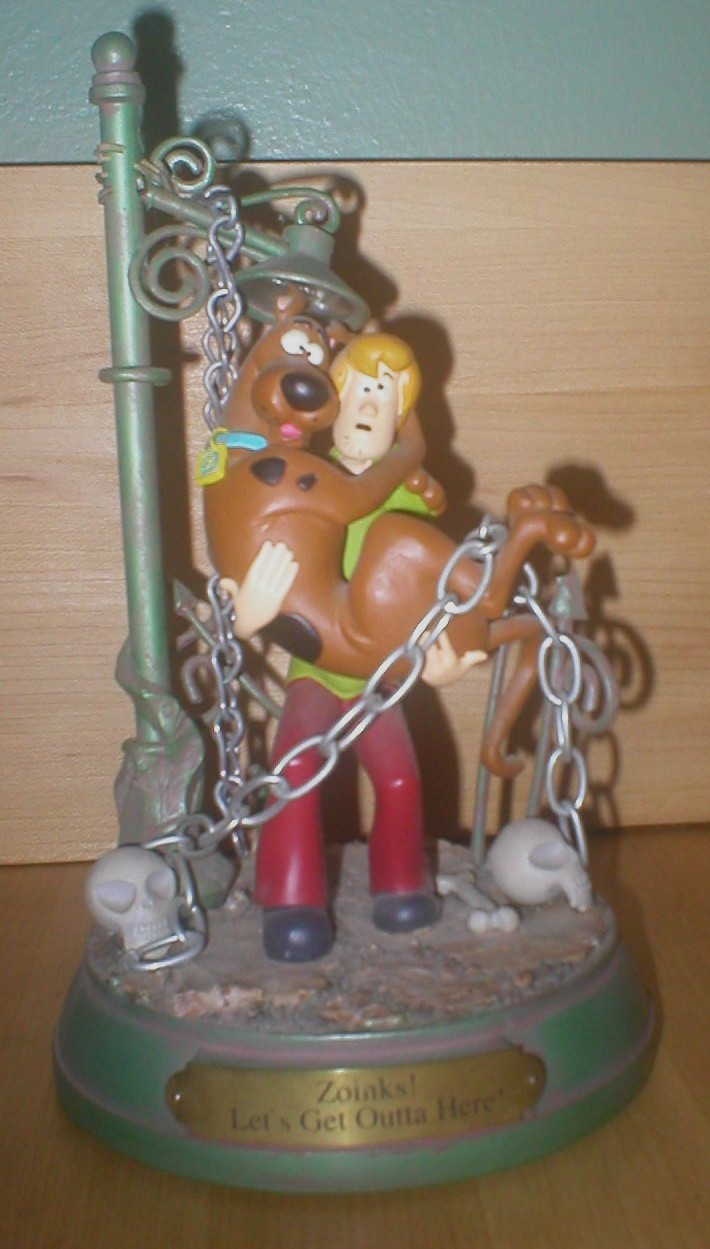
What I Learned from Watching Scooby-Doo

Scooby-Doo. Amazing, isn’t it? Here it is, nearly fifty years after the first episode aired, and Scooby-Doo movies and cartoons are still being made.

I’ll admit that I haven’t watched any of the newer programs myself, so I can’t speak as to their quality. I loved the original Scooby-Doo shows way too much to taint my memory of them with some newer (and undoubtedly less charming) version of a classic. Besides, I still watch the reruns from time and time, and you know what? I’ll be darned if they aren’t just as good as they were when I was a kid. Of course, maybe I appreciate them on a slightly different level now.

Because it turns out that the Scooby-Doo shows, in their early manifestations, weren’t about a gang of teenagers and a talking dog. They weren’t about how many ways you can work chocolate sauce into a quadruple-decker sandwich, or how easily villains are fooled by cheap, impromptu disguises. They weren’t even about solving mysteries. What Scooby-Doo was really about was the triumph of reason over superstition. Because what devotees of Scooby-Doo learned from watching the show was simply this: There is a rational explanation for everything.

It’s brilliantly done. You have Fred and Velma, the logical leaders of the group, who are consistently convinced that there’s no such thing as ghosts and are determined to prove it. You have Daphne, who stands on the fence, being sometimes a believer and sometimes a skeptic. And finally you have Scooby and Shaggy, the superstitious “cowards” who fall prey to every supernatural trick. Yet they’re the ones who always end up having to lure their paranormal pursuers into the gang’s cleverly designed trap. They’re the ones who constantly have to find the courage to confront their fears, and who ultimately reap the greatest satisfaction from uncovering the truth. And they’re undeniably our favorites, the ones we identify with and support.

You can’t help but root for the hungry young man and his faithful and equally hungry Great Dane, to hope that they’ll learn to trust the logic of their peers even as we ourselves learn to trust it. Because the show proves, time and again, how needless their fear really is, how silly their conviction that werewolves and mummies and monsters are real. And as viewers, we know better, because we know how it always ends. The phosphorescent alien footprints trailing across a barren field. The eerie thumping of a mysterious and invisible drummer. The green ghosts emerging from hidden hallways and secret staircases to taunt and terrorize our valiant crew. Week after week, we watch and we learn.

There’s no such thing as ghosts. It’s always a trick, a scheme devised by mere mortal men to keep people away from the site of the haunting or other creepy phenomenon. There’s always a plot to abscond with someone else’s treasure, or to foil the attempts of greedy neighbors to abscond with one’s own. No matter how frightening or eerie or persuasive the phantom, it always turns out to be a man in disguise.

That’s what makes Scooby-Doo the ultimate symbol of my generation. It’s why we think the way we do; why we champion proof and science, and why we’ve discarded spooks and angels. It’s why when a door slams shut in the middle of the night we suspect a prowler and not a poltergeist. It’s why we blame trick photography and digital imaging for producing shapes and shadows we can’t discern or identify. It’s why we’ve lost belief in demonic possession and intensified our interest in mental illness, and why we hope to find aliens and not to fight them. Because we know that crime is real. That evil is real. That fear is real. But we also know that no supernatural power lies behind them. Only a human, just like us.

Is it better this way? Perhaps. Except that we’ve gone beyond the golden Scooby-Doo moment of discovering that the spirit of which we were deathly afraid is just a run-of-the-mill crook playing a trick. There’s no revelation here, no joy in finally uncovering the man behind the mask. Because we never thought for a moment that the ghost was real. We never believed it was anything more than another troubled human taking what wasn’t theirs and scaring people in the process. Because that’s how thoroughly we understand humans now, how much more dangerous they are than demons and phantoms. Fear doesn’t come from outer space or beyond the grave anymore. It’s right here beside us, sleeping in the upstairs apartment or working in the next tiny cubicle or tramping down the same tiled hallway.

Science has triumphed. Rationality has triumphed. But they haven’t turned our world into a prettier or less intimidating place. Rather they’ve made us aware that what humans harbor in the darkest depths of their hearts is more frightening by far than any monster we could have imagined. We expect monsters to kill and destroy without thinking, and without reason. We don’t expect spirits to care whom they frighten, or whom they hurt. But we expect humans to behave better than beasts or bogeymen. How do we explain it when they don’t?

Scooby-Doo understands. Because here, in the real world, behind every event we can’t explain, there also lies a mystery to unravel. Perhaps it’s not the mystery we were expecting, because it’s not merely a matter of proving that the ghost is a fake, or that there’s a real live person behind it. This infinitely more complex riddle can never be solved in twenty-two minutes with a jumbo box of laundry detergent and an industrial-sized fan. It’s the mystery of human behavior, of what truly transpires on the other side of the masks that all of us wear.

OLYMPUS DIGITAL CAMERA

“Missed Connection” on The Pittsburgh Flash Fiction Gazette

My erotic flash fiction piece “Missed Connection” has been published in The Pittsburgh Flash Fiction Gazette:

http://pittsburghflashfictiongazette.net/fiction-missed-connection-lori-schafer/ (Adult Content)

A couple of months ago, I wrote a post about my short-short “Delayed Connection,” which was then the home-page story on Romance Flash. In it I describe how the original idea for that very sweet, very romantic story came to me from this one, “Missed Connection,” which is a much more sexual and also strangely sadder piece.

The original premise was actually not, as you might think, the chance meeting at the airport. Rather it was about the confession with which the story begins. Because I think we can all relate to that, to the regrets we have over the “one that got away,” over never making a move when we had the chance. How afraid we were to share our feelings, for fear of being rejected, yet how simultaneously eager we were to admit them, on the unlikely chance that our emotional and/or physical affection would be returned. The narrator here has taken the bold and incredibly foolish step of actually making the confession – in writing, no less – not in the middle of the acquaintance, but after it’s too late for anything to happen between her and her object of desire.

What could possibly motivate a character to do something like that? There’s nothing in it for her, obviously, nothing to be gained but an increase in her pain and humiliation, so why would she do it? The answer is simply that she wanted him to know. At the very last, she wanted him to know how attractive he was to her, and what kind of fantasies he inspired, even if it meant exposing her deepest secrets to someone who had already left her behind. It’s a remarkably unselfish act. Stupid, surely, but unselfish.

I’d like to say that she’s rewarded for making this unusual parting gift, and perhaps, in a way, she is. In the end, she still doesn’t get what she wanted. But maybe she feels a little better about not getting it. And if you find yourself grieving over a lost love, you would be a fool to hope for more than that.

***

You can also read “Missed Connection” in my recently released collection of erotic short short stories To All the Penises I’ve Ever Known: Erotic Shorts by Lori Schafer, only $0.99 in digital formats on Amazon (Universal Link), Barnes and NobleSmashwords, ITunes, and Lulu. Large print paperback is only $5.99!

white underwear on a string against cloudy blue sky

Would you like to be notified when I have a new release? Please sign up for my newsletter.

I’m Going to Be a Featured Author on The Pittsburgh Flash Fiction Gazette Next Month!

Please note: Contains adult content.

http://pittsburghflashfictiongazette.net/lori-schafer-special/

For one week next month, publisher Guy Hogan (@GuyHogan) will feature four of my erotic flash fiction stories on his magazine’s front page, as well as an interview with me. Needless to say, I’m honored. Guy recently redesigned the Gazette so that it looks prettier than ever, and I think it’ll be really neat seeing all my work up there at once, fancy as all get out.

The four stories featured will be:

“To All the Penises I’ve Ever Known”

“Last Date”

“Ballroom Dance”

“Missed Connection”

The first three have been published in the Gazette over the last nine months; the final piece is making its debut with the special.

I’m not going to tell you what I’ll be discussing in my interview, but you’ll definitely be seeing a side of me you haven’t before. Guy originally asked me for my answers to the questions he asked Anna Bayes in his feature Anna Bayes Uncensored. This is how I replied:

Why do women suck c**k and swallow c*m?
Smoking is bad for you. So are corn dogs. C**k is the healthy alternative when you want something long, warm, and tasty in your mouth.
Most women prefer to swallow c*m when they can. It cuts down on both the laundry and the mopping.

Advice on eating p***y?
Try it with a side of ice cream.

For some reason he decided to make my questions harder ;)

I’m not sure exactly when the Gazette will be running my feature, but I’ll be sure to post when it does. Hope to see you there!

“Baby and Me” on Story Shack Magazine

My short-short “Baby and Me” has been published on Story Shack Magazine:

http://thestoryshack.com/2014/02/10/baby-lori-schafer-illustrated-james-brown/

This is a daily flash fiction site along the lines of Every Day Fiction, except that publisher Martin Hooijmans (@thestoryshack) offers an amazing and unique additional feature – an artist to provide an illustration for your story!

How cool is that? What an opportunity for writers and artists who have never even met to collaborate on a project! In addition, I was fortunate enough to be paired with award-winning artist James Brown (@jb_illustrates), whose style, I thought, really went well with my piece:

http://jamesbrownillustration.com/

James’ bio:

Slightly obsessed with picture books, James enjoys writing and illustrating his own. He would love to see ‘Marlon’s Amazing Moustache’ and ‘Mum’s Having a Monster’ on bookshelves so he can dedicate them to his baby daughter, Eliza.

He illustrates for Baby London magazine and Stew Magazine for Curious Kids. James came third in the Illustrate It 2013 picture book competition and is one of five illustrators to win the SCBWI’s Undiscovered Voices 2014 competition.

It’s wonderful, really, what the internet has done for artists, talented folks who might otherwise have been relegated to the status of starving for the sake of art. It’s easy to forget about the people behind all those drawings and photos and images you see every day on the web, but they’re there, toiling away with their pencils and crayons, digital cameras and graphic design software.

And let’s not forget about the publishers who engage artists like James and writers like me to generate all of these millions of pages of content enjoyed by billions of people (and the occasional pet) all around the globe. So kudos to Martin for putting together a very neat website – I wish him the very best of luck with it!

James Brown, jamesbrownillustration.com

James Brown, jamesbrownillustration.com

* * *

“Baby and Me” is one of the stories featured in my autobiographical short story and essay collection Stories from My Memory-Shelf: Fiction and Essays from My Past (only $0.99 Kindle, $5.99 paperback). To learn more about it, please visit the book’s webpage or subscribe to my newsletter.


The Dubious Witness: Does New Research into the Functioning of Memory Make All of Human Recollection Unreliable?

This week I read two seemingly unrelated news stories. One was inspired by the recent accusations made by Dylan Farrow against Woody Allen. In this article that appeared today in The Daily Beast, author and researcher Cara Laney argues that “It’s Shockingly Easy to Create False Memories.”

http://www.thedailybeast.com/articles/2014/02/09/it-s-shockingly-easy-to-create-false-memories.html#url=/articles/2014/02/09/it-s-shockingly-easy-to-create-false-memories.html

As you likely recall, there were a number of scandalous cases of alleged child sexual abuse in the 80s and 90s, some of which sounded unlikely to have really occurred. Pedophiles are comparatively rare, and because of what they do, they usually operate in absolute secrecy. Collusion among pre-school teachers in sexually abusing the children in their charge therefore sounded a bit far-fetched. This case and others like it seriously called into question the reliability of children as witnesses, and furthermore suggested that it was possible to influence kids, through the power of suggestion, into believing something really happened even when it didn’t.

A few days ago, I saw this article on Science Daily: “Your Memory Is No Video Camera: It Edits the Past with Present Experiences.”

http://www.sciencedaily.com/releases/2014/02/140204185651.htm

A forthcoming study in the Journal of Neuroscience will detail how researchers discovered that “memory is faulty, and how it can insert things from the present into memories of the past when those memories are retrieved. The study shows the exact point in time when that incorrectly recalled information gets implanted into an existing memory.”

According to the results of the study, memory does not merely record what has happened to us; rather, it serves as a tool for our adaptation and survival:

“Our memories adapt to an ever-changing environment and help us deal with what’s important now… Memory is designed to help us make good decisions in the moment and, therefore, memory has to stay up-to-date. The information that is relevant right now can overwrite what was there to begin with.”

In other words, it is not only children who are unreliable witnesses; we all are. We are all capable of rewriting the past to suit our present needs, even though at times it may be difficult to uncover the reasons why we should prefer one recollection over another.

I’m not going to attempt to decipher the truth of the Dylan Farrow/Woody Allen case; only the two of them will ever know whether the allegations are true. Or will they? If the new research into the functioning of memory has been interpreted correctly, it is actually possible, however unlikely, that neither of them will recall with accuracy what the exact nature of their relations were. Certainly it’s plain to see that if Woody Allen did commit these abuses, he would have solid reasons to rewrite his memories of them. It’s just as easy to suppose, given the filmmaker’s well-documented relationship with Soon Yi, that Dylan Farrow could have shaped her own childhood memories to reflect that knowledge.

What is truly terrifying about this is that not only can we no longer rely on the testimony of others; we can’t even rely on our own. Suppose that Dylan Farrow does have false memories. Her pain is no less real because of that. In fact, her pain is undoubtedly greater, because the truth of what she has said has been called into question. Even if her recollections are accurate down to the smallest detail, we can’t ever be sure of that because we know now that this is not how memory works.

The implications for eyewitness testimony are mind-boggling. The depositions of witnesses have long been known, of course, to be subject to vagaries that can’t always be explained by fear of consequences, imperfect recall, or acts of self-interest. Now the whole system is called into question. If Ms. Laney is correct, witnesses can be led to lie under oath merely by being asked the right kinds of questions, testimony that will not be false because the person giving it will believe it to be true. There may be such a thing as an objective “truth,” but it is of little use to us if we can’t know what it is.

Which leads me to wonder whether we need a new approach to our search for truth when it comes to human memory. The rewriting of memories is supposedly not random, after all; it is presumed to be an adaptive feature of human behavior. So perhaps if we wish to uncover the reality of a recollection, what we need to do is assess the adaptive purpose of internally reworking the memory in question. Certainly there could be value in reconfiguring or perhaps even repressing a painful memory if it permits us to move forward with our lives. But isn’t it also possible that we might mentally recast a bad experience to make it more terrible than it was? For example, if you got into a car accident because you were driving too fast on a rainy night, mightn’t your memory actually amplify the terror you felt when you heard your tires screeching and saw the guardrail closing in? Wouldn’t it be possible that you would remember the pain of that broken leg as being ten times worse than it really was? Because increasing the horror of that memory is going to help you to survive; in the future you will drive more slowly when it’s dark and wet.

There may, in fact, be good reason why isolated stories regarding verifiable child abuse, taken from the news, have led to rashes of such accusations. In a backhanded way, this process of reworking memory may be protecting our children. Because a child who believes that he or she was abused while alone with a caregiver – even when he or she wasn’t – is going to learn something from that: adults can’t always be trusted. And the sad fact is, sometimes that’s a lesson a kid needs to learn.

Which brings me to one final thought – is the brain’s ability to rewrite memories in any way related to certain mental disorders such as anxiety and PTSD? Conditions that are triggered by real-life happenings are clearly heavily dependent on the sufferer’s recollections of those events. Do people who suffer from nervous disorders do so because they have more intense memories of traumatic events, or because they lack the ability to reconstruct those events in their minds into kinder, gentler forms? One thing is certain. We are only beginning to scratch the surface of the role that memory plays in shaping us as human beings and determining the course of our lives. Memory defines who we are and who we think we are; it is an integral part of the peculiar fiction of being human. 

Brother No More: Story Share Literacy Project

http://hokustory.com/books/view/535

What an amazing, fantastic, wonderful idea!

This was my first thought when I heard about the Story Share Contest. A product of the collaboration of a group of partners, including Benentech, CAST, the National Center for Learning Disabilities, Orca Book Publishers, Motivate, and Jabico Enterprises, the goal of the contest was to amass a library of short story books for teen and young adult beginning readers. Stories for beginning readers are created in Tar Heel Reader, while those at the intermediate (3rd or 4th grade level) are placed in the Hoku library.

What makes the Story Share concept special is that its focus is on collecting works that contain subject matter of interest to teens and young adults, but which are written for a lower reading skill level. How brilliant is that? It seems so obvious now, but it never would have occurred to me how difficult it must be for an older person who is trying to learn to read to find reading material that actually interests them. I mean, Dr. Seuss is great. The Berenstain Bears are great. But if an eighteen-year-old is stuck reading books like these just because those are the kinds of books that are available for people at his or her reading level, they’re rather rapidly going to lose interest, which is no way to encourage young adults to learn to read.

Anyway, as soon as I heard about the contest, I knew I wanted to write something for it, and the story-book I’ve linked to above was the end result. Brother No More is a dark but ultimately uplifting tale of a young adult drug dealer with loose gang affiliations whose twelve-year-old sister is accidentally killed in a drive-by shooting. The hero, George, copes with Mary’s death not by seeking revenge on those who killed her, but by secretly seeking to undermine the very system that makes it possible such tragedies to occur.

I won’t kid you – it was no mean feat putting this story together. First of all, it ended up being over 7,200 words, which is quite a long short story by any standard. Second, it took a great deal of effort to make it work for a lower-level reader. Fortunately, the Hoku guidelines are pretty informative about how best to ensure that the target audience will be comfortable with your writing. For example, you’re supposed to construct short, simple sentences without multiple clauses, and use words of no more than four syllables. Using short sentences was easy enough once I got the hang of it. It actually came out somewhat flash fiction style, I would say – without a lot of fancy verbiage, and no unnecessary modifiers. The vocabulary was tougher. Unless you’re an elementary school teacher, it’s difficult to know what kinds of words would be recognizable to a student at the third or fourth grade reading level. And besides that, your readers are not going to be eight- and nine-year-olds, but teenagers. They probably have decent speaking vocabularies; they just don’t necessarily know what those words look like on paper. So chances are good you can get by with somewhat more sophisticated language than you would use in an actual children’s book, even though on paper the reader is at the same skill level.

Thematically, too, I felt it was important to speak to the audience on a more adult plane, within limits. For instance, I would not have elected a loose, fragmented style of writing, or chosen a topic that was too subtle, simply because I would worry that if the reader had to struggle to understand it, they might think it was their comprehension that was at fault and not the complexity of the writing or subject matter. Encouraging a reader to stretch their limits is one thing, but pushing them to the point of frustration accomplishes nothing. However, I didn’t think my particular story ran into this problem. A couple of times I decided to change the details of a scene because I couldn’t get my point across without using words I thought might be too advanced. But that, of course, is part of the challenge!

The other challenge for me was in the formatting and the use of images. The formatting is the only aspect of the Hoku book design that I would complain about, because it is not compatible with Word and you can’t simply copy and paste from one to the other without having to reformat. This is a serious problem, because editing within the Hoku format isn’t practical, which means you basically have to write and polish the story in Word and then re-create it, a few paragraphs at a time, in Hoku. I totally understand why they use the format they do – in the end you really have a product that looks like a book rather than a text document – but it was time-consuming. I spent nearly four hours just transferring my file onto the ninety Hoku pages so that it would display properly. Someone needs to call up Bill Gates and see if he’ll create an app for that.

The design tools, however, were quite easy to use and went a long way towards enabling the writer to create a polished, nice-looking digital book. Adding images was especially simple, as the individual pages have blocks set aside for pictures and you just click whether you want to add an image on that page or not, and you can upload straight from there. They naturally encourage the use of images, which are certainly simple enough to acquire nowadays even if you’re not artistic (which I’m not). I did take my own photos, though. I actually would have liked to use more images, but since I was worried about how long my story was going to be – 100 pages was the limit – I didn’t want to risk having to reformat the whole thing all over again if I went over.

Anyway, formatting issues aside, creating my story was an overwhelmingly positive experience. I actually really enjoyed the special challenge of writing it, and I’m looking forward to completing a sequel – and possibly another after that – in the next few months. I do hope, though, that I’ll get some kind of feedback on whether the readers like my story or not. With over 500 entries submitted, I’m not foolish enough to get my hopes up on winning a prize in the contest, but it would be nice to get some opinions on my story-book before I start writing more like it. I can really sort of see this becoming a long-term thing for me – my author pro bono work, if you will. I’ve always thought that if I had a lot of money, I’d like to donate it to a library. Well, here I can actually help to build the library. And in the end, I suspect that will be much more satisfying.

You can find out more about Hoku, Tar Heel Reader, and the Story Share Contest at http://storysharecontest.com/about.php or on Twitter @StoryShareCntst.

Cover Image for Brother No More

Flash Fiction: Night Falls

My short-short “Night Falls” has been published in Every Writer’s Resource:

http://www.everywritersresource.com/shortstories/night-falls-lori-schafer/

I originally wrote this short-short for last year’s Flash Fiction Chronicles “String of 10” Contest. The premise of the contest is a list of ten randomly generated words and a suggestive theme. You’re supposed to use at least four of the words and your interpretation of the theme to create a story of no more than 250 words. Here was the prompt for last year’s contest:

EVENING-QUARRY-ACCENT-ROSE-TEAR-MINUTE-GRAVE-CLOSE-ENTRANCE-BOW
I want to put a ding in the universe. –Steve Jobs

http://www.everydayfiction.com/flashfictionblog/string-of-10-five-flash-fiction-contest-begins-now/

I decided to use all ten words – I figured that was part of the challenge – and I interpreted the Steve Jobs quote quite literally. The result was “Night Falls,” an interesting if somewhat bizarre little piece that’s totally unlike anything else I’ve ever written. Guess that proves that writing prompts really do provide creative inspiration!

If I have time, I’d like to write something for this year’s contest, too. I may have to compromise on the ten words this time around, though. It’s hard to imagine a 250-word story in which “bookmark” and “catastrophe” both appear.

LITTER-ENTRANCE-SAFE-SPIRITUAL -SPOTLIGHT-BOOKMARK-CATASTROPHE-RAZOR-FAULTY-ULTIMATE

I prefer the errors of enthusiasm to the indifference of wisdom. -Anatole France

http://www.everydayfiction.com/flashfictionblog/string-of-10-six-flash-fiction-contest-begins-now/

The deadline is February 4th. I’m looking forward to seeing how other writers tackle the premise. For that matter, I’m interested in seeing how I’m going to tackle it!

Night Falls Moon and Stars