Lori Schafer – On hearing of my mothers death six years after it happened..

Lovely review of On Hearing of My Mother’s Death by author Kat Green!

Kat G's avatarTime for a Kat Chat

BOOK REVIEW:

Rating: fivestar

Blurb:

It was the spring of 1989. I was sixteen years old, a junior in high school and an honors student. I had what every teenager wants: a stable family, a nice home in the suburbs, a great group of friends, big plans for my future, and no reason to believe that any of that would ever change.

Then came my mother’s psychosis.

I experienced first-hand the terror of watching someone I loved transform into a monster, the terror of discovering that I was to be her primary victim. For years I’ve lived with the sadness of knowing that she, too, was a helpless victim – a victim of a terrible disease that consumed and destroyed the strong and caring woman I had once called Mom.

My mother’s illness took everything. My family, my home, my friends, my future. A year and a half later I would…

View original post 354 more words

Guest Post: Lori Schafer-On Hearing of my Mother’s Death

Guest Post with Mary Blowers. Please note that Mary is also currently accepting submissions for her “Dreams and Visions” Anthology; more info on her site: http://marydekokblowers.wordpress.com/2014/08/28/submissions-requested-for-anthology/

Your book is available for sale in Kindle Store!

That’s the email you get when your Kindle pre-order goes live. It happens at midnight, local time, all around the globe, at a different time in every market in which your book is being sold. It’s four o’clock right now where I live. This one was for the UK.

My book has been available in Australia for roughly ten hours. It will hit here in five or in eight – I don’t know what time zone Amazon uses in figuring twelve o’clock in the United States.

Only five to eight hours. I confess I’m not ready – not close to ready. Not only because I still have guest blog posts to write, not only because I have yet to make trailers or even my tweets, not only because I haven’t yet chosen what sites I am going to use for promotion. I’m simply not ready to know.

I’m not ready to know whether my book’s going to sell. I’m not ready to learn whether the months of pre-release preparation will have been worth it or a complete waste of my time; I’m not ready to see my book flop, flounder, or fail, or what is most likely, get lost in the shuffle of millions of others that no one will find.

It’s a great book, if you don’t mind my saying. Although, as always, there will probably be some who won’t like it, I expect, in general, that it will be well-read, well-received, and well-reviewed. That is, if anyone finds it, if anyone buys it, if it gets any reviews.

There’s a hollow in the pit of my stomach that visits me rarely; I have few occasions in my life that prompt this response that most people call nerves. My body is tired and my brain is exhausted but there’s still so much to do, so much to prepare, so much to research, so much to write.

I wish that so much of my future wasn’t dependent upon this. I wish that I could write books and not have to sell them; I wish more than anything not to have to rely upon selling them. I wish I were sitting on the beach in Oxnard and that it was warm and that there was sun and that I was writing a book and not trying to sell one.

If wishes were horses…

… I’d grab hold of the nearest stallion and let him run me all the way to Utah.

This ought to be fun, I think, not a day filled with dread, but it’s still better, still better than what tomorrow may bring, or the day after that, or the following week, or the month after next. Still better than knowing what I don’t want to know, still better than facing the fact that countless authors have faced in the opening moments of their potential careers – that it makes no difference if your work is good, if no one ever reads it.

But I’ve still got my rooftop: I’ve still got my greenhouse; I’ve still got my sunshine. And if I still have far too many blog posts to write, that’s all right, too, because at least I am writing. It feels good to be writing. Not good enough to de-tangle my nerves or de-jiggle my jitters or fill the hole in my heart where there ought not to be one. But close. Close enough to keep trying.

I’m Sick of the Sound of My Own Voice – But I Hope You’re Not!

Well, I’ve finally done it! I’ve finished editing the audiobook of On Hearing of My Mother’s Death Six Years After It Happened. I confess it was a much more laborious process than I had originally anticipated, and even now I’m not sure I’m quite going to meet ACX’s specifications. I suspect that I may have to do a bit more digital manipulation and possibly even some re-recording before they give it the go-ahead, but with only three days remaining until my book release, I’m thrilled just to move it to one of my two dozen back burners for a while.

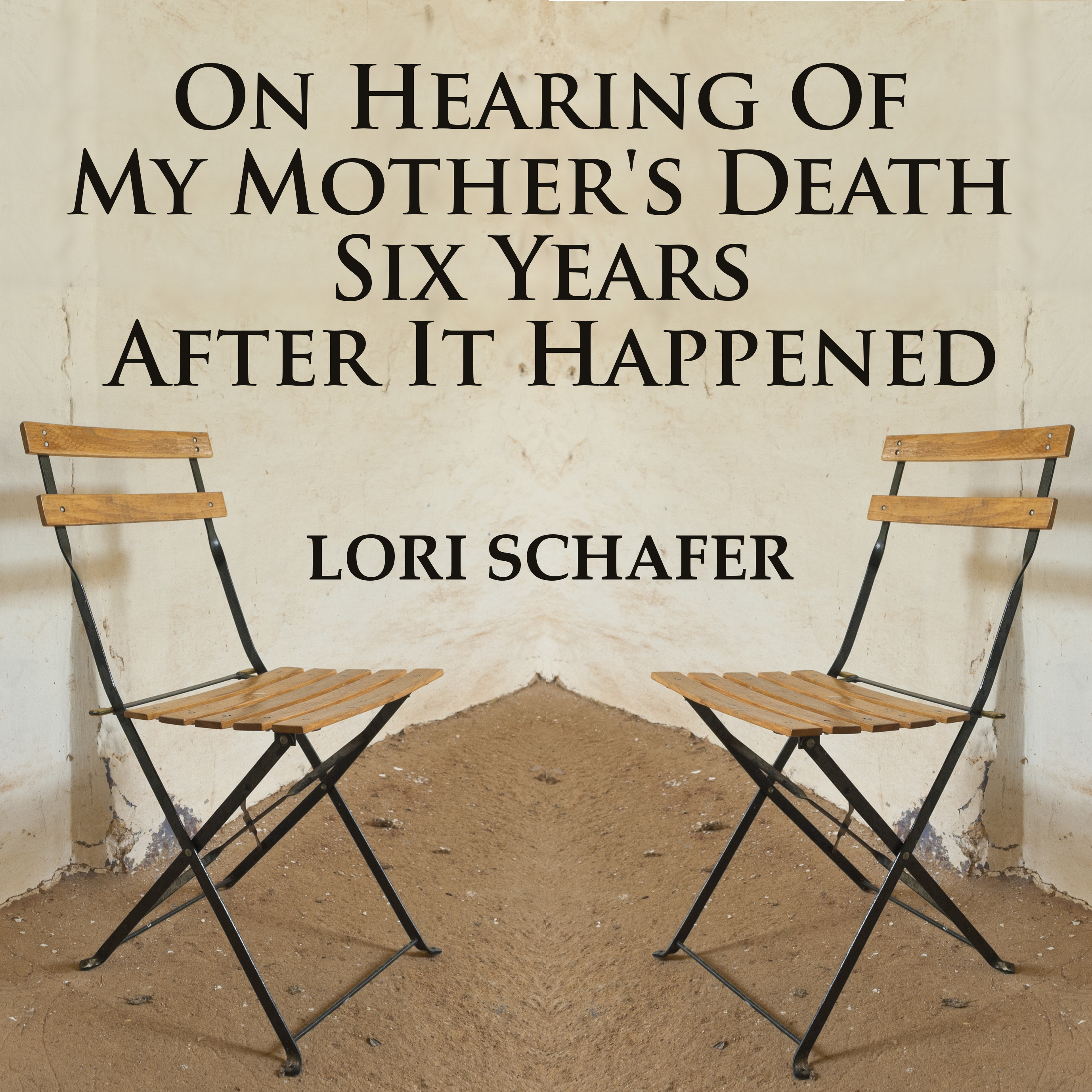
I’ll admit that I was surprised to learn that my book cover would have to be reformatted for the audiobook. I mean, I understand why they want a square cover – presumably to mimic the look of a CD, laserdisc, or vinyl record – but in the current digital age, it doesn’t really seem as if it should matter, particularly when the cover is for browsing purposes only and no one is actually going to receive a physical product. Evidently technology moves faster than consumer preferences over what their book covers, whether audio or eBook, ought to look like. Anyway, here is the adjusted cover. As you can see, although the execution differs, the “empty chair” theme remains:

Mother's Death Audiobook

But more on the audiobook production and publishing process later. For now, here’s the five-minute sample recording I submitted along with the rest of my files. I would really appreciate any feedback you could give me on this, because I’ve just noticed something very strange – when I play it back on the desktop computer on which I did the editing, it sounds pretty clean, but on my laptop there are quite a few annoying clicks and pops, and it also seems a lot quieter. I thought you weren’t even supposed to get degradation on a transfer of a digital recording, so maybe it’s my crappy laptop speakers or my even crappier internet connection.

So what do you think? Could you listen to me read for two and a half hours? At this point, believe me – better you than me!

Words Reveal What Masks Conceal: An Essay on Halloween

When I was in the seventh grade, my English teacher assigned us a creative writing project for Halloween. We were to compose short stories, which we would then read aloud before the class, coupled with a competition of sorts in which the students would vote on who had written the best one.

Now in my pre-teen years, I was not what you would term the most popular kid in school. Perhaps it was those horrible “Student-of-the-Month” photos of me hanging in the main hallway, which they somehow always managed to take right after gym when my hair was flying every which way, or perhaps it was the oxford shirts and corduroy trousers in which my mother dressed me because I refused to participate in ridiculous wastes of time like school-clothes shopping. It certainly didn’t help that in addition to being smart and studious, I was also very, very shy, which led many to believe that I was stuck-up. I suppose if you’re naturally adept at making conversation, it’s difficult to understand that other kids might not be.

You can therefore easily picture the scene in the classroom that day: the anxious adolescent girl slouched in her seat, sweat drenching the armpits of her button-up shirt as she watched the clock, fervently hoping that time would run out before her turn came. You can imagine my nervousness when, five minutes before the bell, my teacher called me to the front of the class, the last reader to go; my terror as I stumbled up to her desk clutching the half-sheets of paper on which I’d scrawled my assignment. As usual, I had pushed the limits on the suggested length – my story was at least twice as long as anyone else’s – and the only saving grace of this enforced public humiliation, I thought, was that I would undoubtedly run out of time to finish it before the lunch bell rang.

Tucking my loose hair back behind my ears and focusing my eyes firmly on my papers, I began to read. It turned out that reading wasn’t so bad; unlike giving an oral report, you didn’t actually have to look at any of the other students. And it was a decent story, I reflected as I flipped through the pages, concentrating hard on not losing my place. At least my classmates were sitting silently, which made them easier to ignore.

At last I reached the climax of my tale, which was where it turned gruesome. The main character had gotten trapped in a fire, and I remember describing, in disgusting detail, the sizzle of the hairs frying on his arms as the hot flames neared. I remember describing the flames devouring his flesh, great flaps of it falling from his skeleton as his skin seared away. And I remember the silence of the classroom; I remember it breaking, the moans and groans that swelled all around me as I depicted my main character’s excruciating demise, only to be interrupted by the harsh clanging of the bell.

No one stirred; no one rose; no one left. I glanced at my teacher, who nodded. The other students sat rapt while I finished my story, and they applauded when I was done. There was no question that I had won the contest.

I was pleased that my story had gone over well, of course, but it wasn’t until the following week, when other kids were still coming up to talk to me about it, that I understood that I had somehow made an impression that went beyond my gruesome, graphic horror story. It was as if I had revealed that somewhere beneath that classic nerdy exterior was a real honest-to-goodness person, a kid who thought about things like destruction and death, and flames eating flesh, and how best to describe such horrific events.

I’ve never been big on Halloween, myself. I’ve never liked the pressure of having to pick out a costume and then explain why I chose it; I’ve never even understood the appeal of dressing up and playing pretend. I have other ways of exploring my dark side. Nowadays you won’t find me in a starched, striped shirt, or in old-fashioned slacks, but don’t be fooled by the sweats and sports bra in which you’ll typically see me lounging about the house, because that’s not who I am, either. It’s just a costume; an innocuous mask meant to show nothing, to reveal nothing, to suggest nothing. My thoughts are inside me. They can never be exposed by a mere choice of outfit.

Jack-O-Lantern


Funeral for Charlie

I absolutely love this story. I think it’s one of the funniest things I’ve ever written and I’m eternally grateful to Australia’s that’s Life! Fast Fiction Quarterly for publishing it in their Winter 2013 issue. Unfortunately, they had to edit out some of my best lines for length and content, and I didn’t think the published version was quite as good as the original. I did, however, think the picture and blurb they posted with it were hysterical. As the rights have now reverted to me, for the curious, here is the full original story:

FUNERAL FOR CHARLIE

Charlie was dead. It was hard to say what had done him in, but given that his roommates Rusty and Redhead had passed away unexpectedly the week before, my husband suspected environmental causes. Not me, though. I suspected Fishy.

The teeniest of all of our goldfish, Fishy had outlived not merely several new fish, but several entire sets of new fish, of a variety of breeds and sizes. We had often remarked on the unquenchable virility which seemed to sustain his minute form while our other fish went belly-up all around him. When poor Charlie got sick, he took to lurking in a corner of the tank, scarcely flapping his large fins, not moving, not eating; barely even breathing. We had watched him anxiously for days before the end. That night I had slept restlessly. Waking up long before dawn and failing to fall back into sleep, I finally got up and went into the kitchen to fix a glass of warm milk. Flicking on the light by the fish tank, I was startled to discover that Fishy had taken up residence in Charlie’s corner, and was, as nearly as a fish can, sitting on Charlie’s head as if trying to smother him. He quickly swam away but it was too late; I had already seen him. And the next morning, Charlie was dead.

I couldn’t prove anything, of course. But I did examine the body pretty carefully when Bob brought it sadly to the surface in the fraying green net, and it seemed to me as if Charlie was missing an awful lot of scales for a domestic goldfish. There were also some detectable gouges on his underside, almost as if he had been fighting. But it was pretty hard to pin anything on Fishy. He swam about as enthusiastically as ever in his empty tank, now entirely bereft of playmates, but not appearing to suffer from either loneliness or a renewed sense of his own mortality. And if he looked with fond or melancholy recollection at the plastic bridge that Charlie used to like to hide behind, or the fake coral that his brothers had favored, it never showed in his face.

“I’ll be right back,” Bob said, holding his hand under the wet mesh to prevent drips from falling all over the floor.

“Wait, where are you taking him?” I asked, alarmed.

“Um, to the toilet?” he replied, as if it were a stupid question.

“Charlie’s not going to fit down the toilet!” I answered indignantly.

“Sure he will!” Bob assured me. “He’s no bigger than a turd.”

“Are you crazy?!! He’s at least twice as big around as a turd!”

“Not my turds!” Bob answered proudly. “And if those will go down the toilet, this goldfish will, too, you’ll see.”

“Okay,” I said, trying hard to comprehend why we were arguing over this, “Okay, let’s just suppose that Charlie really is no bigger than a turd. He’s still not a turd, he’s a fish. A turd breaks up in the water; a dead fish will not. He will get stuck halfway down the pipe and you will be stuck trying to plunge up dead fish.”

“Listen, sweetheart,” Bob said, his tone bearing none of the affection implied by the term, “I’ve fixed plenty of toilets in my day, and I know how big the opening in the pipe is. That fish is going down, mark my words.”

I marked them and followed him into the bathroom. I bowed my head as he plunked our deceased friend respectfully into the deep. I listened quietly as he somberly activated the flusher. And then I watched as the water swirled away, taking Charlie on one final miraculous journey to the home of his ancient ancestors, to the ocean the abrupt end of his short life had precluded him from ever going to see. And then I flushed again for good measure.

It didn’t take. The water backed up into the toilet, causing Bob to flush again, full red in the face this time.

“He didn’t go all the way down,” I observed.

“There’s probably something else stuck in there,” Bob reasoned.

I made hissing noises that can’t be translated into words before finally spluttering, “That fish is stuck in the toilet! Do you hear me?! Stuck in the toilet. There is a dead fish in our toilet!”

“He can’t have gotten stuck; he was too small. And even if he did, I’m sure he’ll break loose and go down eventually.”

“Break loose? Break loose eventually? No way, uh-unh, mister. I am not peeing on that toilet knowing that Charlie’s in it. And we don’t even know where he got stuck. What if a rotten fish comes popping back up into the bowl?”

“That’s unlikely,” Bob assured me.

“Darn right it is,” I answered huffily. “Because you’re going to get that fish out of the toilet no matter what you have to do. And you know why? Because it’s your fault he’s in there.”

I resolutely returned to the kitchen, accompanied by the comforting cadence of Bob’s creative cursing and the gruesome gurgling of the plunger as it sought to resurrect the unfortunate former member of our household from his watery grave. I sidled nonchalantly over to the fish tank. Fishy was still nibbling a leftover bit of his solitary breakfast, flicking his tail-fin contentedly, his conscience apparently as untroubled as the calm unruffled waters which now surrounded him.

“I know it isn’t really Bob’s fault,” I conceded, now that he was out of earshot. “It’s yours. You may have gotten away with it this time, but now I’m on to you. And you know what else? Charlie might not have fit down the toilet, but there’s no question in my mind that you’ll go down quite nicely. One day, one day, Fishy… whoosh!!” I threatened.

Fishy just spat out his chip of orange fish food and swam carelessly away.

***

I have to offer full credit to boyfriend “Bob” on this one for unintentionally providing most of his own dialogue. In spite of all of the evidence to the contrary, he persisted in refusing ever to admit that Charlie just didn’t fit down that pipe.

We did, however, mutually agree to stop buying fish after that.

***

“Funeral for Charlie” is one of the stories featured in my autobiographical short story and essay collection Stories from My Memory-Shelf: Fiction and Essays from My Past (only $2.99 Kindle, $6.99 paperback). To learn more about it, please visit the book’s webpage or subscribe to my newsletter.
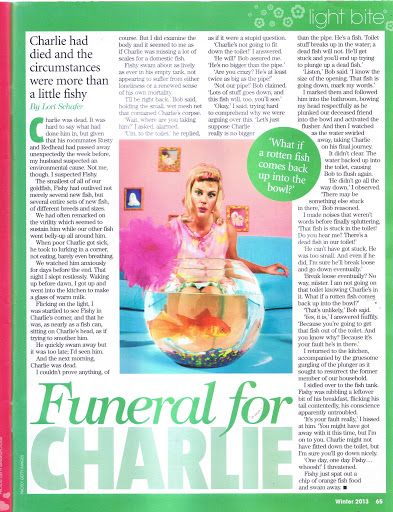
That's Life Fast Fiction Quarterly Publication and Author Commentary: Funeral for Charlie

New Goodreads Review of On Hearing of My Mother’s Death!

Byron Edgington (http://www.byronedgington.com/), author of The Sky Behind Me: A Memoir of Flying and Life, has posted his review of On Hearing of My Mother’s Death Six Years After It Happened on Goodreads. I read it yesterday, and his remarks about the book are so kind that I’m still blushing – in fact, his only complaint is that the book is too short (see my comments following the review):

“Here we have an extended essay/memoir on surviving a parent’s psychosis, inventing a life and then learning of the death of the long-forgotten parent many years after her passing. It’s much too easy to compare such works as Ms Schafer’s to other neglected childhood fare: Jeannette Walls ‘Glass Castle,’ Christina Crawford’s ‘Mommy Dearest’ etc. Too easy, because the parents in those memoirs cannot be easily forgiven; they can only be easily explained. Their cruelty stems from ambition, neglect, the depredations of poor parenting skills. Ms Schafer’s mother, on the other hand, offers a much more subtle, we might say inexplicable source of her wanton neglect and cruel treatment: mental illness and its untreated ravages.

Lori Schafer is an accomplished writer at the apex of her craft. Her images and reflections shimmer on the page: “grilled cheese and tomato…butter-brown bread…’ including good alliteration and excellent use of sentence length variation, she keeps readers moving forward. “The sidewalks were empty. I was empty.” Beautiful stuff.

Transitions are well done, despite many flashbacks and oblique references. Only one time, at an end chapter, and a reference to ‘Lila’ did this reviewer lose the thread, but then it picked up again.

Schafer’s use of a fictional device inside her memoir is very well done. She writes as ‘Gloria,’ to explain the horrors of a childhood in crisis, while giving herself a bit of remove as the writer. It’s an excellent device, and it works very well. It’s also entirely understandable. Much like any child will have an invisible friend, or a security blanket, Schafer has Gloria.

The writer’s voice stays consistent throughout, shifting with subtlety between the teenage, angst-ridden Lori and the determined older Lori living in a car in Berkeley and making her own way. “I was learning,” she writes, scraping for bottles and cans in Berkeley “…like the poor man’s Santa Claus.”

There are a few loose threads: We’re never told what happened to ‘Sandra Johnson.’ Indeed, none of the siblings’ lives are explained. There’s a reference to Schafer’s own concern about being poisoned, a thinly-veiled worry that she might have acquired her mother’s mental illness, but this is not addressed or enlarged. We don’t hear about mom’s own family history, or what may have contributed to her instability, only that ‘Judy Green-Hair’ is a serial marrier. Just open a vein, as they say; readers want more details.

Indeed, one critique of this memoir may be that it’s too darned short, that readers want to know much more about who this writer is: how did that young woman survive all she did? What resources did she uncover in herself? How’s she doing now? Has she finally found ‘a safe place?’

Wordsworth wrote, ‘…the child is father to the man,’ and we must assume he meant mother to the woman as well. If so, at the end of her fine memoir, Lori Schafer pays tribute to that young mother of herself. This is a good, fulfilling memoir. I just wish it was longer, darn it. Four stars, only because it’s too short.”

Byron Edgington, author of The Sky Behind Me: A Memoir of Flying & Life

Although it’s not an unqualified five star review, I’m really very pleased with it because Byron’s feedback actually gave me a great idea. It’s true that there are certain parts of the story into which I do not delve, in particular, regarding my mother’s family history, or what ever happened to my sister. I can’t provide answers to those questions simply because I myself don’t know the answers. My mother’s parents died when I was too young to know them; I don’t remember her sister and was merely acquainted with my uncle. I know very little about my mother’s life before me, and virtually nothing about the rest of her family. Likewise, my sister and I fell out of touch even before I left home, and as to Sandra Johnson, she’s a mystery that will forever remain unsolved.

But at no point do I ever make any of this clear to the reader. Most people, I think, see “family” as constituting a group of people; a set of relations with whom one shares varying levels of affection or bonding. For me, “family” meant Mom. She was it; there really wasn’t anyone else to fall under that heading. So it frankly never occurred to me that I might need to explain why I wasn’t talking about those larger family issues. But, of course, Byron is absolutely right; readers will be curious about those aspects of the story, and even if I have no real answers to give them, I like the idea of explaining why.

And this, of course, is one of the beauties of independent publishing. I’m not bound to someone else’s contract, or to a print run of thousands of copies that are already stacked and waiting in warehouses. So why not add another chapter? Even with my current crazy schedule, I can probably even get that done before the release date, and start fresh with an improved version of the story. A good idea is a good idea – even if it wasn’t my idea!

So thank you, Byron, for taking the time to detail what you thought was missing from my book. Your feedback is greatly appreciated, and I hope you’ll be glad to know that someone is listening.

Goodreads Book Giveaway

On Hearing of My Mother's Death Six Years After It Happened by Lori Schafer

On Hearing of My Mother’s Death Six Years After It Happened

by Lori Schafer

Giveaway ends November 23, 2014.

See the giveaway details
at Goodreads.

Enter to win