Monthly Archives: September 2014

Nightmare in Hot Springs II: Death Springs Eternal

(a continuation of this post)

The sinkhole at Mammoth does not only contain fossils of mammoths. Other large animals did occasionally slide down the slippery slopes and become trapped inside, but the excavations conducted so far have indicated that such events were comparatively rare. Many of the other mammals and scavengers that resided in the area, having in general paws and claws, were more likely to be able to scramble their way out of the hole if they did end up inside it than the mammoths with their flat, poorly gripping feet. One notable exception is a truly rare find indeed, the bones of one Arcdotus Simus, the giant short-faced bear.

Giant Short-Faced Bear

He wasn’t lightly termed a giant; this fifteen-hundred pound beast stood twelve feet on his hind legs, while his height at the shoulder when he was on all fours matched that of a human.

This brutish fellow makes the modern-day black and grizzly bears (shown below on the left) look perfectly cuddly by comparison. Indeed, it puts one in mind of other Ice Age creatures, like the saber-toothed cat, which was similarly a bigger and far nastier version of the modern-day mountain lion.

Bear Skulls

What an amazing continent this must have been, in the days of the Ice Age! It’s difficult to imagine creatures of such size and ferocity living alongside humans – perhaps because they don’t anymore. It’s even hypothesized that it was not climate or habitat change, but man himself that directly caused the extinction of the oversized animals that were once plentiful upon the North American continent. Is it a coincidence that many of these species – which could have had few natural predators – went into decline with the arrival of human hunters?

There have in human history been numerous cultures that derived a majority of their sustenance from a single species like the mammoth, which could provide not only food, but clothing and shelter as well. Witness, for example, the mammoth bone houses built by ancient tribes of the Ukraine, Poland, and the Czech Republic:

Mammoth Bone House

Mammoth Bone House Inside

Imagine how eerie it feels to the modern person, accustomed to walls of wood or stone, to sit in the barely penetrable darkness surrounded by hundreds of bones of long-dead creatures, the sounds from outside the hut muffled by the skins covering the enclosure. To the ancients who lived in such places, one must have been continually reminded of what a gift the mammoth was to the humans who hunted it, of how tremendously its death could improve the lives of those who sought it.
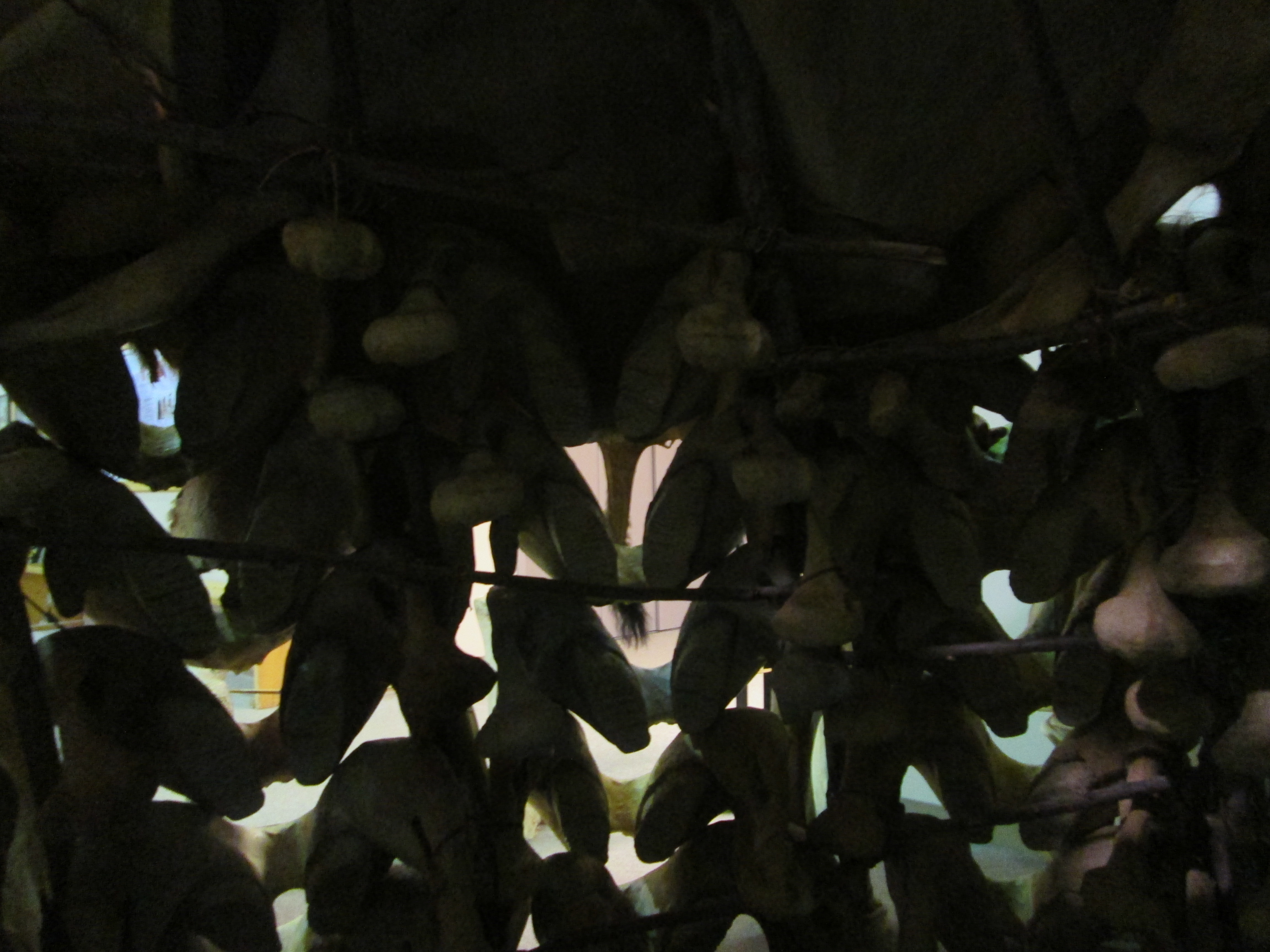
Mammoth Bone House from Inside

But one can imagine, too, how too much dependence on a single species could ultimately lead to the failure of a culture or a people. Many animal species have been hunted to their ultimate demise; however, probably countless more have become extinct indirectly, owing to loss of habitat, to man’s “conquest” of the environment. And it is not the only so-called lesser animals that are vulnerable to losing their livelihood in this manner. The Plains Indians provide a classic example of a similar disaster befalling humans. For ultimately it was not the war against the Indians that defeated the Indians; it was the vanishing of the buffalo, the reduction of their range, the wholesale slaughter of herds for their furs. Without the buffalo, the people of the Plains had no means of making a living on the land for which they fought. In his lack of regard for animal, man once again destroyed man.

There was a final exhibit at the Mammoth Site concerning recent newsworthy finds, particularly in Russia, of carcasses of mammoths found frozen and nearly intact, so well-preserved by the frost, in fact, that the meat was still good. This represents a fascinating development in the study of archaeology, for it is my prediction that as global warming continues and previously glacialized areas are exposed, we will discover more and more bodies of Ice Age creatures that have been cryogenically preserved down through the ages. Indeed, areas like Russia, much of which is, and historically has been, wilderness, are likely rife with such remnants long ago buried in snow and in ice. There have been no visitors to disturb them, no people to poach the tusks, no dogs to drag away the bones.

But in spite of the immeasurable boon to science, I fear it will be but a small comfort, as the ice around the earth melts away, if we uncover the remains of long-lost creatures that flourished during the last Ice Age and are able to study them. For much as we may admire the creatures who came before, their bones and flesh can only serve as a grim reminder of the extremes of which our planet is capable, and of what can happen to species that are ill-prepared to adapt to drastic shifts in the weather.

* * *

If you would like to see more photos from my cross-country travels, please follow my new Pinterest account at http://www.pinterest.com/lorilschafer/.
For updates on my forthcoming memoir The Long Road Home, which I am drafting during this road trip, please follow my blog or subscribe to my newsletter.

Why I Write

First, let me thank writer and born buckaroo Charli Mills for introducing me to this blog hop. You can read her “Why I Write” post here:

http://carrotranch.com/2014/08/19/why-i-write/

Like Charli, I have no single explanation for why I write. I am not one of those writers who feels internally compelled to write, as if it’s as necessary to me as eating or breathing. For a long time – fifteen years, in fact – I didn’t write at all, unless it was for school or work. I’ll never know the reason why I stopped – I simply lost the creative impulse, I suppose – but I do know why, two and a half years ago now, I started again.

A few years back, I found myself with an inexplicable yet incredibly powerful attraction to a married man. I suppose it’s quite common at my age, because by the time you get to be my age, most men and women of your acquaintance are married. I was, of course, painfully aware that nothing could ever come of it, and naturally I never had any intention of trying to make anything come of it, either. Except in my mind.

Yet the attraction persisted. And what was more, in spite of the impossibility of the situation, I found, to my surprise, that I really enjoyed it. I enjoyed thinking about it, I enjoyed considering the possible scenarios, I enjoyed the idea of it probably as much or more than I would have enjoyed actually doing it. And one day it occurred to me that instead of wasting my time with idle fantasies – because I am at heart a New Englander, and it goes against my nature to engage in activities that are unproductive – that perhaps I should try to write them down. Perhaps, I thought, it might be entertaining to tell our story, the way it would happen, if it ever could happen.

What would happen? I wondered. How would that actually pan out, if he and I got together? What would it be like if we had an affair? Not just the sexy parts, although those were important, too, but the nitty-gritty everyday details of it. How would it begin? Where would we meet? How would we cover it up? Would our relationship be about sex or love or something in between? What would happen when the passion fizzled, as it inevitably must? What if there were an emergency when we were together? How would it finally end?

These were all interesting questions that were well worth exploring. Nonetheless, I didn’t intend for the idea to grow and emerge the way it did. I saw it is merely an exercise, not as My Life with Michael, the 110,000-word novel that it eventually became. But somehow in the course of writing that novel, I felt as if I’d had that affair. I had been with this man, from the crude beginnings of our forbidden courtship through our bittersweet parting some four years later. I no longer wondered what it would be like to be with him. In my imagination, I already had been.

Possibilities began to open in my mind. I didn’t only have to write about my own personal secret wishes and fantasies. There were many fascinating scenarios to explore; many non-traditional relationships rife with their own potential for comedy and drama. I began another book, Just the Three of Us, a very funny and surprisingly sentimental romance involving three friends who somehow find themselves in a three-way love relationship.

How I loved writing that book! How deeply I submerged myself in that story, in the humor and unlikelihood of it; how well I got to know those imaginary characters, even the main one, who is startlingly similar to me. How protective I became of my time on the roof in the sunshine with my laptop; how cranky I’d become when stupid, meaningless irritations like work took time away from my sun and my writing. How much my life revolved around that book while I was writing it; how easy it was to center my world around those three people and their problems, which were amusing, instead of around me and mine, which were not.

Yet I didn’t know then what was happening to me. I couldn’t have guessed that my need to sit quietly for long hours in the sun was about more than a desire to write, about putting my feelings and fears and fantasies down where I could read them. I couldn’t have known then that within two years, there wouldn’t be much else that I could do without pain. I couldn’t have suspected that whatever undiagnosed form of arthritis – most likely rheumatoid – that I’ve got would have debilitated me to the extent that it has; that it would have reduced me to trying to squeeze in just a few more months of travel before I’m unable to do things like hike or drive. As often as I had daydreamed about leaving my jobs, I never could have dreamed that I would be forced to leave them, that I would be unable to perform simple tasks like shuffling papers around on my desk without pain. I couldn’t have imagined that writing would become not merely a source of comfort and solace, but my only source of comfort and solace. I couldn’t have anticipated that the fantasy life I was living in my books would become more precious to me than my real life, that it would become virtually the only means I had of truly living.

It was fortunate that we found each other again when we did, writing and I. Because before I got sick, I could have imagined a life without it. I had a life without it. Perhaps some part of me knew that that was about to change. Perhaps subconsciously I guessed that something was wrong, that soon I would need something to occupy the new wide-open spaces in my once-active life, that soon I would have a compelling reason to write. It is rather a funny coincidence, at that. Every once in a while I suppose we do get what we need, when we need it.

At times the course of my life has felt like traversing the Badlands of South Dakota. Every time I manage to fight my way over one rough, craggy peak, another looms larger before me, more ominous and treacherous than the last. They aren’t obstacles in my path. They are my path.

???????????????????????????????

Writing cannot smooth the way for me. It can’t solve my problems, or reverse the progress of my illness, or alleviate the physical pain that is, at times, nearly all-consuming. But it does make it easier to bear. It does make it possible for me to forget it for a while. It does let me pretend that little has changed for me, apart from the normal changes that come with aging. It lets me dream of a world in which my problems are larger than my hip waking me in the middle of the night or not being able to hold a pint glass that’s full of beer. My characters have fun, happy problems – about sexual desire, about getting older, about finding love and keeping it alive. My novels give me dilemmas I can manage and resolve, not the absurd yet constant difficulties that pervade my life now, like how many days it’s going to take my joints to recover from a hour’s walk, or how many trips I must make up to the roof to get all of my stuff up there so that I can write.

Writing is like a gift to me now. It gives me another life, an alternate reality, a world in which I can do and be anything I want to do and be, a world in which I have no limitations except those of my own imagination. In a time in which I’m struggling to accept the me that I now am and one day will be, it is the last remnant of the me I used to be, of the me I always thought I could and would be.

Why do I write? Because writing is all I have left.

No, I take that back.

It’s what I have left.

* * *

Please be sure to visit the following three lovely authors, each of whom will be posting their own “Why I Write” essays within the next few weeks:

Hi! I’m Brianna Soloski and I’m an English writing graduate student, focusing on editing and publishing. I’m an avid reader and writer and have self-published a few things on Amazon. I have a BA in Humanities and an MA in Teaching from Sierra Nevada College. When I’m not writing or working or going to class, I can be found with my Kindle in hand. I also love spending time with friend and traveling. I run a freelance business and am the editorial assistant of DAVID Magazine, a Las Vegas city lifestyle magazine.
Blog | Facebook Author Page | Facebook Personal Page | Twitter

Penny Wilson is a writer whose skills span fiction, mysteries and poetry. While juggling her career in Fort Worth, Texas with family and friends, she tirelessly devotes time each day to her true passion…writing. Having spent her youth in a transient family, Penny believes that her many unusual experiences, including meeting people from a variety of backgrounds and environments, have helped to shape her outlook on life. These experiences continue to enhance her writing, creating characters that readers can connect with in her stories and poetry. Penny is currently working on three books: a fictional story based on fact about American migrant workers in the 1950’s and 1960’s, a fairy tale that will appeal to the tween set, and a fictional adventure/mystery that will soon be completed. Penny’s blog, http://pennylanethoughts.wordpress.com/, has a number of loyal followers and explores her childhood memories, poetry, and other topics.

Paige Adams Strickland, a teacher and writer from Cincinnati, Ohio, is married with two daughters. Her first book, Akin to the Truth: A Memoir of Adoption and Identity, is about growing up in the 1960s-80s (Baby-Scoop Era) and searching for her first identity. It is also the story of her adoptive family and in particular her father’s struggles to figure out his place in the world while Paige strives to find hers. After hours she enjoys family and friends, pets, reading, Zumba ™ Fitness, gardening and baseball.
Website: www.akintothetruth.com.
Facebook: http://www.facebook.com/AkintotheTruth

Why You Should Never Invite a Bison to a Picnic

… because they tend to wander off to find food on their own.

This puts me totally out of order in my posting, but I was so excited I couldn’t help myself:

This furry fella doesn’t seem at all perturbed by the large crowd gathered around watching him stroll up the middle of the roadway in search of lunch.

Nice side view of the bison as it turns back towards the cameraperson (me!) to continue chomping on the grass by the side of the road.

* * *

If you would like to see more videos from my cross-country travels, please check out my new YouTube channel: https://www.youtube.com/channel/UCb5RugrJMSHh6_4hkgHmkMA.

For updates on my forthcoming memoir The Long Road Home, which I am drafting during this road trip, please follow my blog or subscribe to my newsletter.


Nightmare in Hot Springs: A Serial Killer Strikes Again

About an hour south of Rapid City lies Hot Springs, South Dakota. But there’s a darker side to the naturally occurring warm water around which the town is based. In fact, during the last Ice Age, the creatures that lived around Hot Springs were continually stalked – by a serial killer!

IMG_2036

One of the killer’s many victims.

Yes, indeed, the scene at Hot Springs is the stuff of which horror movies are made. It was only in the last century that evidence of this monster, which, astonishingly, continued to murder its victims over a period of seven hundred years, was finally uncovered. As there can be no statute of limitations on such a series of heinous crimes, archaeologists are working around the clock to catalogue the remains of perhaps hundreds of victims of this deadly killer. Who could have done such a thing? What unholy terror could have repeatedly destroyed – and with apparent impunity – such terrific and powerful beasts?

For you see, the primary victims of this diabolical criminal were not flightless birds, or helpless little mammals, but some of the largest land creatures known during the last Ice Age – the mammoths!

The better-known woolly mammoth paled in size compared to the much larger Columbian mammoth.

The better-known woolly mammoth paled in size compared to the much larger Columbian mammoth.

I am relieved to report that the murderer of these majestic creatures has at last been identified. This hardened criminal will escape punishment, I fear, as it, too, has long since been buried. But the evidence of its crimes lingers, and the whole sad story may finally be told.

It appears that some twenty-six thousand years ago, when mammoths were still plentiful on the North American continent, a sinkhole developed in the region, much like this one that was used for the Vore Buffalo Jump. However, in Hot Springs, the force of the collapse caused the hole to tap into a warm artesian well, which in turn caused grass to grow in the area year-round, even in winter. When food was scarce, mammoths would be naturally attracted to the site. They would snack on the grass, then perhaps climb down the sides of the sinkhole for a sip of water. Once inside, their flat feet would be unable to gain traction on the slippery sides of the sinkhole, and they would become trapped inside, floundering about helplessly until they either drowned or starved.

Mammoth footprints. Surprisingly, they don't make much of a mark. Comparatively few remains of smaller mammals have been found at the site, likely because animals with claws rather than hooves were better able to scramble out of the sinkhole.

Mammoth footprints. Surprisingly, they don’t make much of a mark. Comparatively few remains of smaller mammals have been found at the site, likely because animals with claws rather than hooves were better able to scramble out of the sinkhole.

Thus, unlike at Dinosaur National Monument, the tragedy at the Mammoth Site was not mainly the result of a single event, such as a drought, but rather a series of accidents, likely all nearly identical in form. It is worthy of note that every one of the many skeletons that has been uncovered at Mammoth came from a juvenile male. Knowing what we do about modern-day elephant societies, which are matriarchal, these were likely young elephants which were banished from their herds and went off on their own, and therefore had no wiser, more experienced mammoths to warn them against the dangers of the sinkhole. In addition, these lonesome individuals, being outcasts, probably traveled further afield than the others did in their search for food.

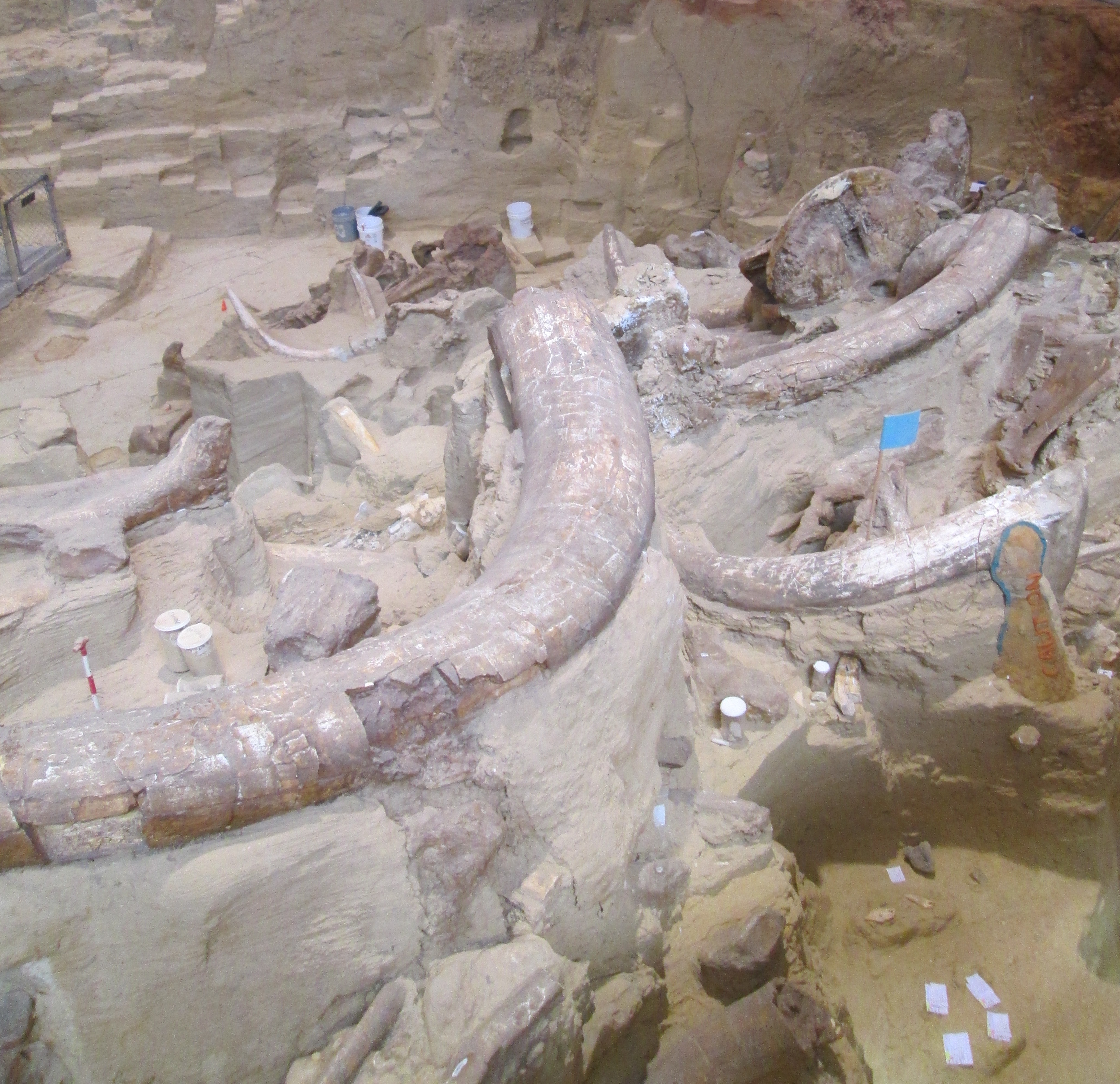
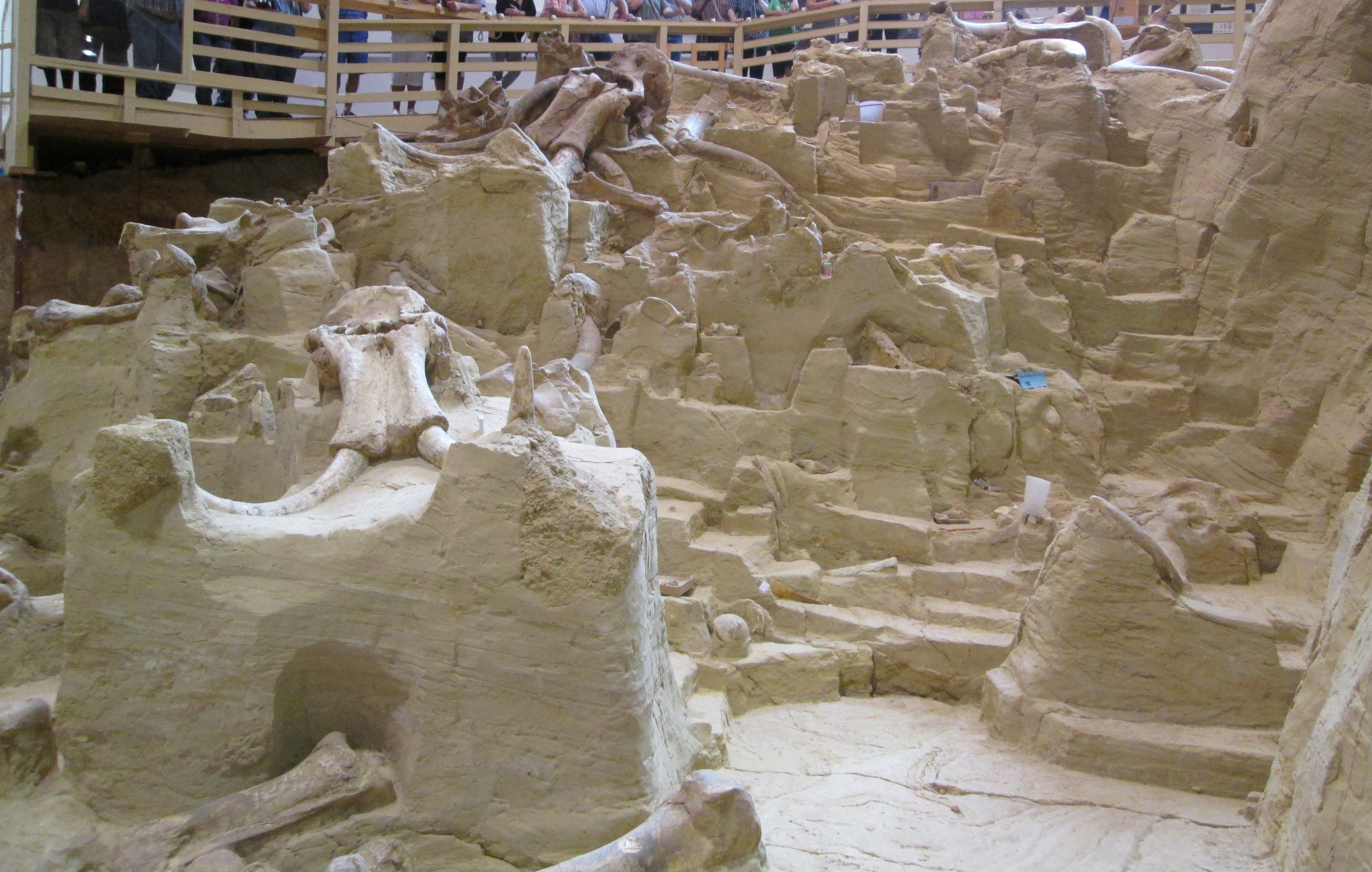
After about seven hundred years, the sinkhole had filled in to such an extent that it evidently no longer posed a hazard for mammoths and other local creatures. The mammoth tragedy, however unhappy it was for its victims, has resulted in a truly spectacular archaeological find. Nearly all of the bones have been left in situ, which means they still lie virtually as they were found.

IMG_2039

Clearly identifiable mammoth skulls.

Indeed, the site is an active archaeological dig; you can see on the board the new bones that have been uncovered during the current season alone.

IMG_2055

You can see, too, that the bones at this site are much easier to pick out from among the dirt and rocks than those at Dinosaur, and this is because these bones have not fossilized. They are evidently not old enough for the bone to have been replaced by harder minerals, leaving mere casts of where the remains once were. Instead, we see here the original bones, which, visually, have a markedly different texture from fossilized bones, which resemble rock.

???????????????????????????????

Mammoth tusks. I don’t care how well-preserved they are; I’m not licking one!

According to our tour guide, if you’re in doubt, you can also identify a bone by licking it; if you’re tongue sticks, it’s bone. I confess that that little tidbit rather put me off the idea of pursuing a sixth career as an archaeologist.

Now, as at Dinosaur, this incredible find was made possible by mountain building forces in the region, namely the uplifting of the Black Hills, which brought the rock layer containing the mammoth skeletons closer to the surface. The remains were found, as these kinds of things often are, during excavation for a new building. It makes you wonder how many more such sites lie beneath the surface, especially in these rural mountainous regions, just awaiting discovery.

And, as at Dinosaur, the nature of the tragedy that befell these creatures created a set of conditions in which large numbers of skeletons would be found in one location. Unlike at Dinosaur, however, there was no river or flooding to jumble up the remains of the creatures that died, which means that many of the skeletons have been found largely intact, as is very apparent when you examine the uncovered bones.

Be sure to return for Nightmare in Hot Springs II: Death Springs Eternal, in which we conclude the story of the killer at Mammoth by examining one of its other unwitting and now-extinct victims – the giant short-faced bear!

* * *

If you would like to see more photos from my cross-country travels, please follow my new Pinterest account at http://www.pinterest.com/lorilschafer/.

For updates on my forthcoming memoir The Long Road Home, which I am drafting during this road trip, please follow my blog or subscribe to my newsletter.

A Sacred Place Is Where You Find It

Surprisingly enough, although I have been to Rapid City and its environs before, I had never heard of Devil’s Tower. I only stumbled across it this time because it was featured on a throwaway tourist map of the area that was forced upon me by some motel. Devil’s Tower! I thought excitedly. I love landmarks named Devil! Consider, for example, The Devil’s Golf Course in Death Valley – if it was named after you-know-who, you know it’s going to be worth seeing.

Of course, as readers have reminded me since, Devil’s Tower is the destination featured in Close Encounters of the Third Kind. Given its fame and the way it sticks up out of the ground like a veritable stairway to the heavens, it is rather difficult to imagine how I could have missed a landmark like this on my prior trips through Wyoming, particularly when it’s visible from miles and miles away:

Devil's Tower from a Distance

I suppose I can’t be blamed too much for overlooking it. As you can plainly see, It’s plunk out in the middle of nowhere. Have no fear about your morning java, though. The lonely road to Devil’s Tower is proof positive that you really can get a cappuccino literally anywhere in the United States:

Coffee Shop Nowhere

Contrary to its name, Devil’s Tower was not traditionally perceived as a haven for the Dark Lord, but rather as a holy place that featured prominently in both Native American lore and in the traditions of white settlers of the region.

Devil's Tower Sign I

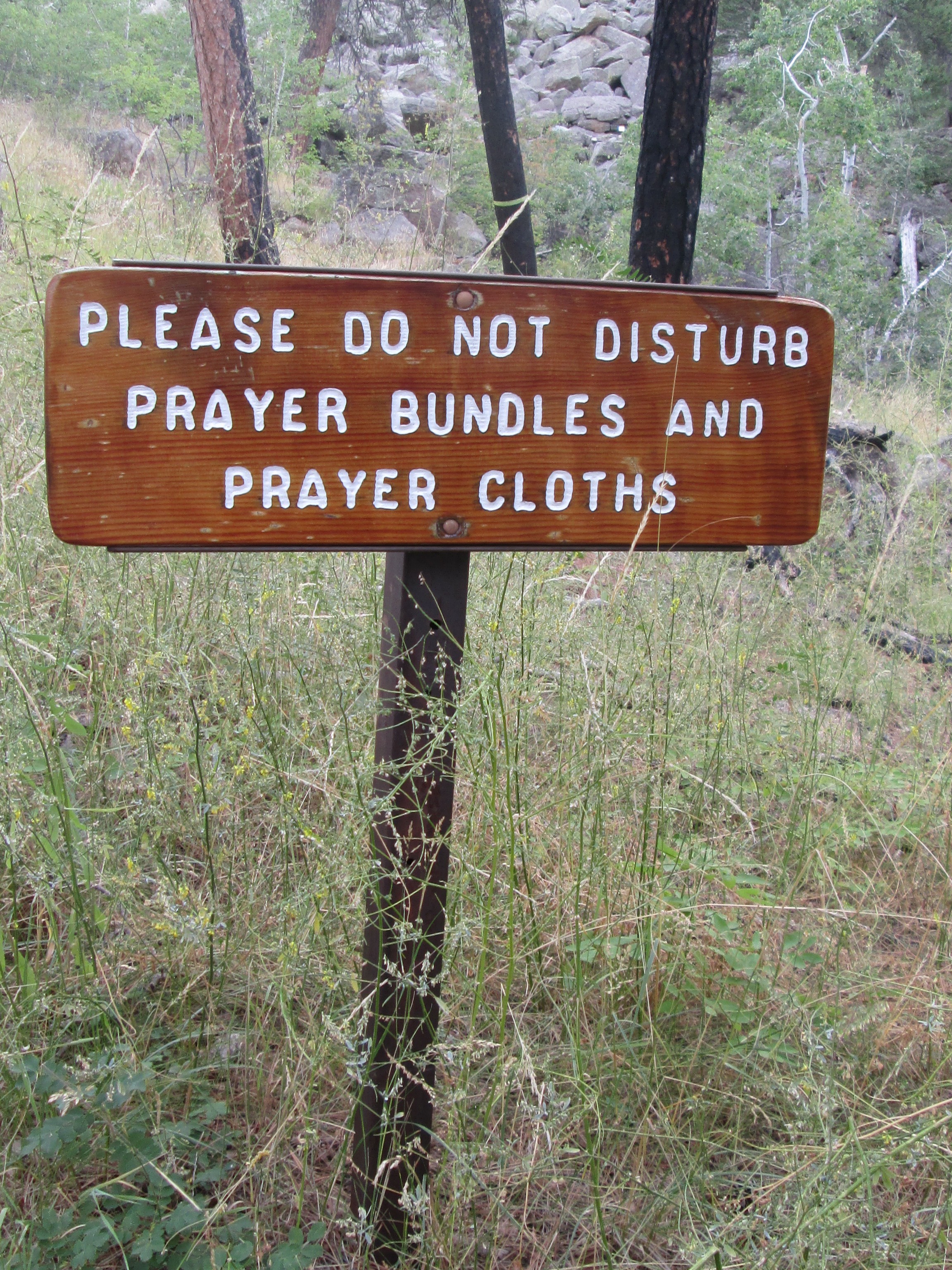
Indeed, some of the Native tribes still visit the tower for religious purposes, as is evidenced by the prayer cloths and bundles scattered all about the wood that surrounds the tower:

Devil's Tower Sign II Cropped

I myself am not a very spiritual person. But when you’re standing in the shadow of this unusually designed and seemingly inexplicable 900-foot monolith, it’s hard not to be moved.

Devil's Tower Closeup II

But as permanent and everlasting as it seems, the tower, of course, will not live forever. All about its feet lies abundant proof that it, too, is slowly self-destructing, that the days of its existence may be numbered to but a moment in geologic time. For while the igneous rock of which the tower is formed is far tougher and less subject to the forces of erosion than the sedimentary rock that once surrounded it, it also cannot survive indefinitely. One by one, the columns of which the tower is constructed will break off and crumple in heaps all around it, creating a field of giant stones in the midst of this quiet and peaceful wood.

Broken Columns

It will be a lengthy process. It has been a hundred years since the last column collapsed, and in the meantime, the tower continues to grow taller as more sediment is eroded from the plain. The tower itself also stands immune to one of the direst natural calamities of the region – the wildfire.

IMG_1941

These blackened trees appear to present evidence of just such a calamity. Fires are a natural part of the western ecology, and, left to their own devices, help to renew the forest floor without causing excessive damage to established trees. But, as is often the case when people interfere with nature, fires have become more devastating to our vast areas of forest in the last hundred years. This is because human efforts to suppress wildfires have caused buildups of fuel in wooded areas – which means that when fires do burn, they burn much hotter and are far more destructive.

It’s a lesson for all of us. Every year our skies are darkened by the smoke and soot of wildfires; every year our fire fighters risk their lives attempting to control these blazes in an effort to spare our homes and other places we hold dear. It’s only natural that in our approach to the world, we put humans first. But at what cost? Do we really derive any long-term benefit from interfering with the natural ebb and flow of our forest ecologies? Or are we merely postponing the inevitable and, in the process, causing greater harm than good?

It is human nature to develop attachment to the land. The land in which we are born, the land in which we grow up, the lands in which we experience our first love, our first adventure, our first taste of freedom; the land in which we choose to grow old and die. Places form a large part of how we define ourselves, of how we comprehend our position in the world. Who among us has not gone out of our way to drive past a house we lived in as a child? Who among us does not remember “where we were” during important events in history, such as the John F. Kennedy assassination, or 9/11? Who among us does not imagine the chapters of our lives as beginning and ending with the places we have lived, because every new place is, in our minds, distinctly different from the last, even if the move was only across a state or down the block?

The Native Americans understood this. Many of their origin stories are centered around the land, around the gifts of land, the gifts of places that were granted to their people by their god or gods. It is perhaps one of the reasons why the shift to reservations was so painful, so intolerable to the Native tribes. You cannot simply remove a people from one land to another and expect them to be satisfied, even if the trade were, on paper, fair and equal. The land does not represent merely a way of life, a means of earning a living. It is the very essence of a people.

We will always fight to protect our sacred places, whether they be a stretch of coastline on the eastern seaboard, a beloved old elm in our own front yard, or a four-block neighborhood in the city of Cleveland. Places move and inspire us. We cannot bear to see them altered or destroyed. But of course, eventually they must be. Even a monument like Devil’s Tower cannot stand forever. Nothing can.

But perhaps we can take comfort in knowing that this particular landmark will continue to stand, for as long as we ourselves are living, and for many generations after us. It is, for all human intents and purposes, an essential and everlasting part of the landscape. It is land at its very best. Permanent. Indestructible. Sacred.

* * *

If you would like to see more photos from my cross-country travels, please follow my new Pinterest account at http://www.pinterest.com/lorilschafer/.

For updates on my forthcoming memoir The Long Road Home, which I am drafting during this road trip, please follow my blog or subscribe to my newsletter.

Devil’s Tower: Imposing, But Not Really Evil

* * *

If you would like to see more videos from my cross-country travels, please check out my new YouTube channel: https://www.youtube.com/channel/UCb5RugrJMSHh6_4hkgHmkMA.

For updates on my forthcoming memoir The Long Road Home, which I am drafting during this road trip, please follow my blog or subscribe to my newsletter.

Buffalo Jump!

Many of us are familiar with the concept of the “Buffalo Jump,” of course, but in all my travels, I had never actually seen the site of one before. After spending a dark and stormy night outside of Rapid City, I decided to duck over to Wyoming to visit Devil’s Tower. It wasn’t long after dawn when I spotted signs on the highway directing me to this noteworthy landmark:

Buffalo Jump

Very thorough explanation, isn’t it? But what, you may be wondering, as I was, does the buffalo jump actually look like? After considerable searching in the early morning light, I finally realized that it lay in an unmarked field just across the road:

Buffalo Jump 2

That’s one heck of a sinkhole, but it doesn’t seem as though buffalo could become effectively trapped in it, does it? Perhaps not – but it was a sinkhole, after all, that was responsible for creating one of the most spectacular archaeological sites in the world today – Mammoth!

???????????????????????????????

* * *

If you would like to see more photos from my cross-country travels, please follow my new Pinterest account at http://www.pinterest.com/lorilschafer/.

For updates on my forthcoming memoir The Long Road Home, which I am drafting during this road trip, please follow my blog or subscribe to my newsletter.
They Call It Rapid City Because If You Don’t Hurry, You Might Miss Something

It never fails to come as a surprise. The midwestern states always seem like vast stretches of nothing until, wham! They hit you with something truly spectacular. Or, in the case of Rapid City, with many things truly spectacular.

It doesn’t seem like much at first. A good-sized town tucked away in the northeast corner of South Dakota, not far from Sturgis of “Sturgis Raw!” fame, which fans of The History Channel will recognize in an instant as the site of one of the biggest motorcycle rallies in the world.

Knucklehead

They call this area The Black Hills. But it is perhaps best known for one rather grayish-tan hill:

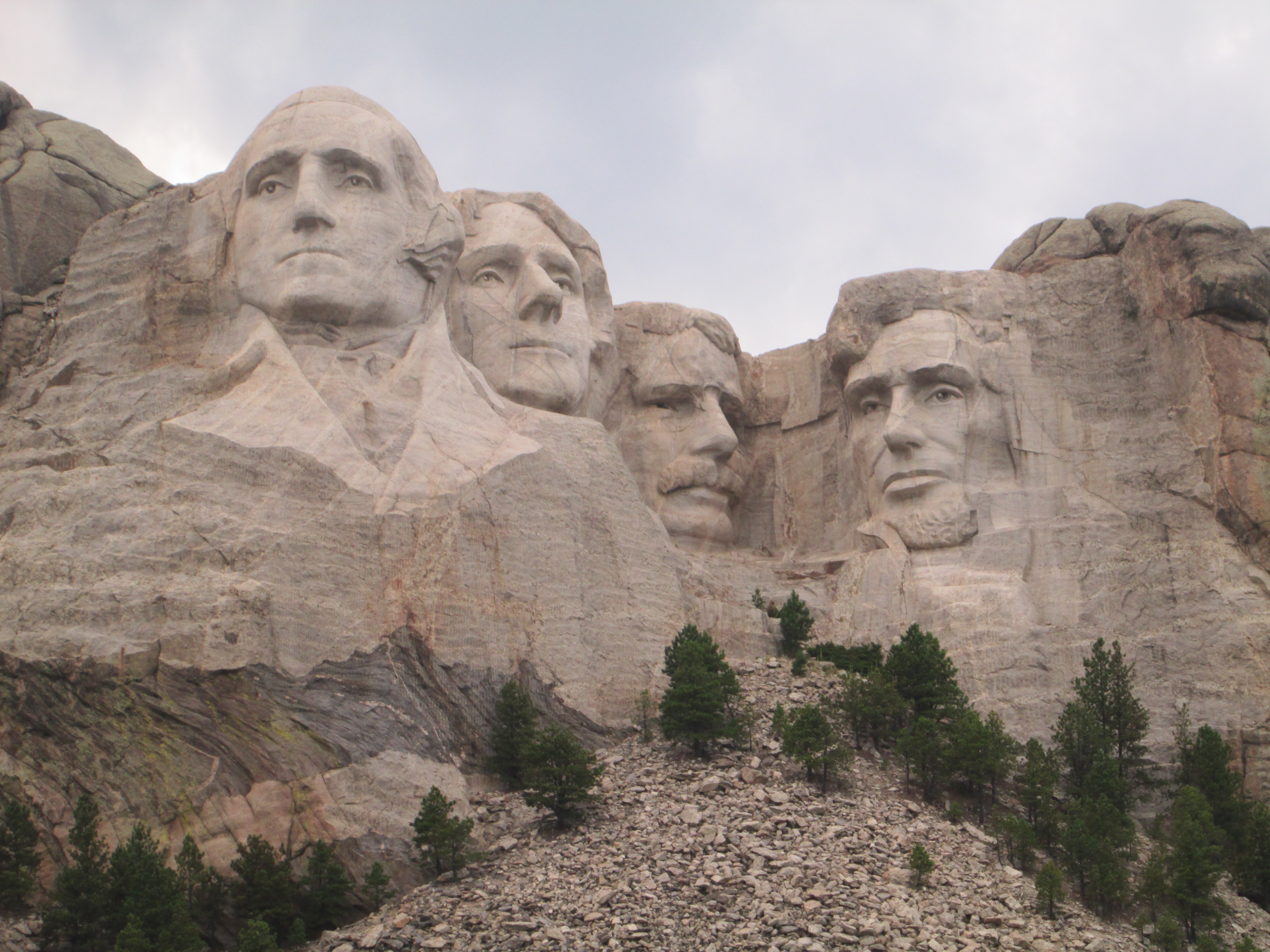
Mount Rushmore

Every day, thousands of people flock to Mount Rushmore, to this ultimate homage to dead presidents. It is so cheesy, yet so reassuring. It reminds us that in fifty years currently popular celebrities like Kim Kardashian and Pitbull will be long forgotten – yet these four presidents will live on in the American imagination. Not because of their principles, not because of their achievements, but because some sculptor thought it would be really cool to memorialize their heads on the side of a mountain.

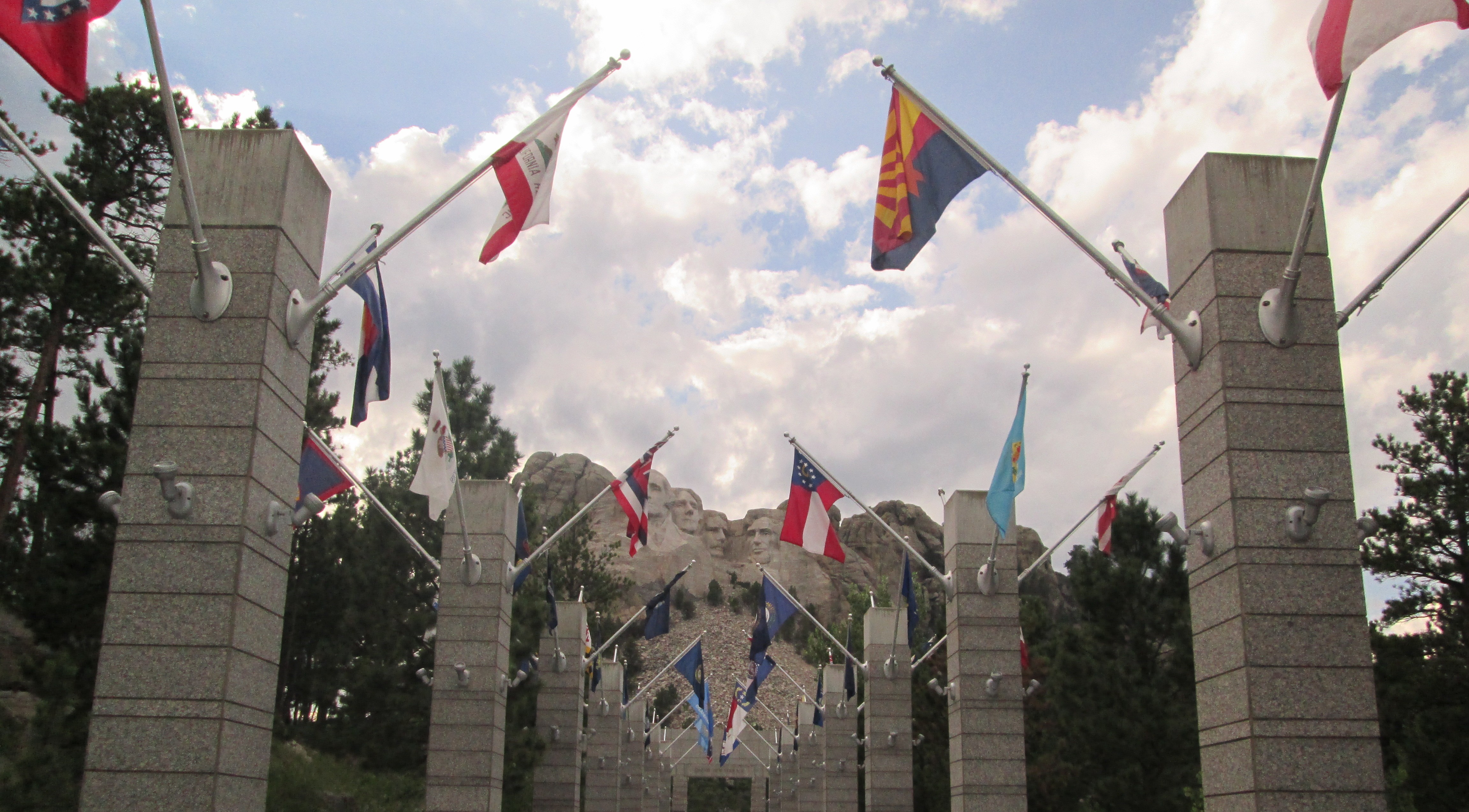
And you know what? It actually is really cool. And what’s even cooler is that they livened up that dull, colorless mountain by turning the entrance to it into an Avenue of Flags containing the banners of each of the fifty states:

Avenue of Flags

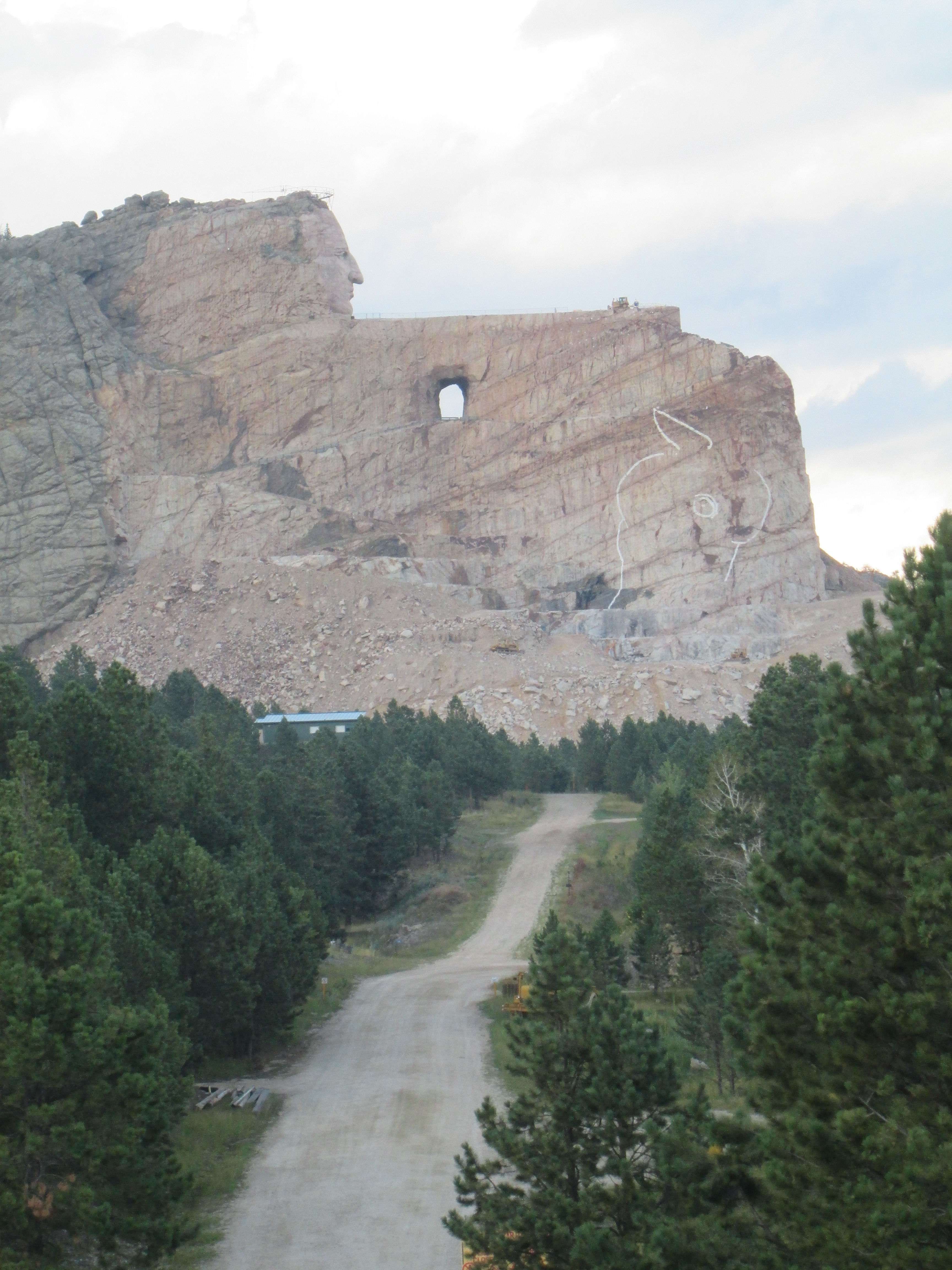
The whole monument is so cool, in fact, that another sculptor – with entirely different motives – decided to attempt a similar gambit some twenty miles to the south:

Crazy Horse Monument II

Any guess what famous figure that’s supposed to be? Maybe this will help:

Crazy Horse Model

That’s right; this mountain is – or is going to be – a monument to Crazy Horse, the famed Indian warrior who inspired such fear and admiration in the spirits of white men, and who, a century and a half later, remains an icon of the Plains Indian to both red and white men alike. This massive project – which, if completed, may be the largest sculpture in the world – receives no federal funding and has been a work-in-progress since 1948. However, I think it’s safe to say that even if the project is never finished, it has ensured that Crazy Horse will enjoy a permanent place in American history.

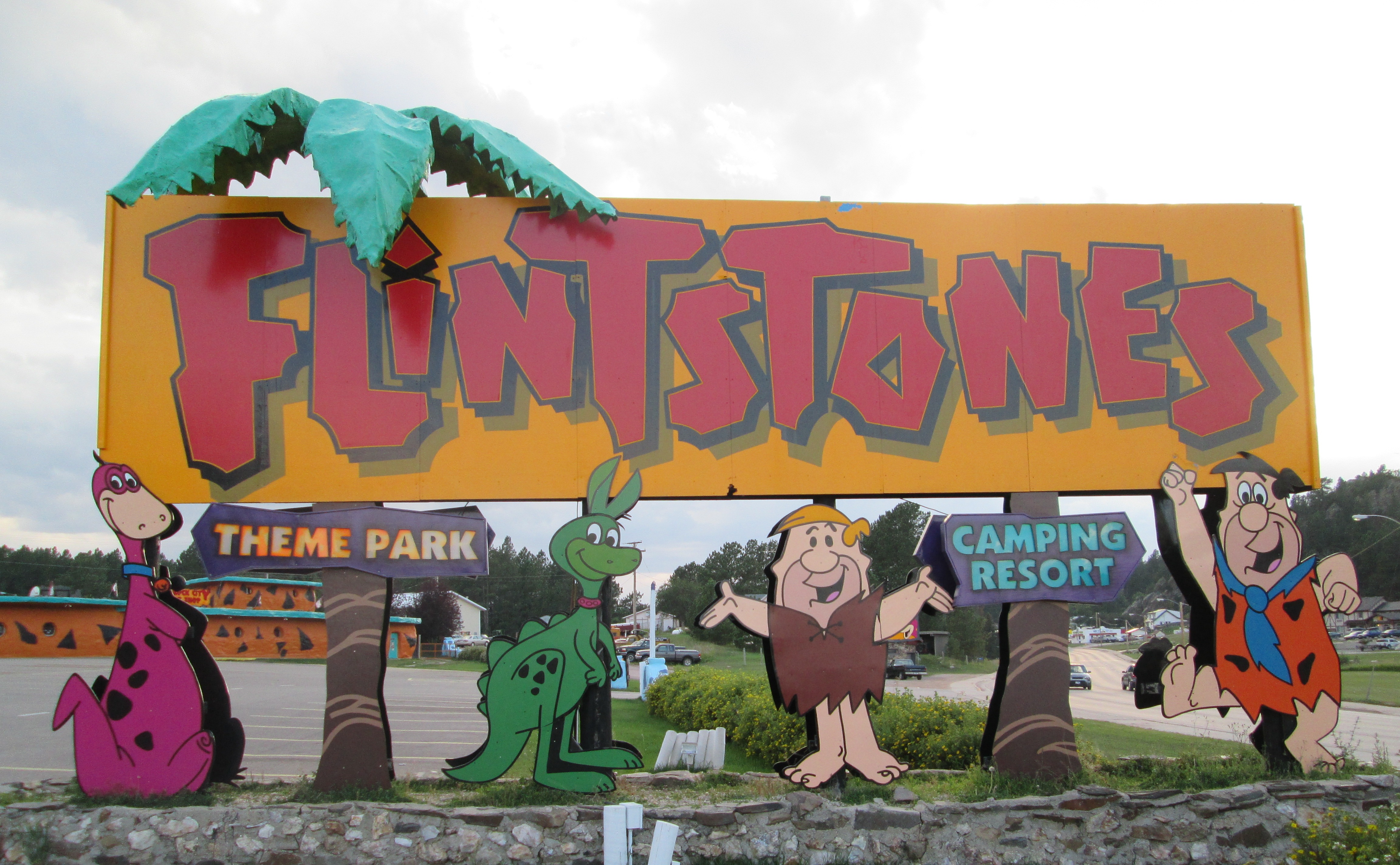
It is perhaps ironic that not far south of the Crazy Horse Mountain lies Custer State Park, named for the cocky yet ill-fated Indian fighter who met his doom on a Montana battlefield which I hope to see again later in my trip. It is perhaps fitting that General Custer and his outmoded ways of thinking have been commemorated by an equally antiquated theme park, which has been constructed in the city that also bears his name:

That’s right – in Custer you can order food from the Flintstones drive-in…

Flintstones Theme Park II

… or make a call from the Bedrock phone booth, which can be really handy if, like me, you have a third-rate cell service provider and your phone hasn’t worked in a week.

Flintstones Theme Park III

Yes, Rapid City has an abundance of special charms that you won’t want to miss. You don’t have to worry about hurrying down to nearby Hot Springs, though – this guy definitely isn’t going anywhere:

Mammoth

* * *

If you would like to see more photos from my cross-country travels, please follow my new Pinterest account at http://www.pinterest.com/lorilschafer/.

For updates on my forthcoming memoir The Long Road Home, which I am drafting during this road trip, please follow my blog or subscribe to my newsletter.