Tag Archives: flash fiction

“Funeral for Charlie” on Story Shack Magazine

My humorous short-short “Funeral for Charlie” is now up on Story Shack Magazine:

http://thestoryshack.com/short-stories/comedy/funeral-for-charlie/

For those of you who are unfamiliar with Story Shack Magazine, it’s a daily flash fiction site operating under a very cool premise. If they accept your story, they will team you up with an illustrator to do an original drawing for it!

This time I was fortunate enough to receive custom artwork by artist Daniele Murtas (http://dmurtas.blogspot.com/). Hope you enjoy it!

illustration-funeral-for-charlie-940x540

“I watched as the water swirled away, taking Charlie on one final miraculous journey to the home of his ancient ancestors, to the ocean the abrupt end of his short life had precluded him from ever going to see…”

***

“Funeral for Charlie” is one of the stories featured in my autobiographical short story and essay collection Stories from My Memory-Shelf: Fiction and Essays from My Past (only $2.99 Kindle, $6.99 paperback). To learn more about it, please visit the book’s webpage or subscribe to my newsletter.
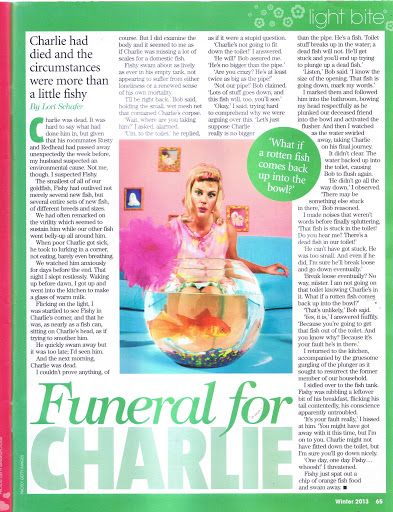
Out! in That’s Life Fast Fiction Quarterly

“Out!” appeared in the Summer 2014 (Australian summer) issue of That’s Life Fast Fiction Quarterly. Tell me what you think!

OUT!

“GET OUT!” a girlish voice shouted in exasperation, unbelievably audible even from across the house, possibly even from across the town. Squealing boyish laughter followed it; fed on it.

“Get out, I said!! Get out of my room!!”

Jake laughed again, louder, nearly giggling with gleeful abandon. “I am out!” he howled back at her triumphantly. “I’m way out here in the hall!”

I didn’t need to get up to look; I could visualize the scene from where I sat cringing at the desk in my office. Jake standing grinning in the hall, gawking at his year-older sister through her open door, the tips of his sneakers defiantly resting just over the edge of her lintel.

“Go away!” Katie yelled, her piercing cry prompting the neighbor’s hounds into a frenzy of agonized howling. “I don’t like you!”

Jake only cackled harder, his small fists slapping like drumsticks against the hollow-sounding sheetrock.

“I mean it!! I don’t like you!”

“I don’ wike you eiver!” he hurled back indistinctly, still chuckling. From the muffled sound of it, probably poking his tongue out at her.

You’re not supposed to interfere, I reminded myself forcibly, massaging my temples in a futile attempt to flatten the thick, bulging veins that had popped out palpably from the sides of my skull. That’s what the parenting books said; let them fight it out amongst themselves. Easy for them to say, I grumbled internally. They didn’t have to suffer through the screeching.

“JAKE!” Katie shrieked suddenly, her voice rising to a pitch that pained my ears and carved a new crack in my glasses. “I – don’t – want – you – in – my – room!” she erupted, nearly breathless with childish fury and indignation. “Get – out!!” Apparently he’d crossed the line in teasing her; trampled the border between her space and his.

“What?!” he yelled back with mock innocence. “I’m not doing anything!” I heard rigorous, rhythmic tapping noises and pictured him performing a slap-happy dance-routine in the hall by her door.

Suddenly there was a loud thunk and a louder cry, a boyish yell of astonishment and pain.

“Uh-oh, Katie!! You’re gonna be in so much trouble! I’m telling!”

“Good!” she retorted scathingly, ostensibly unperturbed by the formidable threat. “I’ll tell what you did, too.”

“I don’t care! Oh no, I don’t! Oh, Mom! Mo-om!”

I wondered what the parenting counselors would think if I pretended I didn’t hear it. I wasn’t sure if I cared.

“Mom!” Jake yelled, bursting into my office with all of the sound and fury of a string of firecrackers going off unexpectedly in the middle of May. “Katie threw a shoe at me! Hit me right here on the head!” He pointed cheerfully at the nasty wound, a small pinkish tint barely visible beneath my fluorescent lights.

“Looks more like a sandal,” I contended calmly, bending closer to examine the visible results of the near-fatal blow. “You don’t seem hurt.”

“But I am!” he expounded happily. “You should punish her; yes, you should!”

“He started it!” Katie yelled, exploding in turn through my doorway as if her catapult was parked right outside. She glared hatefully at her little brother, the hotness of her anger causing the freshly watered leaves of my poor defenseless office plant to wilt in dismay.

“No, I didn’t, you did!”

“Yes, you did, you know you did!”

“I know you are, but what am I?!”

“I’m rubber and you’re glue…”

“GET OUT!!” I shouted suddenly, snatching up my plant and clutching it to my chest as if it were my one true friend. “Get out of my room!!”

They stopped. Turned to glance thoughtfully at one other and hushed. Retreated silently from my office, sadly into the unknown depths of the rest of the house, while I scolded myself over my own childish temper tantrum.

I can’t lie. I enjoyed the quiet in spite of myself.

An hour later I tiptoed gingerly into the empty kitchen, still feeling a little guilty over my impatient outburst and considering whether I ought to compensate with everyone’s favorite dinner and maybe ice cream to boot. Through the wide doorway down the hall I could see them: my two kids lying serenely next to each other on the living room floor, companionably assembling a five-hundred-piece jigsaw puzzle I’d gotten them for Christmas. Their argument as long forgotten as Mom’s unusual fit of anger, their renewed friendship ensured as long as the delicate balance between sibling love and sibling rivalry was carefully maintained. A balance that might be upset by the smallest act, the tiniest sound, the most frivolous word, the most meager interruption to their peaceful co-existence. Maybe they had something there, after all, those parenting books with their recommendations of non-interference.

I ducked unnoticed back into my office; returned to the smooth stillness of my walls and my work, reassured that my children were safe, my family once again loving and intact. A short time later my husband came in from the garage, the blissfully quiet haven in which he’d passed his leisurely afternoon, his work-boots clunking hard against the laminate flooring as if entirely unconcerned about who heard or observed them. “We got a while until dinner?” he boomed, thrusting aside the door of my office with a bang and energetically brushing the dust from his big black mustache onto my still-quivering houseplant. “I was thinking of patching that hole in the living room wall,” he continued, staring at me curiously as I leapt from my rocking, rolling chair, waving my hands incomprehensibly in a frantic effort to shush him.

“Late dinner tonight,” I whispered, silencing his half-uttered response with a kiss while I wondered how many minutes or hours the newfound peace might reign in our little kingdom if only we left our children alone. “But stay out of their room.”

Out2

How Many Times Do I Have to Rewrite This %$^&# Thing?! The “Yellow Wagon” Saga

My flash fiction story “Yellow Wagon” has been published in Every Day Fiction:

http://www.everydayfiction.com/yellow-wagon-by-lori-schafer/

What a journey this story has taken! The final published version of this piece at the link above ended up being twice the length of the original (reproduced following this essay). The editors at Every Day Fiction were possibly interested in publishing it, except that they didn’t like the idea of “misleading” the reader about the wagon, which is precisely what the original version did. In fact, that was the essence of the story. In addition, they thought the premise itself was unbelievable because I had made Debra a first-grader and the argument was that no parent would permit a child that young to walk to school by herself.

Naturally, this threw me for a loop, because, of course, the child in the story was me, and I was not a first-grader but a kindergartner when it happened. Where I grew up in small-town New England, lots of kids walked to school by themselves. There was no such thing as blue-collar flex time so you could drive your kids to school – and many parents took the bus to work because they didn’t have a car, anyway. However, I was certainly willing to grant that we live in a different time, and that perhaps the premise would seem implausible to modern readers, so I re-wrote it to include details that would make it obvious that the story took place in an earlier era.

They still didn’t like it. The issue remained of Debra not appearing to recognize the wagon, which naturally made little sense in their interpretation of the story. I frankly had no idea what to do about this, because my intention for the piece was entirely at odds with their reading of it. I had been attempting to convey the thoughts and emotions of a little girl who has been given a great new responsibility and is trying very hard to behave herself as her mother would wish. It’s not that she doesn’t recognize the wagon – she merely pretends not to because she doesn’t want her mother to think she’s only being careful because she knows she’s being watched. The whole story development – where she keeps looking anxiously over her shoulder to see if the wagon is still following, how she exaggerates her caution in crossing the street, even her final sprint at the end when the pressure becomes too much for her – centers around this concept. What I thought was clever about it was not the fact that it draws the reader down a false path, but that if you reach the end and look back on it, it turns out that the story details were true and accurate all along. The tension was real – except its source was not the wagon, but the feelings of the little girl.

Anyway, they asked for another rewrite, and suggested that I make the story more about Debra and her mother. I’ll admit that this caused me considerable consternation. On the one hand, it was a challenge, and I’m certainly not one to run from a battle. On the other hand, I had no particular interest in writing the story that way. It just didn’t feel like me. It took me longer to transform this simple vignette into heartwarming family fiction than the original story took to write! I’m not disappointed in the way it turned out, although it is a bit on the sentimental side. But I do still believe the original version has its charms – although I’m willing to concede that I may be the only one who thinks so!

It was, however, an interesting lesson. First, because sometimes it’s easy to forget that what I think is obvious as a writer doesn’t necessarily come across to a reader the way I intended it. Editors are usually right, and if these ones weren’t getting it, chances are pretty good lots of other people would have misread my original story, too. And second, because it was my first real experience writing to someone else’s specifications. I mean, sure, I’ve had to write papers on topics that haven’t particularly interested me – but no one has ever told me how to write them. And ultimately, I feel that this is something I should be able to do, even if I don’t enjoy it very much. As wonderful as it is to exercise total control over my fiction, a writer who knows their craft should have the capacity to create work that someone else defines. So I suppose you might say that I, too, took a journey of transformation – and it’s to be hoped that I came out a better writer at the end of it.

YELLOW WAGON (Original Version)

“Right on Orange, left on Revere,” Debra repeated to herself for the dozenth time, kicking away the crisp dead leaves that snapped at her feet like so many untrained puppies. First grade wasn’t like kindergarten; the teachers got mad if you were late. Her mom would be mad, too, if she got lost along the way.

She reached the end of her street and hung a hard right, ignoring the noise of the engine she heard revving behind her. It was only a block more to the light, and when she reached it she stopped dead, waiting cautiously for the green, both feet planted firmly on the sidewalk, not even touching the curb. When her turn came she looked both ways, repeating and exaggerating the motion, and catching in consequence a glimpse of a yellow station wagon with wood paneling that had drawn to a seemingly casual halt on the side of the road behind her.

She crossed hurriedly, shifting the schoolbag in her left hand while gripping the lunchbox more tightly in her right, swinging both in steady rhythm as she walked. Halfway down the block she knelt suddenly and fiddled with her shoelaces. Peeking over her shoulder as she bent forward, she spotted it again, the yellow wagon, which had rounded the corner after her and was still following at a respectful distance.

With grim determination she pressed on, on towards the schoolyard, now only a few blocks away. She could hear the cries of the kids on the playground, see the bright orange sash of the crossing-guard directing traffic, smell the exhaust of the ancient school buses that brought the children who lived on the far side of town. And then suddenly she was on the last block and she was running, running towards the final intersection, the one guarded by the gentle white-haired man with the threatening crimson sign, and then she had flown across it and was vanishing safely into the thick crowd of students and teachers. She turned, breathless, and witnessed the yellow wagon retreating cautiously down the street, crawling silently away as if at last losing interest in the subject of its persistent pursuit.

She remained alert that afternoon; negotiated the crosswalks with care and kept watch for the stealthy wagon, but discerned no sign of it. She sighed with relief as she at last climbed the steps of the porch on which her mother stood happily waving her home.

“How was your day, sweetheart?” she inquired cheerfully. “Were you scared walking to school by yourself?”

“Nope,” Debra replied without hesitation.

“Did you remember to look both ways and cross with the light?”

“Yes, Mom,” she said, smiling, confident that her mother already knew the answer to that question.

“So you’ll be all right walking, then, if I take the car to my new job tomorrow?”

“Of course,” Debra answered. She glanced appreciatively at it, the familiar yellow station wagon with the wood paneling, parked, as always, comfortably in front of their house.

* * *

“Yellow Wagon” is one of the stories featured in my autobiographical short story and essay collection Stories from My Memory-Shelf: Fiction and Essays from My Past. To learn more about it, please visit the book’s webpage or subscribe to my newsletter.

Autumn Leaves on Sidewalk

“Yellow Wagon” on Every Day Fiction

Yellow Wagon

http://www.everydayfiction.com/yellow-wagon-by-lori-schafer/

My family flash fiction piece “Yellow Wagon” has been published on Every Day Fiction!

“Goat” on Every Day Fiction

My flash fiction piece “Goat” has been published on Every Day Fiction:

http://www.everydayfiction.com/goat-by-lori-schafer/

Yep, “Goat” is a true story all right. That was me, the shy, nerdy middle-schooler who couldn’t stomach being the center of attention, yet who suddenly found herself in a bright and unwelcome spotlight thanks to a careless remark by a well-meaning teacher. That was me getting my ponytail yanked by the boy who sat behind me, and suffering the embarrassment of inadvertently drawing a wiener on the blackboard. That was even me once again changing school districts and having to overcome my natural introversion with a whole new crowd of people. How I wished I was still “Goat” then – at least I would have had something to talk about!

What I really enjoy about “Goat” is the way it allowed me to take a humiliating situation and craft it into something positive, and this was true both in the fictional version and in the real-life story. Although I never actually carried that nickname to high school (thank goodness!), oddly enough, the “goat” incident and aftermath proved to be a real turning point for me in terms of my ability to relate to other students, maybe because even at the tender age of thirteen, I was able to have a sense of humor about it. Oh, I would pretend to fume and glare when the other kids made fun, but I never really minded it much. I rarely got the impression that the teasing was mean-spirited. And in any case, it was still way less embarrassing than the time I won that classroom limbo contest. I jumped up and down in celebration for a good minute before another girl came over and whispered in my ear that I’d ripped the seat of my pants making the winning walk under that final stick. And I’d thought that all that cheering was in honor of my victory!

Sigh. Embarrassing moments. We’ve all had our share of incidents we’ll never forget, but wish we could. I know, I know, we should be grateful that we’ve had those experiences, because they’re what’s made us who we are today. But let’s not lose sight of the real value of our lifetimes of humiliation in front of our peers. Inspiration for fiction!

***

“Goat” is one of the stories featured in my autobiographical short story and essay collection Stories from My Memory-Shelf: Fiction and Essays from My Past (only $0.99 Kindle, $5.99 paperback). To learn more about it, please visit the book’s webpage or subscribe to my newsletter.

Goat with Tongue Out

“Missed Connection” on The Pittsburgh Flash Fiction Gazette

My erotic flash fiction piece “Missed Connection” has been published in The Pittsburgh Flash Fiction Gazette:

http://pittsburghflashfictiongazette.net/fiction-missed-connection-lori-schafer/ (Adult Content)

A couple of months ago, I wrote a post about my short-short “Delayed Connection,” which was then the home-page story on Romance Flash. In it I describe how the original idea for that very sweet, very romantic story came to me from this one, “Missed Connection,” which is a much more sexual and also strangely sadder piece.

The original premise was actually not, as you might think, the chance meeting at the airport. Rather it was about the confession with which the story begins. Because I think we can all relate to that, to the regrets we have over the “one that got away,” over never making a move when we had the chance. How afraid we were to share our feelings, for fear of being rejected, yet how simultaneously eager we were to admit them, on the unlikely chance that our emotional and/or physical affection would be returned. The narrator here has taken the bold and incredibly foolish step of actually making the confession – in writing, no less – not in the middle of the acquaintance, but after it’s too late for anything to happen between her and her object of desire.

What could possibly motivate a character to do something like that? There’s nothing in it for her, obviously, nothing to be gained but an increase in her pain and humiliation, so why would she do it? The answer is simply that she wanted him to know. At the very last, she wanted him to know how attractive he was to her, and what kind of fantasies he inspired, even if it meant exposing her deepest secrets to someone who had already left her behind. It’s a remarkably unselfish act. Stupid, surely, but unselfish.

I’d like to say that she’s rewarded for making this unusual parting gift, and perhaps, in a way, she is. In the end, she still doesn’t get what she wanted. But maybe she feels a little better about not getting it. And if you find yourself grieving over a lost love, you would be a fool to hope for more than that.

***

You can also read “Missed Connection” in my recently released collection of erotic short short stories To All the Penises I’ve Ever Known: Erotic Shorts by Lori Schafer, only $0.99 in digital formats on Amazon (Universal Link), Barnes and NobleSmashwords, ITunes, and Lulu. Large print paperback is only $5.99!

white underwear on a string against cloudy blue sky

Would you like to be notified when I have a new release? Please sign up for my newsletter.

“Fluffy Robes and Slippers” on Every Day Fiction

My flash fiction piece “Fluffy Robes and Slippers” has been published on Every Day Fiction:

http://www.everydayfiction.com/fluffy-robes-and-slippers-by-lori-schafer/

This piece was the result of one of the very rare occasions in which I’ve been inspired to write a story by random brainstorming. It was winter, and I was standing in front of the kitchen sink washing dishes and trying to come up with an idea for an ultra-short, and not having very much success, I’m afraid. Then I looked down and saw that I was wearing… Well, I suppose you can guess what I was wearing :)

I’ll admit I was surprised when I saw Every Day Fiction’s Table of Contents and learned that they had me scheduled for the 28th, which is Thanksgiving Day here in the U.S. (Normally EDF posts holiday-themed stories on appropriate occasions.) They included this explanation in their announcement:

“We did not receive any specifically Thanksgiving-themed submissions, but Lori Schafer‘s story “Fluffy Robes and Slippers” is about relationships and having company, and delivers the right sort of message for a holiday that brings families together, so we’ll be sharing it with you on November 28th in honour of the holiday.”

However, most readers will probably never see that explanation, and I wonder how reading the story on Thanksgiving will affect people’s interpretation of it. I don’t know – the scene of the final gathering; it could be a bit depressing for what’s supposed to be a day of celebration.

But maybe it isn’t such a stretch, at that. Perhaps there is an element of gratitude, of appreciation for one’s loved ones; for the warmth and ceaseless devotion of one’s family and friends. How often do people who are on the verge of extinction long for just one more Christmas, one more birthday, yes, even one more Thanksgiving with those they love best? How often, too, are they most sorely missed and most fondly remembered on those very occasions, those special times in which our attention is particularly drawn to the people whose lives we have shared?

Maybe my story was about Thanksgiving after all…

???????????????????????????????

My Short-Short “Poisoned” in The Journal of Microliterature – Thanks to an Editor’s Wonderful Feedback

My flash fiction story “Poisoned” has been published in The Journal of Microliterature:

http://www.microliterature.org/poisoned-by-lori-Schafer

This was a very tricky piece to put together. It was actually inspired by an incident that occurred in the course of my mother’s psychosis. One day she took me to the hospital, complaining of chest and abdominal pains. I was naturally concerned, but I also recall being hopeful that having a doctor examine her would lead to the (I thought) inevitable revelation that she’d lost her marbles. No such luck. But anyway, they took her complaints seriously, because although she was in fairly good health, at forty-one she wasn’t exactly young anymore, and was a smoker besides, so there was legitimate reason to believe there could be a problem with her heart. They gave her the requisite battery of tests, but couldn’t find anything wrong. Now, as an adult, I can pretty easily guess what they must have told her – that she’d had an anxiety attack, which she probably had – but at the time I had no idea such a thing even existed. In fact, I wondered more if perhaps it was all in her head; she was imagining a lot of strange things in those days. Then the doctor left the room and the interrogation began. And that’s when I began to be afraid that she’d somehow manage to pin the blame for her mysterious illness on me.

The first version I wrote of this piece was mostly reflective of that – my terror over being falsely accused and probably convicted of poisoning my own mother with some substance of which no one could prove or disprove the existence. I sent my story off to Microliterature, and a few weeks later I received a response from the editor that basically said (politely) that I had ruined an otherwise good piece by changing the tone halfway through. He was absolutely right. The story ended in hysterics, with the husband being dragged away by the police, which, while it carried the plot in an interesting direction, utterly wrecked the dreadful calm of the first half of the story. He did, however, say that if I ever did a rewrite, I should feel free to resubmit.

So I rewrote it. I changed the second half of the piece entirely, including the ending, making it more about the relationship between the husband and wife than about the consequences of the wife’s accusation. And I was careful to maintain the tone of the first half of the piece throughout, which worked worlds better than the original version. And here you see the results. How grateful I am to that editor! With one brief sentence he nailed what was wrong with that piece and clued me in as to how to change it from a so-so story into a well-done one. I realize, of course, that few editors have the time to address the defects in the submissions they receive. But I hope that those who do make the effort are aware of how much we writers truly appreciate their feedback, and of what an impact a few choice words can make on the quality of a writer’s work.

Addendum: After this story was published, I also composed an alternate version, a nonfiction piece also entitled Poisoned, which is written in the first person and is featured in my memoir On Hearing of My Mother’s Death Six Years After It Happened. It received an Honorable Mention in The Avalon Literary Review‘s Spring 2014 Quarterly Contest and may be downloaded as a FREE eBook at your favorite  eBook retailer; I have also posted it here for those who are curious to compare the two versions.  Needless to say, I was very careful to maintain a consistent tone throughout!

“Found Money” in Burningword Literary Journal

My short-short “Found Money” has been published in Burningword Literary Journal:

http://burningword.com/2013/10/found-money/

Like many of my flash fiction pieces, Found Money is based on events from my own life; it’s even featured in my memoir On Hearing of My Mother’s Death Six Years After It Happened. And, like some of my other autobiographical pieces, at first I wasn’t sure if it really worked well as a fictional story. It actually started out as a considerably longer piece, seven hundred words or so, but somehow I just couldn’t get the middle section right. It sketched out the background of what had happened in the weeks before I found the money, which was itself a story worth telling – in fact, I eventually expanded it and turned it into a separate section of my memoir without fictionalizing it. But to someone who didn’t know the original story was taken from true events, I think the longer version came across as overly dramatic, or at least overdone. After it was rejected by a couple of journals, I took another look at it and decided to cut out the middle altogether. This shorter version I think works much better.

What’s conspicuously and intentionally absent from this piece is any kind of emotion. I don’t think you can afford to have feelings when you’re quite literally starving, and during most of this period in my life, it’s safe to say that the emotional part of my mind was effectively switched off. But I cried when I found that money. Oh, how I cried.

I will never forget the people in that restaurant, either. They only spoke to one another in Chinese, so I have no idea what they said about me, if anything at all. But they went out of their way to be kind to someone who was obviously homeless, and probably very dirty and smelly, and that touched me deeply.

That day marked a turning point in my young life. Not because I found five dollars; a loaf of bread and a small jar of peanut butter later, it was gone. The more important thing I found on the sidewalk that day was something I hadn’t even realized I’d lost. Hope.

* * *

“Found Money” is one of the stories featured in my autobiographical short story and essay collection Stories from My Memory-Shelf: Fiction and Essays from My Past (only $0.99 Kindle, $5.99 paperback). To learn more about it, please visit the book’s webpage or subscribe to my newsletter.

Found Money

That’s Life Fast Fiction Quarterly Publication and Author Commentary: Funeral for Charlie

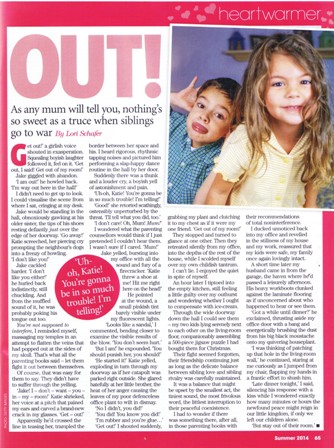
I absolutely love this story. I think it’s one of the funniest things I’ve ever written and I’m eternally grateful to Australia’s that’s Life! Fast Fiction Quarterly for publishing it in their Winter 2013 issue. Unfortunately, they had to edit out some of my best lines for length and content, and I didn’t think the published version was quite as good as the original. I did, however, think the picture and blurb they posted with it were hysterical. As the rights have now reverted to me, for the curious, here is the full original story:

FUNERAL FOR CHARLIE

Charlie was dead. It was hard to say what had done him in, but given that his roommates Rusty and Redhead had passed away unexpectedly the week before, my husband suspected environmental causes. Not me, though. I suspected Fishy.

The teeniest of all of our goldfish, Fishy had outlived not merely several new fish, but several entire sets of new fish, of a variety of breeds and sizes. We had often remarked on the unquenchable virility which seemed to sustain his minute form while our other fish went belly-up all around him. When poor Charlie got sick, he took to lurking in a corner of the tank, scarcely flapping his large fins, not moving, not eating; barely even breathing. We had watched him anxiously for days before the end. That night I had slept restlessly. Waking up long before dawn and failing to fall back into sleep, I finally got up and went into the kitchen to fix a glass of warm milk. Flicking on the light by the fish tank, I was startled to discover that Fishy had taken up residence in Charlie’s corner, and was, as nearly as a fish can, sitting on Charlie’s head as if trying to smother him. He quickly swam away but it was too late; I had already seen him. And the next morning, Charlie was dead.

I couldn’t prove anything, of course. But I did examine the body pretty carefully when Bob brought it sadly to the surface in the fraying green net, and it seemed to me as if Charlie was missing an awful lot of scales for a domestic goldfish. There were also some detectable gouges on his underside, almost as if he had been fighting. But it was pretty hard to pin anything on Fishy. He swam about as enthusiastically as ever in his empty tank, now entirely bereft of playmates, but not appearing to suffer from either loneliness or a renewed sense of his own mortality. And if he looked with fond or melancholy recollection at the plastic bridge that Charlie used to like to hide behind, or the fake coral that his brothers had favored, it never showed in his face.

“I’ll be right back,” Bob said, holding his hand under the wet mesh to prevent drips from falling all over the floor.

“Wait, where are you taking him?” I asked, alarmed.

“Um, to the toilet?” he replied, as if it were a stupid question.

“Charlie’s not going to fit down the toilet!” I answered indignantly.

“Sure he will!” Bob assured me. “He’s no bigger than a turd.”

“Are you crazy?!! He’s at least twice as big around as a turd!”

“Not my turds!” Bob answered proudly. “And if those will go down the toilet, this goldfish will, too, you’ll see.”

“Okay,” I said, trying hard to comprehend why we were arguing over this, “Okay, let’s just suppose that Charlie really is no bigger than a turd. He’s still not a turd, he’s a fish. A turd breaks up in the water; a dead fish will not. He will get stuck halfway down the pipe and you will be stuck trying to plunge up dead fish.”

“Listen, sweetheart,” Bob said, his tone bearing none of the affection implied by the term, “I’ve fixed plenty of toilets in my day, and I know how big the opening in the pipe is. That fish is going down, mark my words.”

I marked them and followed him into the bathroom. I bowed my head as he plunked our deceased friend respectfully into the deep. I listened quietly as he somberly activated the flusher. And then I watched as the water swirled away, taking Charlie on one final miraculous journey to the home of his ancient ancestors, to the ocean the abrupt end of his short life had precluded him from ever going to see. And then I flushed again for good measure.

It didn’t take. The water backed up into the toilet, causing Bob to flush again, full red in the face this time.

“He didn’t go all the way down,” I observed.

“There’s probably something else stuck in there,” Bob reasoned.

I made hissing noises that can’t be translated into words before finally spluttering, “That fish is stuck in the toilet! Do you hear me?! Stuck in the toilet. There is a dead fish in our toilet!”

“He can’t have gotten stuck; he was too small. And even if he did, I’m sure he’ll break loose and go down eventually.”

“Break loose? Break loose eventually? No way, uh-unh, mister. I am not peeing on that toilet knowing that Charlie’s in it. And we don’t even know where he got stuck. What if a rotten fish comes popping back up into the bowl?”

“That’s unlikely,” Bob assured me.

“Darn right it is,” I answered huffily. “Because you’re going to get that fish out of the toilet no matter what you have to do. And you know why? Because it’s your fault he’s in there.”

I resolutely returned to the kitchen, accompanied by the comforting cadence of Bob’s creative cursing and the gruesome gurgling of the plunger as it sought to resurrect the unfortunate former member of our household from his watery grave. I sidled nonchalantly over to the fish tank. Fishy was still nibbling a leftover bit of his solitary breakfast, flicking his tail-fin contentedly, his conscience apparently as untroubled as the calm unruffled waters which now surrounded him.

“I know it isn’t really Bob’s fault,” I conceded, now that he was out of earshot. “It’s yours. You may have gotten away with it this time, but now I’m on to you. And you know what else? Charlie might not have fit down the toilet, but there’s no question in my mind that you’ll go down quite nicely. One day, one day, Fishy… whoosh!!” I threatened.

Fishy just spat out his chip of orange fish food and swam carelessly away.

***

I have to offer full credit to boyfriend “Bob” on this one for unintentionally providing most of his own dialogue. In spite of all of the evidence to the contrary, he persisted in refusing ever to admit that Charlie just didn’t fit down that pipe.

We did, however, mutually agree to stop buying fish after that.

***

“Funeral for Charlie” is one of the stories featured in my autobiographical short story and essay collection Stories from My Memory-Shelf: Fiction and Essays from My Past (only $0.99 Kindle, $5.99 paperback). To learn more about it, please visit the book’s webpage or subscribe to my newsletter.
That's Life Fast Fiction Quarterly Publication and Author Commentary: Funeral for Charlie