http://flashfictionmagazine.com/blog/2014/06/09/the-autocrat/


Are you big and beautiful? Would you like an opportunity to be featured as an eBook cover model? Submit your image for the chance to be selected for the cover of my upcoming erotica eBook, Me and Fat Marge!
Me and Fat Marge is an erotic short story that’s probably unlike any other work of erotica you’ve ever read. Yes, it is sexually explicit, but it’s written in my trademark style, which I call erotica with a sense of humor. This brief (non-explicit) excerpt ought to give you the general flavor:
“Thanks, honey,” Brent says placatingly. “But you know I can’t do that again so soon, right?” He lays a hand on his wiener and flops it helplessly towards her, its magnificent purple splendor reduced now to the color and consistency of a very fat earthworm. It’s not the most appealing sight, but Marge keeps staring at it as if it’s the gourmet concoction she’s been yearning for all along.
“More!” she insists.
Still interested? Great! My plan was to release this as a free eBook on Amazon and other outlets in order to generate exposure for my novels. But when I started thinking about what I was going to do for a cover, it occurred to me – Hey! Why not also make the cover an opportunity for someone else to expose themselves? (Pun totally intended.)
So here’s the deal. You provide the digital image and give me an unrestricted license to use it for this project. In return, I promise to promote you on my website, on my social media channels, and in the eBook itself, where, if desired, I will include links to your social media profiles and your bio, which I will be happy to edit for you if it needs polishing. There will also be an opportunity for the model whose image is selected to do a reading of the story for my YouTube channel should she wish to do so.
As I intend to release this as a free eBook, I can’t offer you monetary compensation for use of your image. However, it will give you some great exposure and a really cool credit to add to your resume, which could be incredibly useful if you’re seeking work as a model or actress or just need a little something extra to beef up your portfolio. And entering the competition will require very little effort on your part – you may simply email your name and the image you would like to use to me at lorilschafer(at)outlook(dot) com and I will select the winner from among those who enter.
I should mention that I have no conception of what Marge should look like, or even what kind of pose she should occupy, although I’m imagining that most likely she’ll be reclined. My advice is to read through the story and see what it inspires. You can read the entire piece here, where it was originally published in the very cool Erotic Review Magazine:
http://eroticreviewmagazine.com/fiction/2273/
Bear in mind also that your image will need to be of a high enough quality to work as an eBook cover, so the resolution has to be pretty good. In addition, you will have to certify that you own the rights to license it, so likely you won’t be able to re-use an image you’ve sold elsewhere. And, of course, since it will appear on Amazon and other publicly accessible websites, it must also be suitably tasteful – provocative but lacking outright nudity.
If there’s sufficient interest, I may even turn this into a full-fledged feature on my website so that I can promote and display the photos of everyone who enters. If it goes well, I may also want to do similar promotions for some of my other upcoming short story eBooks, such as The Hannelack Fanny; Or How I Learned to Stop Worrying and Love My Rump (I’ll let you imagine what kind of picture I’ll be looking for there).
Feel free to email me at lorilschafer(at)outlook(dot)com with any questions you may have. I will actively be promoting my model search on Twitter if you wish to follow me there @LoriLSchafer. I look forward to seeing your photos – and hopefully finding the new face of one of my most unique – and personable – story characters, Marge!

Are you an author with a blog? Would you like to participate in a writing process blog hop?
It’s simple! Here’s what you would need to do:
1) Send me a short bio and a link to your blog.
2) On June 16th I will link to your blog from my blog in a blog post like that described in step 3.
3) On June 23rd you do the following:
a. Link back to my blog with the bio information below saying I am the one who introduced you to the blog hop.
b. Answer these four questions about yourself in that blog post:
i. What am I working on?
ii. How does my work differ from others of its genre?
iii. Why do I write what I do?
iv. How does your writing process work?
c. At the bottom or your blog post give the bio and link to three other bloggers/authors you’ve found – this will continue the chain.
Here is my bio and website information:
Lori Schafer is a writer of serious prose and humorous erotica and romance. More than thirty of her short stories, flash fiction, and essays have appeared in a variety of print and online publications, and her first novel, a work of women’s fiction entitled My Life with Michael: A Story of Sex and Beer for the Middle-Aged, will be released in 2015. Also forthcoming in 2015 is her second novel Just the Three of Us: An Erotic Romantic Comedy for the Commitment-Challenged. On the more serious side, her memoir, On Hearing of My Mother’s Death Six Years After It Happened: A Daughter’s Memoir of Mental Illness, will be published in October 2014. When she isn’t writing (which isn’t often), Lori enjoys playing hockey, attending beer festivals, and spending long afternoons reading at the beach.
If you’re interested, please e-mail me at lorilschafer(at)outlook(dot)com to confirm. I will take the first three authors to respond. I look forward to learning more about you!

He’s going to hop any minute now… I can tell.
I am participating in Diane DeBella’s #iamsubject project http://www.iamsubject.com/the-iamsubject-project/. Here is my #iamsubject story.
ON WRITING MY MEMOIR
I forgot her.
I hadn’t intended it. I didn’t mean to forget, or to set her aside. I didn’t plan to consign her to the fog of some distant past, or to the blur of some hazy future. I had no plans for her at all. I didn’t even realize that she was missing. I did not know that she had been forgotten.
About a year ago, this young woman I had banished from my memory returned without warning. I know what prompted it. I found my mother’s obituary online. She had died, without my knowing it, six years before.
My mother was gone. Her insanity and the cruelty to which it drove her would lie forever buried, vanquished by the final failure of her physical being; she would never return. But that young woman would.
She came to me first in the guise of a story. Not a memory, but a story, a short piece of fiction that bore a striking resemblance to a vague recollection I had of her life. It wasn’t true. It wasn’t real. How could it have been?
A short time later, she came again, with another story to tell. To quiet her, once more I put her in fiction. But I didn’t examine her character closely. She couldn’t bear examination, and neither could I. Still, she kept coming. She appeared before me month after month, in story after story, until suddenly I realized that the stories were no longer fiction. They had diverged unexpectedly into other forms, into nonfiction and narratives, essays and vignettes. Short bursts of truth expunged onto paper.
They meant little at first. A memory here, an incident there. Never very personal, and never very real, at least not to me. Events that had indeed transpired, but in another woman’s life. Not in hers, and certainly not in mine.
I continued to write them down nonetheless. They were compelling, these bits and pieces of someone else’s past. Some of them sad. Some of them frightening. But after a time it hurt, telling her stories. It was no longer merely an exercise; I began to feel it, someplace inside. Someplace I had forgotten I still kept inside.
They were horrible stories. A mother’s psychosis. A daughter’s terror. Stories of pain and isolation, of threats and violence. Stories of a woman who needed help and never knew it; stories of a girl who cried for help and never received it. Stories of hunger and homelessness, of the ever-present fear of capture and the deathly slow torture of starvation. Stories of a runaway shivering through cold autumn nights filled with loneliness and desolation. It pained me to tell them so I stopped. I had forgotten that girl and her stories two decades before. What sense was there in bringing them back now?
I put them away. But I could not put her away. She would not go quietly, as she had twenty years before, when, more than anything, I had needed to leave her behind. This time she stayed; this time she waited. Until I was ready to tell the rest of her story.
It happened unexpectedly one spring afternoon, just a few weeks ago, when the sun was shining brightly and a stiff breeze was blowing across the rooftop where I like to do my writing. The last six thousand words, the ones I had been holding back, the ones that told the rest of her story. Not of what had happened to her. That I had told already, the factual version, a clinical history of severe mental illness. No, these words finally revealed how I felt about it, of what it meant to me, deep down in places I don’t care to explore. How sorry I am for her pain. How deeply I feel for her, that young woman whose life took such dreadful and devastating turns. How deeply I feel for me, for having to remember. For how much it hurts me to remember.
I found myself weeping as I typed, weeping over a long-distant past, the words blurring before my eyes as, for the first time in twenty-some years, she came sharply into focus, that girl that used to be me. How hard it is to hurt for someone else. How much harder still, to hurt for yourself.
I had tucked her away into the deepest recesses of my mind, into the darkest corners of my heart, that unfortunate young woman I once knew so well, so intimately, that I could not have distinguished between her and me. I thought I could leave her behind, as I had left my family behind; thought I could forget, get by without her.
But that day on the rooftop with the sun warming my face and the wind whipping away my tears, I knew this could not be. I had lost a vital piece of myself, of who I am and who I was. I had to reclaim her, to re-forge the connection between her and me, to integrate us, the former she and the current me.
The following day I added the final segment to my memoir. It depicts perhaps the most important part of our journey together because it’s the story of our transition, from her into me. The story of how a dauntless young woman somehow managed to dig her way out of a hole of despair, to hold onto hope in a sea of hopelessness, to fight a battle she had little to no chance of winning. Because what I discovered, when I opened the door to let her back into my life, was that much of my strength lies not with me, but with her. And as I find myself facing a new set of trials I finally understand how much I need her, how firmly I must grasp hold of the young woman I used to be, for she, more than I, has the power to persevere, to overcome, to survive.
Perhaps I do not like the memories she brings. Perhaps I would prefer to allow her to settle quietly into the dust of my personal history, to let her remain forever buried, as my mother is now. But with her inside me I need not shy away from fear, from pain. She copes with fear. She handles pain. She is, and always has been, subject.
I cannot be subject without her. But together, we can be.
***
Update: I am thrilled to announce that my essay “On Writing My Memoir” has been selected for inclusion in Diane DeBella’s I Am Subject anthology! Please click the image below or visit iamsubject.com to learn more.
For more information about my memoir On Hearing of My Mother’s Death Six Years After It Happened: A Daughter’s Memoir of Mental Illness – available November 7th in paperback and audiobook, and available now for Kindle pre-order – please click the image below or visit the book’s webpage.
Hey, that’s my story! :)
Our best friends were having a baby. Inwardly, I groaned.
“You know what this means, Frank?” I complained to my boyfriend. “They won’t be going out with us anymore.” One by one our friends had succumbed to the bothersome burdens of boring adulthood: first marriage, now children. Soon only Frank and I would be left gloriously unencumbered.
“Sure they will,” he reassured me. “It’ll just be earlier. And, um, noisier.”
He should know. His sister had a kid, a rambunctious pre-school aged brat with no redeeming qualities that I had ever observed. Frank volunteered to baby-sit every so often. I called this my quarterly booster of birth control. Each time his nephew arrived I wanted children even less.
Frank, I suspected, was a bit soft on the kid thing. He seemed to like children an awful lot for someone who claimed not to want any. Once he had even told…
View original post 933 more words
I found this recently in a filing cabinet. I wrote it when I was seventeen – can you tell? ;)
I am posting it for Opinionated Man’s HarsH ReaLiTy challenge: http://aopinionatedman.com/2014/05/25/harsh-reality-challenge-got-an-opinion/. Enjoy!
***
“Freedom’s just another word for nothing left to lose… It ain’t nothin’ honey, if it ain’t free.” – Me and Bobby McGee
Freedom is choice. There are always choices, even the choice of death. Force need never override the strength of one’s will or belief; it is a matter of importance, priority. Which is better, submission and self-treachery, or death with honor and truth? Who is “right,” the terrorist who murders others for freedom, or the kamikaze who kills himself for the freedom of others? I say neither. That’s not what liberation is meant to be.
Freedom is lack of fear, lack of the chains that bind our human hands to the rocks that lie trapped in the walls of Platonian caves miles beneath the earth’s surface. Within true freedom hide the gods, the gods of the souls of man. I might be an anarchist, but I do not believe in the laws of today. They are unreal; they must become unnecessary, natural, unforced, unimposed by the fears of the powerful. Liberty needs no rules nor restrictions. The frightened ones gasp – visions of murder, theft, rape, etc. consume their reason. Because detachment from authority alone cannot defeat crime; people must learn also to lose their own limitations. For it is secret fear and enforced convention that create violence; revenge on the species is the only release for the constrained mind. I may be an idealist, but I believe that only “good” is born of freedom; growth and achievement are its offspring. But detachment from the impositions of authority is not the whole; people must also let go of themselves.
Freedom is a necessity for the survival of everyone, everything. Bondage suffocates the spirit. Freedom is self-awareness. With understanding, the “unknown” shrivels, our fear of it vanquished. Magic is performed when fear is surpassed and chances and risks are taken and tried. In great art and poetry exist no boundaries, no need for limitations on expression, no repression. Freedom is total experience with all levels of reality, experimentation with its parameters. Yet physicaly, the drives for food, drink, sex, etc., must not be denied in the interests of metaphysical consciousness. The body permeates and reflects all of our existence and cannot be ignored; self-control must not force even the unusual impulsion into the cracked mold of confused convention.
Personal liberty is the solution to and elimination of the trials of the “civilized” world; in fact, it is the only goal worth the struggle. I could be ignorant, but I believe that society does not even recognize true freedom. Sadly, only those with “nothing left to lose” may attempt it, for rejection, humiliation, and scorn follow on the heels of real absolution. People will not accept what they fear.
So that’s me. That’s what I think; that’s what’s important to me. I could have taken this space to write about my class rank, or my College Board scores, or my extracurricular activities. All of which mean something. But humanity is humanity because of knowledge, and my thoughts are what distinguish me from every other primate. And I think – no, I know that freedom is life, and I cherish every second of it I have ever discovered. The nation, the world, the universe, is waiting to live and be free. And the whole of my being is devoted to the cause.

Hess, Rudolf, Commandant of Auschwitz, tr. Constantine FitzGibbon, World Publishing Company: Cleveland and New York, 1951.
Commandant of Auschwitz combines the autobiography which Rudolf Hoess wrote while awaiting trial at Nuremberg as well as a number of official statements he gave to his interrogators regarding other SS personnel with whom he had significant contact. There is a lot I could say about this book, because Hoess, rather surprisingly, has a number of interesting ideas and observations, particularly in regards to the concept and execution of imprisonment and the lesser-known victims of the concentration-camp system, but for the moment I’ll confine myself to what he has to say about conducting the affairs of Auschwitz.
Hoess makes no bones about his political beliefs; he unwaveringly avers his continued allegiance to the Nazi Party, and, unlike many Nazis, who denied complicity with the concept behind or execution of the Holocaust, even suggests that he would have been in favor of it were it vital to the cause:
“Whether this mass extermination of the Jews was necessary or not was something on which I could not allow myself to form an opinion, for I lacked the necessary breadth of view.” p. 160.
However, what is most fascinating about the book is that as it progresses, it becomes clear that Hoess was, generally speaking, against the customary Nazi treatment of the Jews, not out of compassion for their situation or any sense of wrongdoing in causing their suffering, but for purely bureaucratic reasons.
Thus he complains about the nature of the site, which lacked sufficient water, drainage and building materials for the size it was later to assume; he argues against the massive overcrowding, which caused disease to run rampant and had terrible psychological effects upon the inmates, which he believed led to rapid deterioration in their health; against the incompetence and maliciousness of the guards under his control, whose approach to corporal punishment he felt was detrimental to the objective of maintaining peace in the camp while it conducted its operations. He berates the Food Ministry for constantly reducing rations during the course of the war, not because he had pity for the starving concentration-camp dwellers, no, but because it prevented him from maintaining an adequately-functioning work force. The selection process itself, he argues, was faulty at its core:
“If Auschwitz had followed my constantly repeated advice, and had only selected the most healthy and vigorous Jews, then the camp would have produced a really useful labor force and one that would have lasted.” p. 176.
The implication is that more Jews should have been sent immediately to the gas chambers rather than being corralled into the work details if the goal of attaining adequate war-workers was to be achieved. In other words, if Hoess had had his way, the concentration camps would have contained a large contingent of healthy, well-fed Jews and many more dead ones.
Hoess relates anecdotes of the desperate starvation of the camp residents; of inmates being attacked and beaten by their fellows for a crust of bread, of cannibalism among Russian prisoners-of-war. He assures us that his war-time prisoners became little different from civilian criminals, unhesitant to sacrifice their fellows in order to improve their own condition; in order to get an edge on survival. He speaks of the attachment of the Jews to the members of their own families; of the efforts of the mothers to calm their children as they walked into the gas chambers or to throw them out of the doors, pleading for their young lives, just before they are sealed. And then he tells a story of one Special Detachment Jew who had been assigned to the burning of corpses. When the man pauses for a moment in the course of his labors, Hoess inquires of the Capo in charge as to the cause. The Capo informs him that one of the dead in the pile is the man’s wife.
But following his moment’s pause, the man has already gone back to work. And that is when it struck me, that in spite of the distinction between the powerful and the powerless, what a terrible similarity exists between the Commandant and the prisoner. The Commandant does not deal with people; he deals with issues, problems, supply chains, bureaucracy. He is almost entirely detached from the suffering of those under his care. And likewise the inmate has detached himself from his own suffering; he is unable to acknowledge or permit it to penetrate him. Instead he merely attends to his work, the work that, ironically, makes him free, even as the sign above the gate so illusively promised. Detachment means survival; and the ability to detach oneself from one’s circumstances is perhaps a necessary adaptation. For as long as people are able to view one another without acknowledging their humanity, their personhood, they will treat their fellows cruelly. And in order to endure that cruelty, those who suffer from it will have to become like their oppressors: empty of compassion and feeling, intent only on bare survival.
It is now well-known that many Nazis who were recruited into concentration-camp or extermination services were unable to endure it; indeed, many were transferred, upon request, from participation in the brutalities that accompanied occupation and deportation into other branches of service. Considerable care and effort were expended in making exterminations tolerable for the executioners as well as their victims; as horrendous as the mass gassings were, they were viewed as more humane, less wearing on the soul than the mass shootings which had theretofore been employed. Hoess describes how numerous of his subordinates approached him, expressing deeply-troubled thoughts over the mass exterminations; how he deemed it his duty to appear unmoved. Not all of the Nazis were able to view their captives as chattel, as mere bodies to be fed and housed and employed and killed and burned, any more than some of their victims were able to forget the essential humanity of their captors. Consider Hoess’ description of the Allied air raids, which brought terror to the skies over Germany and the occupied lands:
“Attacks of unprecedented fury were made on factories where prisoners were employed. I saw how the prisoners behaved, how guards and prisoners cowered together and died together in the same improvised shelters, and how the prisoners helped the wounded guards.
During such heavy raids, all else was forgotten. They were no longer guards or prisoners, but only human beings trying to escape from the hail of bombs.” p. 183.
Humans, one and all. Hoess is not one of the Nazis who viewed the Jews as somehow less than human, and therefore worthy of extinction. He sincerely believes that they were a threat to what he sees as the truly German way of life, and that the measures that were taken against them were necessary in order to preserve the integrity of the nation. He is therefore offended by the vicious propaganda propagated by publications such as Der Stürmer, believing its exaggerated attacks upon Jewish morals and behavior capable of backfiring and creating sympathy for the Jews. He argues that the nations conquered by Germany during the Second World War should have been treated with greater respect and kindness, which would have unmanned much of the resistance which grew following the invasion. And finally, in the ultimate expression of utter disregard for the unadulterated evil imposed upon the unoffending peoples of the world, Hoess at last concedes that the Holocaust should not have occurred. But listen to his reasons why:
“I also see now that the extermination of the Jews was fundamentally wrong. Precisely because of these mass exterminations, Germany has drawn upon herself the hatred of the entire world. It in no way served the cause of anti-Semitism, but on the contrary brought the Jews far closer to their ultimate objective.” p. 198.
The Holocaust was wrong, according to Hoess, not owing to fundamental human principles of kindness and decency, or compassion for one’s fellows, but because it did not serve the Nazi cause. Which eerily implies that he believes that it would have been “right” had it only served the purpose for which it was intended. Is that, too, an essentially human characteristic? To be able to justify the means, if they achieve what is perceived to be a desirable end?

Lithograph by Leo Haas (1901-1983), Holocaust artist, who survived Theresienstadt and Auschwitz. From the Center for Jewish History – no known copyright restrictions.
My humorous short-short “Funeral for Charlie” is now up on Story Shack Magazine:
http://thestoryshack.com/short-stories/comedy/funeral-for-charlie/
For those of you who are unfamiliar with Story Shack Magazine, it’s a daily flash fiction site operating under a very cool premise. If they accept your story, they will team you up with an illustrator to do an original drawing for it!
This time I was fortunate enough to receive custom artwork by artist Daniele Murtas (http://dmurtas.blogspot.com/). Hope you enjoy it!

“I watched as the water swirled away, taking Charlie on one final miraculous journey to the home of his ancient ancestors, to the ocean the abrupt end of his short life had precluded him from ever going to see…”
***
“Funeral for Charlie” is one of the stories featured in my autobiographical short story and essay collection Stories from My Memory-Shelf: Fiction and Essays from My Past (only $2.99 Kindle, $6.99 paperback). To learn more about it, please visit the book’s webpage or subscribe to my newsletter.
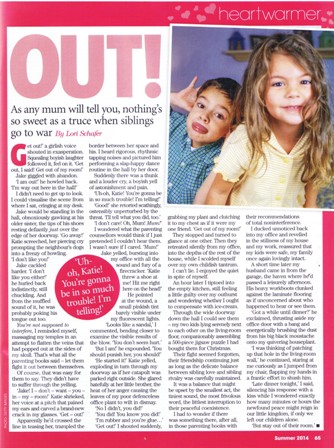
“Out!” appeared in the Summer 2014 (Australian summer) issue of That’s Life Fast Fiction Quarterly. Tell me what you think!
OUT!
“GET OUT!” a girlish voice shouted in exasperation, unbelievably audible even from across the house, possibly even from across the town. Squealing boyish laughter followed it; fed on it.
“Get out, I said!! Get out of my room!!”
Jake laughed again, louder, nearly giggling with gleeful abandon. “I am out!” he howled back at her triumphantly. “I’m way out here in the hall!”
I didn’t need to get up to look; I could visualize the scene from where I sat cringing at the desk in my office. Jake standing grinning in the hall, gawking at his year-older sister through her open door, the tips of his sneakers defiantly resting just over the edge of her lintel.
“Go away!” Katie yelled, her piercing cry prompting the neighbor’s hounds into a frenzy of agonized howling. “I don’t like you!”
Jake only cackled harder, his small fists slapping like drumsticks against the hollow-sounding sheetrock.
“I mean it!! I don’t like you!”
“I don’ wike you eiver!” he hurled back indistinctly, still chuckling. From the muffled sound of it, probably poking his tongue out at her.
You’re not supposed to interfere, I reminded myself forcibly, massaging my temples in a futile attempt to flatten the thick, bulging veins that had popped out palpably from the sides of my skull. That’s what the parenting books said; let them fight it out amongst themselves. Easy for them to say, I grumbled internally. They didn’t have to suffer through the screeching.
“JAKE!” Katie shrieked suddenly, her voice rising to a pitch that pained my ears and carved a new crack in my glasses. “I – don’t – want – you – in – my – room!” she erupted, nearly breathless with childish fury and indignation. “Get – out!!” Apparently he’d crossed the line in teasing her; trampled the border between her space and his.
“What?!” he yelled back with mock innocence. “I’m not doing anything!” I heard rigorous, rhythmic tapping noises and pictured him performing a slap-happy dance-routine in the hall by her door.
Suddenly there was a loud thunk and a louder cry, a boyish yell of astonishment and pain.
“Uh-oh, Katie!! You’re gonna be in so much trouble! I’m telling!”
“Good!” she retorted scathingly, ostensibly unperturbed by the formidable threat. “I’ll tell what you did, too.”
“I don’t care! Oh no, I don’t! Oh, Mom! Mo-om!”
I wondered what the parenting counselors would think if I pretended I didn’t hear it. I wasn’t sure if I cared.
“Mom!” Jake yelled, bursting into my office with all of the sound and fury of a string of firecrackers going off unexpectedly in the middle of May. “Katie threw a shoe at me! Hit me right here on the head!” He pointed cheerfully at the nasty wound, a small pinkish tint barely visible beneath my fluorescent lights.
“Looks more like a sandal,” I contended calmly, bending closer to examine the visible results of the near-fatal blow. “You don’t seem hurt.”
“But I am!” he expounded happily. “You should punish her; yes, you should!”
“He started it!” Katie yelled, exploding in turn through my doorway as if her catapult was parked right outside. She glared hatefully at her little brother, the hotness of her anger causing the freshly watered leaves of my poor defenseless office plant to wilt in dismay.
“No, I didn’t, you did!”
“Yes, you did, you know you did!”
“I know you are, but what am I?!”
“I’m rubber and you’re glue…”
“GET OUT!!” I shouted suddenly, snatching up my plant and clutching it to my chest as if it were my one true friend. “Get out of my room!!”
They stopped. Turned to glance thoughtfully at one other and hushed. Retreated silently from my office, sadly into the unknown depths of the rest of the house, while I scolded myself over my own childish temper tantrum.
I can’t lie. I enjoyed the quiet in spite of myself.
An hour later I tiptoed gingerly into the empty kitchen, still feeling a little guilty over my impatient outburst and considering whether I ought to compensate with everyone’s favorite dinner and maybe ice cream to boot. Through the wide doorway down the hall I could see them: my two kids lying serenely next to each other on the living room floor, companionably assembling a five-hundred-piece jigsaw puzzle I’d gotten them for Christmas. Their argument as long forgotten as Mom’s unusual fit of anger, their renewed friendship ensured as long as the delicate balance between sibling love and sibling rivalry was carefully maintained. A balance that might be upset by the smallest act, the tiniest sound, the most frivolous word, the most meager interruption to their peaceful co-existence. Maybe they had something there, after all, those parenting books with their recommendations of non-interference.
I ducked unnoticed back into my office; returned to the smooth stillness of my walls and my work, reassured that my children were safe, my family once again loving and intact. A short time later my husband came in from the garage, the blissfully quiet haven in which he’d passed his leisurely afternoon, his work-boots clunking hard against the laminate flooring as if entirely unconcerned about who heard or observed them. “We got a while until dinner?” he boomed, thrusting aside the door of my office with a bang and energetically brushing the dust from his big black mustache onto my still-quivering houseplant. “I was thinking of patching that hole in the living room wall,” he continued, staring at me curiously as I leapt from my rocking, rolling chair, waving my hands incomprehensibly in a frantic effort to shush him.
“Late dinner tonight,” I whispered, silencing his half-uttered response with a kiss while I wondered how many minutes or hours the newfound peace might reign in our little kingdom if only we left our children alone. “But stay out of their room.”




 Lori Schafer's Short Subjects I Feel Like Writing About