Tag Archives: memoir

My Writing Process: The Roof is the Place to Work!

Greetings, and welcome to the writing process blog hop! I was introduced to this blog hop by Author S. Evan Townsend:

S. Evan Townsend has been called “America’s Unique Speculative Fiction Voice.” After spending four years in the U.S. Army in the Military Intelligence branch, he returned to civilian life and college to earn a B.S. in Forest Resources from the University of Washington. In his spare time he enjoys reading, driving (sometimes on a racetrack), meeting people, and talking with friends. He is in a 12-step program for Starbucks addiction. Evan lives in central Washington State with his wife and has three grown sons. He enjoys science fiction, fantasy, history, politics, cars, and travel. He currently has five published fantasy and science fiction novels.

http://blog.sevantownsend.com

Like the other participants in this blog hop, I’ve answered four assigned questions about my writing and how my writing process works. Please also take a moment to visit authors Jayne Denker, Briane Pagel, and Elise Abram, whose bios and links are at the end of this post. They will be answering the same questions next week.

1. What am I working on?

What am I not working on? ;)

But seriously, I have a variety of projects in the hopper. I’m putting the finishing touches on my memoir On Hearing of My Mother’s Death Six Years After It Happened: A Daughter’s Memoir of Mental Illness, which is being published in October. I’m 40,000 words into a new romance, a sequel to Just the Three of Us, which I’m hopeful will be just as sweet and funny as the original, and 120,000 words into my mega-monster of a novel Shipwreck Island: How One Woman Spent Twenty Years on an Island with Sixteen Sailors and Lived to Tell the Tale, which, frankly, is probably only about half done.

Although I’m not able to spend as much time on short work as I would like, I’ve also got twenty or so shorter pieces out on submission, and I’m preparing several e-book compilations of short stories and essays in a variety of genres, which I hope to release independently before I go out of town later this summer. In August and September, I’m planning a lengthy road trip across the United States and Canada, during which time I will be beginning my second memoir, The Long Road Home, the idea for which was inspired by this trip.

2. How does my work differ from others of its genre?

Easy – it doesn’t fit neatly into any genre. My novels have too much sex to be women’s fiction, too much humor to be erotica, and too few alpha males to be romances. But they’re entertaining nonetheless, and I like to think that rather than forcing my work to conform to a specific genre, maybe I can instead gently nudge the accepted conventions in new directions.

Now that I think of it, though, my memoir also suffers from some genre confusion, as segments of it are written as if they’re fiction. There are good reasons why I wrote it that way, as I explain in my book, but I suppose it also doesn’t read like typical nonfiction.

3. Why do I write what I do?

I don’t think about that very much – I just write what comes to me. My novels became novels because they were such big, long ideas, involving in-depth characterization and fairly complex plots. When I have shorter ideas, they become flash fiction or short stories. Of course, I’m sure it’s no coincidence that my longest works revolve around relationships and sex – which seems to be mostly what I’m into right now – but I can easily see that changing as time passes and I become interested in other things.

My memoir actually began quite unintentionally. I had composed a number of short pieces – fiction and essays – depicting certain events in life with my mother, who became violently mentally ill when I was sixteen. At some point it occurred to me that it might be interesting to tie them together somehow – with a frame story, if you will. I’ll admit I was fairly stunned when it came together the way it did – it wasn’t something I had expected to write.

4. How does your writing process work?

It’s constantly in flux. I believe quite firmly that forcing myself to work on something when I’m not in the mood for it is not the pathway to greater productivity. You will never catch me committing to a certain number of words or hours per day, and I will likely never participate in NaNoWriMo or similar events. If I feel like writing, I write; if I feel like editing, I edit; if I feel like working on my latest novel, I do; if I feel like writing a blog post, I do that instead. There are always so many things I’m working on – and so few strict deadlines – that I rarely feel obligated to go against my mood, which I believe is one of the reasons I’ve been able to generate so much work in the past two years. Every so often I have to force myself to forego writing in order to complete “administrative” tasks, and that’s the one time my natural sense of discipline and New England work ethic have to kick in and make me do things even when I don’t want to. But I do enjoy the satisfaction of metaphorically crossing those types of tasks off my list, and I’m always happier afterwards to go back to writing.

In terms of how I write, I’m all over the place. A short piece I will generally compose from beginning to end, with at least half a dozen revisions before I’m happy with it. My books I’ve mostly started in the middle, writing individual scenes when I feel inspired to do them, and simply positioning them in the text in the order I plan for them to appear, so that I can tie them together later. When I get to about a hundred pages, I go back to the beginning and start revising, editing and adding new material as I go along, the end result being that I never really complete a “rough draft.” After I finish another hundred pages or so, I’ll go back and do the same thing, from start to finish, which means that different sections of my manuscript will often be at different stages of polish. Some chapters I will intentionally not complete because I haven’t yet decided exactly how they’re going to go, while others might be virtually in their final form very early on in the process. And then of course when the whole thing has been written from start to finish, I go through it several more times, picking out awkward sentences and those that could be funnier, more clever, or more meaningful or poignant, and re-working them accordingly.

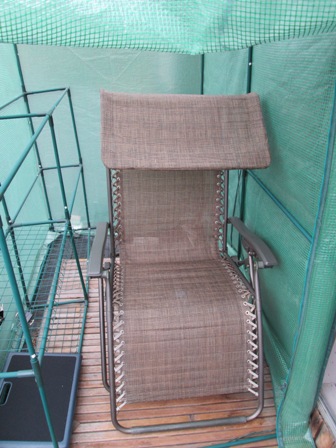
This is where I usually work:

Writing Process I

???????????????????????????????

Last year I bought this stand-alone greenhouse that’s bolted down to a small deck on the one flat part of the roof. As long as the sun’s out, it stays comfortably warm in there, even in winter. This is wonderful for me because I do prefer to work outdoors, and besides that, it gives me a natural schedule – mornings and evenings are for desk work, afternoons are for writing. There’s a power outlet right by the window where I can plug in my laptop, and that chair is pretty comfortable – although I do end up spending quite a sum on sunscreen! So, if you’re ever flying over the Bay Area and you spot a strange green contraption perched on a rooftop for no apparent reason, give me a wave! You’ll know that I’m hunkered down inside, generating my next – well, whatever it’s going to be! :)

Please take this opportunity to check out these three authors, who will be blogging about their writing processes next week!

Jayne Denker:

Jayne Denker divides her time between working hard to bring the funny in her romantic comedies (By Design; Unscripted; Down on Love, A Marsden Novel #1; and the upcoming Picture This, A Marsden Novel #2, publishing July 17) and raising a young son who’s way too clever for his own good. She lives in a small village in western New York that is in no way, shape, or form related to the small village in her Marsden novels. When she’s not hard at work writing another book, the social media addict can usually be found frittering away startling amounts of time on Facebook (Jayne Denker Author), Twitter (@JDenkerAuthor), and her blog, JayneDenker.com.

Blog: http://JayneDenker.com

Briane Pagel:

Briane Pagel is currently writing this biography for this blog. In fact, he’s typing this sentence right now. Now this one. Now he’s thinking this biography isn’t the most compelling one, and that perhaps he should make some stuff up to jazz it up a bit like say he went skydiving one time, only that’s actually true. He did go skydiving this one time, back in 1994, when he made a list of 25 things to do before he turned 26. He completed the list, too. It included skydiving, and the Polar Bear Jump where he had to go into Lake Michigan on New Year’s Day… great, now he’s starting to ramble. You can read more about him on “Thinking The Lions,” http://www.thinkingthelions.com“, and he publishes “lit, a place for stories,” which is an online literary magazine at http://www.nonsportsman.com.

Elise Abram, B.A. B.Ed., M.Ed:

Teacher of English and Computer Studies by day, wife and mother by night and author whenever she can steal some time, Elise is the proud author of Phase Shift, The Mummy Wore Combat Boots, and Throwaway Child, available on Amazon and KoboBooks. She pens a blog about literature, popular culture and the human condition whenever the muse moves her.

Elise’s fourth book, a young adult paranormal thriller entitled The Revenant will be released in eBook and in print on July 10, 2014 by Black Rose Writing.

Connect with Elise at http://www.eliseabram.com

Two Fathers: A Portrait from My Youth

He is holding up a clean and empty jelly-glass; bright, colorful cartoon characters chasing merrily around its rim, my long-anticipated reward earned with weeks of peanut-butter sandwiches.

He is hiding behind his dense, secretive mustache, handing me a can of cheap warmish beer, laughing loudly at me tentatively tasting it; spitting it vehemently out.

He is clasping my hand and leading me down the street to the local bar; propping me up on a barstool so all his friends can see, can joke with me and about me while I twirl about on the red vinyl, tall and proud to be out with Daddy.

He is standing at the wire fence, watching me playing in the dirt of our yard, asking, “Is your mother home?” Perhaps not realizing that I don’t recognize him anymore; will have to ask Mom later who that man was, the mysterious stranger who visited her that afternoon and called me by name. Perhaps not knowing that all of my memories of him have already been boiled down to these simple four.

And then he is gone.

***

He sits by himself in the green-painted barn, back of their house, listening to the Italian radio station, smoking his pipe and reading a newspaper, its foreign words and syllables impenetrable runes, like his shadowy face in the dark and tobacco-filled haze.

He defies approach, inspires timidity; despises interruption and declines conversation. They shake to address him; quiver in apprehension, dare only when driven by direst need.

“Bubba? Bubba, can I have five dollars?” the youngest son inquires, cowering, backing slowly away even as he speaks.

Harsh mumbling ensues; the status of the request indeterminable to those waiting anxiously outside.

“To go to the movies? Please, Bubba?”

The mumble metamorphoses into a shout; sends the child scurrying away from the barn, out underneath the clutching, hanging vines of the wine-grape trellis, back into the house where his mother waits, her lips pursed, her head shaking sadly.

“Mangia,” she commands kindly, pointing to the table laid with salad and bread and pasta while she fixes a plate for her husband, who will eat, by himself, in the green-painted barn at the back of their house.

***

Originally published in Vine Leaves Literary Journal, April 2013.
© Lori Schafer 2013

“Two Fathers” is one of the pieces featured in my autobiographical short story and essay collection Stories from My Memory-Shelf: Fiction and Essays from My Past (only $2.99 Kindle, $6.99 paperback). To learn more about it, please visit the book’s webpage or subscribe to my newsletter.

***

I originally wrote this story in an effort to create an ultra-short of one hundred and fifty words or less for a contest. I don’t recall what prompted it, but somehow I got to thinking of my biological father and the very few memories I have of him, which, interestingly enough, taken all together, came out to about a hundred and fifty words!

The second segment is about the father of the best friend I had from the time I was four or five until I was about twelve. In the hundreds of times I visited my friend’s house – which, except for the year we spent living in Connecticut, was just across the street from ours – I don’t believe I actually saw the man more than a dozen times, and never once in all those years did he speak to me. Of course, most of the time he was busy working to support their five children, and there was no doubt that he loved his family very much. But as a kid I was only cognizant of the fear.

I also wrote a third segment of this piece about my “main” stepfather – that’s the one I had the longest – but I didn’t really care for the way it turned out so I omitted it. I’m still not sure if I should have included it after all. It certainly would have put a different spin on the piece as a whole, because it was a fairly flattering portrayal of a man who, without being anyone’s biological father, was nonetheless the best father I ever had. Except that in the end, when the marriage dissolves, the stepdad moves away and is never heard from again, and my intent was to make the story evocative rather than melancholy. And at bottom, I think it makes for a better “vignette” without coming to such a resounding conclusion, and that’s what Vine Leaves does best.

Father and Daughter

I am Subject: On Writing My Memoir

I am participating in Diane DeBella’s #iamsubject project http://www.iamsubject.com/the-iamsubject-project/. Here is my #iamsubject story.

ON WRITING MY MEMOIR

I forgot her.

I hadn’t intended it. I didn’t mean to forget, or to set her aside. I didn’t plan to consign her to the fog of some distant past, or to the blur of some hazy future. I had no plans for her at all. I didn’t even realize that she was missing. I did not know that she had been forgotten.

About a year ago, this young woman I had banished from my memory returned without warning. I know what prompted it. I found my mother’s obituary online. She had died, without my knowing it, six years before.

My mother was gone. Her insanity and the cruelty to which it drove her would lie forever buried, vanquished by the final failure of her physical being; she would never return. But that young woman would.

She came to me first in the guise of a story. Not a memory, but a story, a short piece of fiction that bore a striking resemblance to a vague recollection I had of her life. It wasn’t true. It wasn’t real. How could it have been?

A short time later, she came again, with another story to tell. To quiet her, once more I put her in fiction. But I didn’t examine her character closely. She couldn’t bear examination, and neither could I. Still, she kept coming. She appeared before me month after month, in story after story, until suddenly I realized that the stories were no longer fiction. They had diverged unexpectedly into other forms, into nonfiction and narratives, essays and vignettes. Short bursts of truth expunged onto paper.

They meant little at first. A memory here, an incident there. Never very personal, and never very real, at least not to me. Events that had indeed transpired, but in another woman’s life. Not in hers, and certainly not in mine.

I continued to write them down nonetheless. They were compelling, these bits and pieces of someone else’s past. Some of them sad. Some of them frightening. But after a time it hurt, telling her stories. It was no longer merely an exercise; I began to feel it, someplace inside. Someplace I had forgotten I still kept inside.

They were horrible stories. A mother’s psychosis. A daughter’s terror. Stories of pain and isolation, of threats and violence. Stories of a woman who needed help and never knew it; stories of a girl who cried for help and never received it. Stories of hunger and homelessness, of the ever-present fear of capture and the deathly slow torture of starvation. Stories of a runaway shivering through cold autumn nights filled with loneliness and desolation. It pained me to tell them so I stopped. I had forgotten that girl and her stories two decades before. What sense was there in bringing them back now?

I put them away. But I could not put her away. She would not go quietly, as she had twenty years before, when, more than anything, I had needed to leave her behind. This time she stayed; this time she waited. Until I was ready to tell the rest of her story.

It happened unexpectedly one spring afternoon, just a few weeks ago, when the sun was shining brightly and a stiff breeze was blowing across the rooftop where I like to do my writing. The last six thousand words, the ones I had been holding back, the ones that told the rest of her story. Not of what had happened to her. That I had told already, the factual version, a clinical history of severe mental illness. No, these words finally revealed how I felt about it, of what it meant to me, deep down in places I don’t care to explore. How sorry I am for her pain. How deeply I feel for her, that young woman whose life took such dreadful and devastating turns. How deeply I feel for me, for having to remember. For how much it hurts me to remember.

I found myself weeping as I typed, weeping over a long-distant past, the words blurring before my eyes as, for the first time in twenty-some years, she came sharply into focus, that girl that used to be me. How hard it is to hurt for someone else. How much harder still, to hurt for yourself.

I had tucked her away into the deepest recesses of my mind, into the darkest corners of my heart, that unfortunate young woman I once knew so well, so intimately, that I could not have distinguished between her and me. I thought I could leave her behind, as I had left my family behind; thought I could forget, get by without her.

But that day on the rooftop with the sun warming my face and the wind whipping away my tears, I knew this could not be. I had lost a vital piece of myself, of who I am and who I was. I had to reclaim her, to re-forge the connection between her and me, to integrate us, the former she and the current me.

The following day I added the final segment to my memoir. It depicts perhaps the most important part of our journey together because it’s the story of our transition, from her into me. The story of how a dauntless young woman somehow managed to dig her way out of a hole of despair, to hold onto hope in a sea of hopelessness, to fight a battle she had little to no chance of winning. Because what I discovered, when I opened the door to let her back into my life, was that much of my strength lies not with me, but with her. And as I find myself facing a new set of trials I finally understand how much I need her, how firmly I must grasp hold of the young woman I used to be, for she, more than I, has the power to persevere, to overcome, to survive.

Perhaps I do not like the memories she brings. Perhaps I would prefer to allow her to settle quietly into the dust of my personal history, to let her remain forever buried, as my mother is now. But with her inside me I need not shy away from fear, from pain. She copes with fear. She handles pain. She is, and always has been, subject.

I cannot be subject without her. But together, we can be.

***

Update: I am thrilled to announce that my essay “On Writing My Memoir” has been selected for inclusion in Diane DeBella’s I Am Subject anthology! Please click the image below or visit iamsubject.com to learn more.

For more information about my memoir On Hearing of My Mother’s Death Six Years After It Happened: A Daughter’s Memoir of Mental Illness – available November 7th in paperback and audiobook, and available now for Kindle pre-order – please click the image below or visit the book’s webpage.

How Many Times Do I Have to Rewrite This %$^&# Thing?! The “Yellow Wagon” Saga

My flash fiction story “Yellow Wagon” has been published in Every Day Fiction:

http://www.everydayfiction.com/yellow-wagon-by-lori-schafer/

What a journey this story has taken! The final published version of this piece at the link above ended up being twice the length of the original (reproduced following this essay). The editors at Every Day Fiction were possibly interested in publishing it, except that they didn’t like the idea of “misleading” the reader about the wagon, which is precisely what the original version did. In fact, that was the essence of the story. In addition, they thought the premise itself was unbelievable because I had made Debra a first-grader and the argument was that no parent would permit a child that young to walk to school by herself.

Naturally, this threw me for a loop, because, of course, the child in the story was me, and I was not a first-grader but a kindergartner when it happened. Where I grew up in small-town New England, lots of kids walked to school by themselves. There was no such thing as blue-collar flex time so you could drive your kids to school – and many parents took the bus to work because they didn’t have a car, anyway. However, I was certainly willing to grant that we live in a different time, and that perhaps the premise would seem implausible to modern readers, so I re-wrote it to include details that would make it obvious that the story took place in an earlier era.

They still didn’t like it. The issue remained of Debra not appearing to recognize the wagon, which naturally made little sense in their interpretation of the story. I frankly had no idea what to do about this, because my intention for the piece was entirely at odds with their reading of it. I had been attempting to convey the thoughts and emotions of a little girl who has been given a great new responsibility and is trying very hard to behave herself as her mother would wish. It’s not that she doesn’t recognize the wagon – she merely pretends not to because she doesn’t want her mother to think she’s only being careful because she knows she’s being watched. The whole story development – where she keeps looking anxiously over her shoulder to see if the wagon is still following, how she exaggerates her caution in crossing the street, even her final sprint at the end when the pressure becomes too much for her – centers around this concept. What I thought was clever about it was not the fact that it draws the reader down a false path, but that if you reach the end and look back on it, it turns out that the story details were true and accurate all along. The tension was real – except its source was not the wagon, but the feelings of the little girl.

Anyway, they asked for another rewrite, and suggested that I make the story more about Debra and her mother. I’ll admit that this caused me considerable consternation. On the one hand, it was a challenge, and I’m certainly not one to run from a battle. On the other hand, I had no particular interest in writing the story that way. It just didn’t feel like me. It took me longer to transform this simple vignette into heartwarming family fiction than the original story took to write! I’m not disappointed in the way it turned out, although it is a bit on the sentimental side. But I do still believe the original version has its charms – although I’m willing to concede that I may be the only one who thinks so!

It was, however, an interesting lesson. First, because sometimes it’s easy to forget that what I think is obvious as a writer doesn’t necessarily come across to a reader the way I intended it. Editors are usually right, and if these ones weren’t getting it, chances are pretty good lots of other people would have misread my original story, too. And second, because it was my first real experience writing to someone else’s specifications. I mean, sure, I’ve had to write papers on topics that haven’t particularly interested me – but no one has ever told me how to write them. And ultimately, I feel that this is something I should be able to do, even if I don’t enjoy it very much. As wonderful as it is to exercise total control over my fiction, a writer who knows their craft should have the capacity to create work that someone else defines. So I suppose you might say that I, too, took a journey of transformation – and it’s to be hoped that I came out a better writer at the end of it.

YELLOW WAGON (Original Version)

“Right on Orange, left on Revere,” Debra repeated to herself for the dozenth time, kicking away the crisp dead leaves that snapped at her feet like so many untrained puppies. First grade wasn’t like kindergarten; the teachers got mad if you were late. Her mom would be mad, too, if she got lost along the way.

She reached the end of her street and hung a hard right, ignoring the noise of the engine she heard revving behind her. It was only a block more to the light, and when she reached it she stopped dead, waiting cautiously for the green, both feet planted firmly on the sidewalk, not even touching the curb. When her turn came she looked both ways, repeating and exaggerating the motion, and catching in consequence a glimpse of a yellow station wagon with wood paneling that had drawn to a seemingly casual halt on the side of the road behind her.

She crossed hurriedly, shifting the schoolbag in her left hand while gripping the lunchbox more tightly in her right, swinging both in steady rhythm as she walked. Halfway down the block she knelt suddenly and fiddled with her shoelaces. Peeking over her shoulder as she bent forward, she spotted it again, the yellow wagon, which had rounded the corner after her and was still following at a respectful distance.

With grim determination she pressed on, on towards the schoolyard, now only a few blocks away. She could hear the cries of the kids on the playground, see the bright orange sash of the crossing-guard directing traffic, smell the exhaust of the ancient school buses that brought the children who lived on the far side of town. And then suddenly she was on the last block and she was running, running towards the final intersection, the one guarded by the gentle white-haired man with the threatening crimson sign, and then she had flown across it and was vanishing safely into the thick crowd of students and teachers. She turned, breathless, and witnessed the yellow wagon retreating cautiously down the street, crawling silently away as if at last losing interest in the subject of its persistent pursuit.

She remained alert that afternoon; negotiated the crosswalks with care and kept watch for the stealthy wagon, but discerned no sign of it. She sighed with relief as she at last climbed the steps of the porch on which her mother stood happily waving her home.

“How was your day, sweetheart?” she inquired cheerfully. “Were you scared walking to school by yourself?”

“Nope,” Debra replied without hesitation.

“Did you remember to look both ways and cross with the light?”

“Yes, Mom,” she said, smiling, confident that her mother already knew the answer to that question.

“So you’ll be all right walking, then, if I take the car to my new job tomorrow?”

“Of course,” Debra answered. She glanced appreciatively at it, the familiar yellow station wagon with the wood paneling, parked, as always, comfortably in front of their house.

* * *

“Yellow Wagon” is one of the stories featured in my autobiographical short story and essay collection Stories from My Memory-Shelf: Fiction and Essays from My Past. To learn more about it, please visit the book’s webpage or subscribe to my newsletter.

Autumn Leaves on Sidewalk

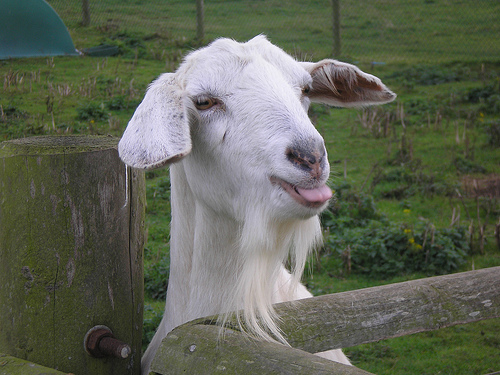
“Goat” on Every Day Fiction

My flash fiction piece “Goat” has been published on Every Day Fiction:

http://www.everydayfiction.com/goat-by-lori-schafer/

Yep, “Goat” is a true story all right. That was me, the shy, nerdy middle-schooler who couldn’t stomach being the center of attention, yet who suddenly found herself in a bright and unwelcome spotlight thanks to a careless remark by a well-meaning teacher. That was me getting my ponytail yanked by the boy who sat behind me, and suffering the embarrassment of inadvertently drawing a wiener on the blackboard. That was even me once again changing school districts and having to overcome my natural introversion with a whole new crowd of people. How I wished I was still “Goat” then – at least I would have had something to talk about!

What I really enjoy about “Goat” is the way it allowed me to take a humiliating situation and craft it into something positive, and this was true both in the fictional version and in the real-life story. Although I never actually carried that nickname to high school (thank goodness!), oddly enough, the “goat” incident and aftermath proved to be a real turning point for me in terms of my ability to relate to other students, maybe because even at the tender age of thirteen, I was able to have a sense of humor about it. Oh, I would pretend to fume and glare when the other kids made fun, but I never really minded it much. I rarely got the impression that the teasing was mean-spirited. And in any case, it was still way less embarrassing than the time I won that classroom limbo contest. I jumped up and down in celebration for a good minute before another girl came over and whispered in my ear that I’d ripped the seat of my pants making the winning walk under that final stick. And I’d thought that all that cheering was in honor of my victory!

Sigh. Embarrassing moments. We’ve all had our share of incidents we’ll never forget, but wish we could. I know, I know, we should be grateful that we’ve had those experiences, because they’re what’s made us who we are today. But let’s not lose sight of the real value of our lifetimes of humiliation in front of our peers. Inspiration for fiction!

***

“Goat” is one of the stories featured in my autobiographical short story and essay collection Stories from My Memory-Shelf: Fiction and Essays from My Past (only $0.99 Kindle, $5.99 paperback). To learn more about it, please visit the book’s webpage or subscribe to my newsletter.

Goat with Tongue Out

Moving In, Moving Out, Moving On: A Memoir

My short memoir “Moving In, Moving Out, Moving On” has been published in Foliate Oak Literary Magazine:

http://www.foliateoak.com/lori-schafer.html

Although this piece now forms a part of my memoir On Hearing of My Mother’s Death Six Years After It Happened, I was originally prompted to write it for the 2012 Ladies Home Journal personal essay contest. The theme was “The Day that Changed My Life.” Boy, was that tough. Very few of my life’s big changes can be traced to one day. The day I nearly drowned a few years ago was a contender, but I don’t think I was ready to write about that yet. The day I ran away from home would have been an obvious choice, but it didn’t make for much of a story. But then there was this day, the day I became aware that my mother was mentally ill, and that, I thought, had possibilities. Still, I suppose it would be a stretch to say that that particular day changed my life; rather, it was more that it marked a turning point in my theretofore comparatively carefree teenage existence.

It’s an interesting idea, though, isn’t it? Every day, people are faced with calamitous events that, in a flash, change their lives forever: accidents, natural disasters, illnesses, deaths in the family. You can’t even prepare for those kinds of changes because, unlike the string of fairly predictable events that make up the majority of modern life – going off to college, finding a job, getting married, having children, retiring – you don’t know they’re coming. Perhaps that’s why these kinds of stories fascinate us; there’s something wonderful in the way people respond to unexpected challenges, sometimes even something heroic. And while none of us wants to suffer a sudden catastrophe, maybe deep down we all hope that we would have the strength and courage to handle one if it came our way.


My Short-Short “Poisoned” in The Journal of Microliterature – Thanks to an Editor’s Wonderful Feedback

My flash fiction story “Poisoned” has been published in The Journal of Microliterature:

http://www.microliterature.org/poisoned-by-lori-Schafer

This was a very tricky piece to put together. It was actually inspired by an incident that occurred in the course of my mother’s psychosis. One day she took me to the hospital, complaining of chest and abdominal pains. I was naturally concerned, but I also recall being hopeful that having a doctor examine her would lead to the (I thought) inevitable revelation that she’d lost her marbles. No such luck. But anyway, they took her complaints seriously, because although she was in fairly good health, at forty-one she wasn’t exactly young anymore, and was a smoker besides, so there was legitimate reason to believe there could be a problem with her heart. They gave her the requisite battery of tests, but couldn’t find anything wrong. Now, as an adult, I can pretty easily guess what they must have told her – that she’d had an anxiety attack, which she probably had – but at the time I had no idea such a thing even existed. In fact, I wondered more if perhaps it was all in her head; she was imagining a lot of strange things in those days. Then the doctor left the room and the interrogation began. And that’s when I began to be afraid that she’d somehow manage to pin the blame for her mysterious illness on me.

The first version I wrote of this piece was mostly reflective of that – my terror over being falsely accused and probably convicted of poisoning my own mother with some substance of which no one could prove or disprove the existence. I sent my story off to Microliterature, and a few weeks later I received a response from the editor that basically said (politely) that I had ruined an otherwise good piece by changing the tone halfway through. He was absolutely right. The story ended in hysterics, with the husband being dragged away by the police, which, while it carried the plot in an interesting direction, utterly wrecked the dreadful calm of the first half of the story. He did, however, say that if I ever did a rewrite, I should feel free to resubmit.

So I rewrote it. I changed the second half of the piece entirely, including the ending, making it more about the relationship between the husband and wife than about the consequences of the wife’s accusation. And I was careful to maintain the tone of the first half of the piece throughout, which worked worlds better than the original version. And here you see the results. How grateful I am to that editor! With one brief sentence he nailed what was wrong with that piece and clued me in as to how to change it from a so-so story into a well-done one. I realize, of course, that few editors have the time to address the defects in the submissions they receive. But I hope that those who do make the effort are aware of how much we writers truly appreciate their feedback, and of what an impact a few choice words can make on the quality of a writer’s work.

Addendum: After this story was published, I also composed an alternate version, a nonfiction piece also entitled Poisoned, which is written in the first person and is featured in my memoir On Hearing of My Mother’s Death Six Years After It Happened. It received an Honorable Mention in The Avalon Literary Review‘s Spring 2014 Quarterly Contest and may be downloaded as a FREE eBook at your favorite  eBook retailer; I have also posted it here for those who are curious to compare the two versions.  Needless to say, I was very careful to maintain a consistent tone throughout!

“Found Money” in Burningword Literary Journal

My short-short “Found Money” has been published in Burningword Literary Journal:

http://burningword.com/2013/10/found-money/

Like many of my flash fiction pieces, Found Money is based on events from my own life; it’s even featured in my memoir On Hearing of My Mother’s Death Six Years After It Happened. And, like some of my other autobiographical pieces, at first I wasn’t sure if it really worked well as a fictional story. It actually started out as a considerably longer piece, seven hundred words or so, but somehow I just couldn’t get the middle section right. It sketched out the background of what had happened in the weeks before I found the money, which was itself a story worth telling – in fact, I eventually expanded it and turned it into a separate section of my memoir without fictionalizing it. But to someone who didn’t know the original story was taken from true events, I think the longer version came across as overly dramatic, or at least overdone. After it was rejected by a couple of journals, I took another look at it and decided to cut out the middle altogether. This shorter version I think works much better.

What’s conspicuously and intentionally absent from this piece is any kind of emotion. I don’t think you can afford to have feelings when you’re quite literally starving, and during most of this period in my life, it’s safe to say that the emotional part of my mind was effectively switched off. But I cried when I found that money. Oh, how I cried.

I will never forget the people in that restaurant, either. They only spoke to one another in Chinese, so I have no idea what they said about me, if anything at all. But they went out of their way to be kind to someone who was obviously homeless, and probably very dirty and smelly, and that touched me deeply.

That day marked a turning point in my young life. Not because I found five dollars; a loaf of bread and a small jar of peanut butter later, it was gone. The more important thing I found on the sidewalk that day was something I hadn’t even realized I’d lost. Hope.

* * *

“Found Money” is one of the stories featured in my autobiographical short story and essay collection Stories from My Memory-Shelf: Fiction and Essays from My Past (only $0.99 Kindle, $5.99 paperback). To learn more about it, please visit the book’s webpage or subscribe to my newsletter.

Found Money

“Scars” An Exploration of the Map of My Body

My essay “Scars” has been published in Ducts Webzine of Personal Stories:

http://www.ducts.org/content/scars/

This piece began with a single phrase that one day randomly insinuated itself into my conscious mind. “The map of my body.” It’s not so illogical when you think about it. The body really is a landscape all its own, complete with hills and valleys, rivers and woodlands, plains and caves. It’s subject to the same physical upheavals: quakes, tremors, winds, storms, and, for the less fortunate ones among us, active volcanoes spewing noxious elements. Much like the modern human landscape, roads run through it in every direction and across countless crossroads; around each peninsula and over every mountain, as if the body itself is a vast network of highways and intersections. And in the midst of this wandering journey, if you care to take it, every so often you find a historical landmark, a sign, if you will, of some noteworthy event that took place on that very spot.

Of course, the body doesn’t have any of those giant brown placards telling you what happened in some otherwise unremarkable field or forest lining the highway, and without that, the landmark is no more meaningful to most than any other scrap of land. Only one who is intimately acquainted with the history of a particular place can look out over the fresh green growth carpeting a battle-scarred land and see in his mind where the cannons once stood or the blood once spilled. Only the expert can envision the scene of the carnage without assistance or direction. And who is more expert than one who lived through it?    

We flock to them, the physical places where great events happened. We read the signs and try to imagine the precise square foot in which Custer fell or Washington froze, as if standing ourselves upon the spot in which it happened can make it somehow more authentic and real; can bring us somehow closer to the events of the past. And it does. By fixing history in space, it also fixes it in time; assigns it a permanent place in our collective consciousness. A landmark cannot fade into history like words in a textbook; so long as someone is interested enough to proclaim its continued existence, it is, and will remain, undeniably, everlastingly real.

And so with our scars. A scar is a story, a memorial to tragedy or triumph. It matters little whether the event that precipitated it was momentous or meaningless; it stakes a claim in our memory because we carry a physical reminder of it always. It is indelibly carved into the landscapes of our bodies, a point at which something significant enough occurred to leave a mark, a mark that we can use to trace history. Not the history of a world or a nation, but a history fully as complex and grand: that of a person.

* * *

“Scars” is one of the essays featured in my autobiographical short story and essay collection Stories from My Memory-Shelf: Fiction and Essays from My Past (only $0.99 Kindle, $5.99 paperback). To learn more about it, please visit the book’s webpage or subscribe to my newsletter.

ducts_title_main_logo_part1