Category Archives: Science & Society

How New Year’s Resolutions Weaken Our Resolve

It’s the first of January again, and all over the world, people are making personal resolutions for 2015. Amazing what a date can do, isn’t it? Millions of humans scattered around the globe, all simultaneously attempting to better their lives by altering their own behavior in positive ways. For many, a new year offers an incentive, a reason to push towards self-improvement or greater satisfaction with one’s life and one’s being. And what better day to feel as if you’re starting over than New Year’s Day? It’s a day of reflection on the year gone by and on the year yet to come. It’s a day in which to consider whether we’re moving towards the goals we’ve set for ourselves, or whether we need to change the paths we’re on in order to come closer to achieving them. And the making of resolutions is perhaps the vital final step of this process, because there’s little point in evaluating the state of our lives if we don’t then utilize our conclusions to bring us one step closer to happiness.

The trouble with the New Year’s resolution is that, by its very nature, it doesn’t take effect until after the end of the current year. And in a backhanded way, this encourages us to wait to act upon our resolve. We don’t exercise in December because we’ve decided to get in shape after the holidays. We don’t quit smoking in October because, without the motivation of the New Year’s resolution, we’re afraid we’ll fail. We don’t start tucking money away in August for that dream vacation we’ve always wanted to take, because there’s school clothes shopping to do, and then the holidays are coming up, and once again, we’ve postponed that project to another year.

And then what happens when we, as we inevitably must, fail to keep some of those resolutions we made in so much earnest? We wait again. We try again – the following year. How much of our lives are wasted waiting for this imaginary turning point to roll around so that we can make those changes we believe are so vital to our well-being and sense of fulfillment?

This is the core of the problem with marking time in our lives by special occasions – it causes us to neglect all of the everyday occasions that would have served us equally as well in helping us to attain our goals. Maybe your sweetheart expects you to present her with flowers on Valentine’s Day, but she’ll be much more impressed by the bouquet you bring in November. Chocolate cake is sweeter when it’s not baked on your birthday. Why wait until New Year’s Eve to have a beer and hang out with your friends? Won’t your mom be more pleased if you call her in March just to chat, then if you wait until May to wish her a Happy Mother’s Day?

I don’t ever want to wait until January 1st to change my life. I might want to quit my job on July the 15th, or start writing a book on September the 24th. It doesn’t need to be the first of the year or the first of the month before I decide to move forward with my resolutions; any given Monday will do. I’ll derive just as much joy from turning my life around at 3 o’clock on a Tuesday afternoon in June, as at midnight on a Thursday in January.

So that is my New Year’s resolution. Never again to wait for a new year to arrive before I make my resolve. Never again to pretend that January will be soon enough for me or my life to change. It isn’t.

604-closeup-of-a-clock-pv

State of Micronesia, 2016

My flash fiction story “State of Micronesia, 2016” has been published in Every Day Fiction:

http://www.everydayfiction.com/state-of-micronesia-2016-by-lori-schafer/

I had the inspiration for this story some time ago when I ran across a newspaper article about the Federated States of Micronesia, an island nation which is evidently one of the first to feel measurable and potentially disastrous effects of climate change. There is, in fact, a very real fear that the islands may disappear as sea level rises; this article presents a good summary of the situation as the Pacific Islanders see it: (http://www.pri.org/stories/2014-09-23/pacific-island-nations-theres-nowhere-left-run-climate-change). Now, I have since read contrasting viewpoints – including the view that Pacific Islands that are constructed from coral reefs are in no danger from global warming because the reefs will merely grow as sea level rises, and that the disastrous predictions being made by local governments are motivated by a desire to extort financial assistance from the world’s wealthier powers. However, as such arguments ring to me of the “climate change denial” that is still unfortunately so vocal and widespread, I’m not sure I’m willing to buy the science behind them without greater confirmation of its accuracy than some article somebody posted online.

In any case, I thought it was a concept worth exploring. Because even if the Micronesians are in no danger of losing their homelands, no one can deny that other populations have, in fact, already experienced significant, even culture-altering shifts in their native environments, particularly the Inuits of North America and other arctic peoples. Yet much as we like to believe that this problem only impacts those whose lives revolve around the ice or the sea, it affects all of us. The polar vortex that brought unusual bitter cold across the North last winter, and is expected to again this winter, the ongoing heat and drought out here in California – these are not merely matters of pleasant vs. unpleasant weather. At some point they will begin to affect our ability to provide for ourselves. And how are the Canadians keeping warm when the temperature drops to forty below? By burning fuel. How are agricultural products transported to California’s millions of residents? By fuel-burning trucks. We are not merely battling climate change; climate change itself may actually increase our demands on the planet. And I, for one, am not convinced that our technology is going to be able to keep up with the pace of our environmental destruction.

My story was not well-received by the readers at Every Day Fiction – and frankly even I would agree that many of their criticisms were justified, particularly in the way I’ve portrayed the grandfather character. He is almost a caricature. And I did, in fact, think long and hard about that when I was writing the story. But in the end, that was how I saw him: as an outdated, outmoded, one-dimensional Old World character. Because to me, only such a man would persist in denying what we see happening all around us.

State of Micronesia 2016

Stigma Fighters: Real People Living with Mental Illness

I have a guest post up today on StigmaFighters.com, a site devoted to ending the societal stigma of mental illness by telling the stories of real people who live with mental disorders. I myself am fortunate enough not to be a victim of one of these conditions. But as I point out in my post, you don’t have to be mentally ill to suffer the stigma associated with mental illness.

http://stigmafighters.com/stigma-fighters-lori-schafer/

cropped-cropped-cropped-Stigma-Fighters-V1

Is Your “Anxiety” Real? One Woman’s Experience with Mental Disorder

Several years ago, I visited my doctor with some disturbing symptoms – most notable of which were a recurring rapid heartbeat and chest pains. At my age and physical condition, a heart attack seemed unlikely – but after several days of this I naturally began to worry. Well, let me rephrase that. I actually began to worry the minute the chest pains started, but it took several days for me to get worried enough to go to the trouble of see my doctor.

My doctor agreed, based on my symptoms, that a heart problem was probably not the cause, but he ran tests just to be safe. One clean EKG later, it was clear that something else must be wrong.

“Have you been under any stress?” he inquired.

I laughed. My whole life has been one giant ball of stress.

It was true, though. I had taken on an additional job (on top of my other two) and was working way too much. Besides that, one of my employers was in an extremely precarious financial position, which put a lot of strain on the person who managed the money – namely me. In addition, in the course of our conversation, I revealed that I had had a near-death experience several months before. Well, once my doctor heard that, he was quick to arrive at a diagnosis – anxiety.

It seemed plausible. I was under a lot of stress, and had little time for anything but work which I no longer enjoyed. It was also true that I had been profoundly affected by my near-death experience. Still, it seemed strange. Although I’m certainly what one might call a “worrier,” I had never suffered from anxiety – in the clinical sense – before. Not when my mother developed her mental illness, not when I ran away from home, not even when I was homeless and starving. But perhaps the effects were cumulative, I reasoned. Perhaps all the years of stress had finally caught up to me. I was getting older, after all. Maybe I just wasn’t able to handle things the way I did when I was young.

My doctor prescribed Lorazepam. I normally avoid medications except when absolutely necessary, but after a few weeks, I was so unnerved by these ongoing issues that I agreed to take it. And I did. It was frustrating, though, because it didn’t seem to do much. Yes, the tightness in my chest lessened slightly. Yes, I worried less about the symptoms I did have because my mind went a little hazy when I was on it. But it didn’t solve the problem. It didn’t fix me or return me to normal. I still had that tension, that pounding in my chest and I wondered – would it ever stop?

You can therefore imagine my immense relief when, four months later, my symptoms suddenly vanished as quickly as they had begun. It was over, I thought. Whatever had triggered the anxious response was gone, gone from inside me at last. I could go on with my life.

And I did. I went about my business. More than that. I began thinking about working my way towards a new life – a life that I really wanted.

Several months later, for no apparent reason, my symptoms returned, even worse than before. I’d go to work in the morning, and within a few hours, my heart would be pounding, I’d be sweating profusely, and, of course, totally freaking out that this could have happened to me again. Panicked, I refilled my long-depleted Lorazepam prescription. But again, it had little to no effect on my symptoms.

I was stunned, and more importantly, puzzled. I simply couldn’t understand it. The first time, sure. I could see where the combination of stresses I was under would have caused this kind of reaction. But why would it go away and then come back? Had there been a new triggering event of which I hadn’t been consciously aware?

It was at this point that I decided to start keeping a diary to see if I could discern a pattern as to when my intense feelings of nervousness were at their worst. I never even got that far. Because once I had decided to do that, I realized that my anxiety did indeed have a very definite pattern. It would start in late morning, peak mid-afternoon, and finally start tapering off after that.

This made no sense. Yes, I had a heavy workload, and one of my jobs was incredibly nerve-wracking. But I didn’t see how that anxiety could be tied to a particular job, because my work schedule was different every day. Even on weekends, when I worked from home, I had the same symptoms. What else could possibly be provoking this daily – and seemingly cyclical – response?

My mind turned at once to food, as I knew that blood sugar could affect mood. But since eating in the afternoons makes me exceedingly groggy (falling-asleep-on-my-desk groggy), I have long made a habit of skipping lunch. Therefore it couldn’t be something I ate – could it perhaps be the fact that I wasn’t eating? But if that was the case, then why did my symptoms always go away before dinnertime? If lack of food was the cause, then logically, it seemed as if I should have gotten better only after a meal, not before.

I only had one other habit that I could think of that was tied to particular times of day, and that was coffee. Yes, I did drink a lot of coffee. Mind you, I’d always drunk a lot of coffee. In fact, at this time I was consuming far less than I had at other points in my life – even in spite of having multiple jobs and a correspondingly crazy work schedule. But I drank it very consistently, eight six-ounce cups a day, according to my little coffeepot. I’m a sipper, not a chugger, and it took me from the time I got up around five until noon or one o’clock to finish all that, but I usually did.

It seemed unlikely, I’ll admit. Why would I be able to drink all the coffee I wanted one day without a problem and then feel as if I’m having a heart attack the next? It made no sense. But I was desperate – so desperate that I decided to give it a try, even if it meant messing with my precious morning ritual. I bought some decaffeinated coffee and the next day I made my coffee half-and-half. And that was the end of my anxiety.

How could this be?? Months and months of strain and worry and nervousness that I feared would never go away, and it could all be explained by something as stupid as too much caffeine. But if my coffee-drinking habit was so consistent, then why did my symptoms vanish and then return?

This, it turned out, was the key to the whole problem, and the one that convinced me that I was right. My favorite coffee is actually Costco’s Kirkland Signature Colombian Blend, which is very strong and bold, just the way I like it. However, the Costcos around here are so crowded that I very rarely go to one, so I don’t always have this coffee on hand. Well, when I went back and examined my receipts and mileage logs, it was plain to see what had happened. Around the time my symptoms first started, I had made a Costco run and bought the Kirkland coffee I liked. When that ran out, I drank a different – and presumably weaker – brand from the grocery store for a while. Some months later, I made another Costco run and went back to the Kirkland. And bam! That was when I started having “anxiety” again.

So what is the lesson here? Anxiety is a very real problem for large numbers of people, and undoubtedly for most of them, it does have a psychological cause. But we as a society are perhaps a little too quick to assume that our physical problems result from emotional stimuli. Look at my doctor – what did he see? A high-stress person. A difficult personal history. And unexplained heart palpitations and chest pains. Naturally he jumped to the conclusion of anxiety. But did he ever even ask me if I was taking any stimulants, even the ordinary kind? Did he ask me if I was taking allergy medications, some of which, as I’ve learned since, can also cause heart palpitations? No. He ruled out the obvious potentially serious physical causes and never bothered to dig any deeper than that. Look at you, you poor dear – you must have anxiety. Now hush up and take your medication.

It’s been four years since then, and I have not experienced even a single day of anxiety in that time. Not one. I drink much less coffee now, but I do notice that if I overdo it on the caffeine that the symptoms threaten to return – my chest tightens, my heart rate increases, and I sweat more than usual. But that’s it. It’s not anxiety – it’s physical tension caused by overstimulation of my system. But can you imagine if I had not figured this out? I would have spent the rest of my life choking down worthless chemicals, having god-knows-what long-term effect on my body, and constantly feeling as if my mind’s about to spin out of control. Unlike purely physical ailments, mental illnesses feed off of and reinforce themselves by creating fear and creating worry. It’s not like when you break a leg and you know you just have to wait six to eight weeks for it to heal. You can’t know when or if you will ever recover from an emotional condition. It’s almost enough to give you anxiety.

I suffered for nearly a year – for nothing. From a so-called illness that didn’t even exist. The miracle is that I came out of it more or less emotionally unscarred – and with a healthy skepticism towards the medical profession. I don’t blame doctors. They’re human too, after all, ordinary people trying to do their jobs as efficiently as possible, just like the rest of us. But that’s what makes it so important for patients to be their own advocates. I trusted my doctor because he knows his profession, and I don’t. But he was wrong. And who finally arrived at the right diagnosis? I did. Without any medical training at all. Not because I’m smarter or better educated than he is. No, but because I know my body in a way he never will. I know the intimate details of my life in a way he never will. And ultimately, because I care more about my body and my life than he – or anyone else – ever will.

I decided to put this story out there because it simply horrifies me when I think of how many people there must be who, like me, have been diagnosed with anxiety, but are really suffering from a case of too much Starbucks – or any of the many other readily available modern products that contain stimulants. How will they ever know? Their doctors will probably never even know. And it does make one wonder what effect this misdiagnosed population has on patients with genuine anxiety disorders. Have their treatments been altered or affected because of these other folks who are sadly unaware that there’s nothing actually wrong with them? How does one judge the true efficacy of a medication if it’s also being used on individuals who aren’t really sick?

This, to me, is a very sad situation, one that people should know about. Of course not everyone can be cured of anxiety by reducing or eliminating caffeine – but what a difference to those who can. I’ll be the first to admit that one of my great pleasures in life is the joy of waking up to a freshly brewed cup of coffee. But even that can’t compare to the happiness I felt in discovering that my “anxiety” wasn’t real.

Coffee

Rudolf Hoess, Commandant of Auschwitz

Hess, Rudolf, Commandant of Auschwitz, tr. Constantine FitzGibbon, World Publishing Company: Cleveland and New York, 1951.

Commandant of Auschwitz combines the autobiography which Rudolf Hoess wrote while awaiting trial at Nuremberg as well as a number of official statements he gave to his interrogators regarding other SS personnel with whom he had significant contact. There is a lot I could say about this book, because Hoess, rather surprisingly, has a number of interesting ideas and observations, particularly in regards to the concept and execution of imprisonment and the lesser-known victims of the concentration-camp system, but for the moment I’ll confine myself to what he has to say about conducting the affairs of Auschwitz.

Hoess makes no bones about his political beliefs; he unwaveringly avers his continued allegiance to the Nazi Party, and, unlike many Nazis, who denied complicity with the concept behind or execution of the Holocaust, even suggests that he would have been in favor of it were it vital to the cause:

“Whether this mass extermination of the Jews was necessary or not was something on which I could not allow myself to form an opinion, for I lacked the necessary breadth of view.” p. 160.

However, what is most fascinating about the book is that as it progresses, it becomes clear that Hoess was, generally speaking, against the customary Nazi treatment of the Jews, not out of compassion for their situation or any sense of wrongdoing in causing their suffering, but for purely bureaucratic reasons.

Thus he complains about the nature of the site, which lacked sufficient water, drainage and building materials for the size it was later to assume; he argues against the massive overcrowding, which caused disease to run rampant and had terrible psychological effects upon the inmates, which he believed led to rapid deterioration in their health; against the incompetence and maliciousness of the guards under his control, whose approach to corporal punishment he felt was detrimental to the objective of maintaining peace in the camp while it conducted its operations. He berates the Food Ministry for constantly reducing rations during the course of the war, not because he had pity for the starving concentration-camp dwellers, no, but because it prevented him from maintaining an adequately-functioning work force. The selection process itself, he argues, was faulty at its core:

“If Auschwitz had followed my constantly repeated advice, and had only selected the most healthy and vigorous Jews, then the camp would have produced a really useful labor force and one that would have lasted.” p. 176.

The implication is that more Jews should have been sent immediately to the gas chambers rather than being corralled into the work details if the goal of attaining adequate war-workers was to be achieved. In other words, if Hoess had had his way, the concentration camps would have contained a large contingent of healthy, well-fed Jews and many more dead ones.

Hoess relates anecdotes of the desperate starvation of the camp residents; of inmates being attacked and beaten by their fellows for a crust of bread, of cannibalism among Russian prisoners-of-war. He assures us that his war-time prisoners became little different from civilian criminals, unhesitant to sacrifice their fellows in order to improve their own condition; in order to get an edge on survival. He speaks of the attachment of the Jews to the members of their own families; of the efforts of the mothers to calm their children as they walked into the gas chambers or to throw them out of the doors, pleading for their young lives, just before they are sealed. And then he tells a story of one Special Detachment Jew who had been assigned to the burning of corpses. When the man pauses for a moment in the course of his labors, Hoess inquires of the Capo in charge as to the cause. The Capo informs him that one of the dead in the pile is the man’s wife.

But following his moment’s pause, the man has already gone back to work. And that is when it struck me, that in spite of the distinction between the powerful and the powerless, what a terrible similarity exists between the Commandant and the prisoner. The Commandant does not deal with people; he deals with issues, problems, supply chains, bureaucracy. He is almost entirely detached from the suffering of those under his care. And likewise the inmate has detached himself from his own suffering; he is unable to acknowledge or permit it to penetrate him. Instead he merely attends to his work, the work that, ironically, makes him free, even as the sign above the gate so illusively promised. Detachment means survival; and the ability to detach oneself from one’s circumstances is perhaps a necessary adaptation. For as long as people are able to view one another without acknowledging their humanity, their personhood, they will treat their fellows cruelly. And in order to endure that cruelty, those who suffer from it will have to become like their oppressors: empty of compassion and feeling, intent only on bare survival.

It is now well-known that many Nazis who were recruited into concentration-camp or extermination services were unable to endure it; indeed, many were transferred, upon request, from participation in the brutalities that accompanied occupation and deportation into other branches of service. Considerable care and effort were expended in making exterminations tolerable for the executioners as well as their victims; as horrendous as the mass gassings were, they were viewed as more humane, less wearing on the soul than the mass shootings which had theretofore been employed. Hoess describes how numerous of his subordinates approached him, expressing deeply-troubled thoughts over the mass exterminations; how he deemed it his duty to appear unmoved. Not all of the Nazis were able to view their captives as chattel, as mere bodies to be fed and housed and employed and killed and burned, any more than some of their victims were able to forget the essential humanity of their captors. Consider Hoess’ description of the Allied air raids, which brought terror to the skies over Germany and the occupied lands:

“Attacks of unprecedented fury were made on factories where prisoners were employed. I saw how the prisoners behaved, how guards and prisoners cowered together and died together in the same improvised shelters, and how the prisoners helped the wounded guards.

During such heavy raids, all else was forgotten. They were no longer guards or prisoners, but only human beings trying to escape from the hail of bombs.” p. 183.

Humans, one and all. Hoess is not one of the Nazis who viewed the Jews as somehow less than human, and therefore worthy of extinction. He sincerely believes that they were a threat to what he sees as the truly German way of life, and that the measures that were taken against them were necessary in order to preserve the integrity of the nation. He is therefore offended by the vicious propaganda propagated by publications such as Der Stürmer, believing its exaggerated attacks upon Jewish morals and behavior capable of backfiring and creating sympathy for the Jews. He argues that the nations conquered by Germany during the Second World War should have been treated with greater respect and kindness, which would have unmanned much of the resistance which grew following the invasion. And finally, in the ultimate expression of utter disregard for the unadulterated evil imposed upon the unoffending peoples of the world, Hoess at last concedes that the Holocaust should not have occurred. But listen to his reasons why:

“I also see now that the extermination of the Jews was fundamentally wrong. Precisely because of these mass exterminations, Germany has drawn upon herself the hatred of the entire world. It in no way served the cause of anti-Semitism, but on the contrary brought the Jews far closer to their ultimate objective.” p. 198.

The Holocaust was wrong, according to Hoess, not owing to fundamental human principles of kindness and decency, or compassion for one’s fellows, but because it did not serve the Nazi cause. Which eerily implies that he believes that it would have been “right” had it only served the purpose for which it was intended. Is that, too, an essentially human characteristic? To be able to justify the means, if they achieve what is perceived to be a desirable end?

Lithograph by Leo Haas

Lithograph by Leo Haas (1901-1983), Holocaust artist, who survived Theresienstadt and Auschwitz. From the Center for Jewish History – no known copyright restrictions.

How, On Mother’s Day, Twitter Taught Me the True Meaning of Social Support

Yesterday was Mother’s Day. It is not a holiday I celebrate. I am not a mother myself, and as those of you who know something of my personal history are aware, my relationship with my own mother was critically wounded when she became mentally ill during my adolescence.

I’m generally not much affected by the holiday. It’s been years since I left home, and by now I’ve spent more of my life without my mom than I spent with her. Time heals. But last year I learned that she had died – in 2007. And ever since then I’ve found myself thinking of her much more often, of the mother she was when I was young, and of the mother she became when I was older. And in completing my memoir, which is being released next month, naturally I’ve had to spend a great deal of time digging deeper into my long-repressed feelings towards her, this woman I once loved with all my heart.

And maybe that’s why, on Sunday morning as I was doing my usual Twitter thing, I found myself growing uncomfortable when faced with the steady stream of tweets celebrating moms and motherhood. That’s wonderful, of course, for people who are mothers and who have mothers – they should celebrate. But then I thought, what about those who don’t ? What about all those children – young and old alike – who have lost their mothers? How does it make them feel to be deluged with these reminders of other people’s happy families when their own has been torn apart?

I hadn’t known ahead of time what I was going to tweet that day. I had nothing sweet or tender to offer in honor of the holiday, nothing warm or fuzzy I wanted to say about my mom or anyone else’s. But as I waded my way through my tweetstream, it suddenly came to me that even if I didn’t know what I wanted to say, I knew who I wanted to speak to, this Mother’s Day. Not to the mothers, but to the motherless.

And this is what I posted.

“For all those who can no longer celebrate #MothersDay… Remember #Mom.”

?????????????????????????????????????????????????????????????????????????????????????????????????

And then I got up and made breakfast. When I returned to my computer about an hour later, my tweet had been retweeted 49 times and favorited 70 times.

I was blown away. Needless to say, nothing I have ever posted on Twitter has ever gotten anything close to that kind of response. As of this writing, there have been 133 retweets and 152 favorites – mostly by people with whom I had no prior connection. And people responded! How they responded. Here are a few of the notes I received:

“I remember my mom too! Its the 1st Mother’s Day without her! Be strong, Lori!”

“I put flowers on my mother’s grave too. Miss her so much today.”

“Thank you. Lovely reminder of our mothers lost too early.”

“Thank you Lori. This is a tough day for a lot of us, but this makes it a little easier.”

I was moved. Deeply, deeply moved. My tweet – 70 characters and a photo – had actually reached people, hundreds of them; it had touched them in a brief yet meaningful way. And when you look at the responses it prompted, it’s apparent that there were different reasons why. Some wanted to share their own feelings about their own lost mothers. Some wanted to offer their support to others who might be in pain. And some were merely grateful to be acknowledged – to be given the recognition that Mother’s Day is not necessarily a day of celebration for everyone. The responses varied. But at heart they all stemmed from the same impulse, our unquenchable desire to communicate our feelings to other humans.

It’s often said that social media is about making meaningful connections, about developing relationships with individuals you wouldn’t normally encounter in your local environment. But there’s a different kind of connection that social media also makes possible. Connecting to strangers. People with whom you have no real relationship and probably never will. People with whom you have absolutely nothing in common, except for this – a shared emotion. A shared feeling, a shared experience. A shared bit of the humanity that’s common to us all.

In its own strange way, social media unites us. We’ve all heard of revolutionary movements being organized through Twitter. We’re all aware of the grassroots activism that’s transpiring every day on the internet. We all know how social media is changing our lives, how it’s connecting people all around the world, how it brings people together, how it makes their voices heard.

And what we’re discovering is that we are not alone. There are millions upon millions of others just like us, in all the countries of the world, who are living and loving and laughing and crying and hurting and dying. We no longer have to be alone with our feelings. We can touch, and be touched. We can share our sorrow. We can share our pain. We can find comfort and support in the hearts of strangers. We can find strength in the swell of humanity that surrounds us, in the knowledge that in some of the most essential ways, we are not many, but one.

It’s a powerful age. And a beautiful one. For the first time in history, we can reach out to our fellow humans, all of them. Knowing that they can respond to us. Knowing that they will reach back.

The Dubious Witness: Does New Research into the Functioning of Memory Make All of Human Recollection Unreliable?

This week I read two seemingly unrelated news stories. One was inspired by the recent accusations made by Dylan Farrow against Woody Allen. In this article that appeared today in The Daily Beast, author and researcher Cara Laney argues that “It’s Shockingly Easy to Create False Memories.”

http://www.thedailybeast.com/articles/2014/02/09/it-s-shockingly-easy-to-create-false-memories.html#url=/articles/2014/02/09/it-s-shockingly-easy-to-create-false-memories.html

As you likely recall, there were a number of scandalous cases of alleged child sexual abuse in the 80s and 90s, some of which sounded unlikely to have really occurred. Pedophiles are comparatively rare, and because of what they do, they usually operate in absolute secrecy. Collusion among pre-school teachers in sexually abusing the children in their charge therefore sounded a bit far-fetched. This case and others like it seriously called into question the reliability of children as witnesses, and furthermore suggested that it was possible to influence kids, through the power of suggestion, into believing something really happened even when it didn’t.

A few days ago, I saw this article on Science Daily: “Your Memory Is No Video Camera: It Edits the Past with Present Experiences.”

http://www.sciencedaily.com/releases/2014/02/140204185651.htm

A forthcoming study in the Journal of Neuroscience will detail how researchers discovered that “memory is faulty, and how it can insert things from the present into memories of the past when those memories are retrieved. The study shows the exact point in time when that incorrectly recalled information gets implanted into an existing memory.”

According to the results of the study, memory does not merely record what has happened to us; rather, it serves as a tool for our adaptation and survival:

“Our memories adapt to an ever-changing environment and help us deal with what’s important now… Memory is designed to help us make good decisions in the moment and, therefore, memory has to stay up-to-date. The information that is relevant right now can overwrite what was there to begin with.”

In other words, it is not only children who are unreliable witnesses; we all are. We are all capable of rewriting the past to suit our present needs, even though at times it may be difficult to uncover the reasons why we should prefer one recollection over another.

I’m not going to attempt to decipher the truth of the Dylan Farrow/Woody Allen case; only the two of them will ever know whether the allegations are true. Or will they? If the new research into the functioning of memory has been interpreted correctly, it is actually possible, however unlikely, that neither of them will recall with accuracy what the exact nature of their relations were. Certainly it’s plain to see that if Woody Allen did commit these abuses, he would have solid reasons to rewrite his memories of them. It’s just as easy to suppose, given the filmmaker’s well-documented relationship with Soon Yi, that Dylan Farrow could have shaped her own childhood memories to reflect that knowledge.

What is truly terrifying about this is that not only can we no longer rely on the testimony of others; we can’t even rely on our own. Suppose that Dylan Farrow does have false memories. Her pain is no less real because of that. In fact, her pain is undoubtedly greater, because the truth of what she has said has been called into question. Even if her recollections are accurate down to the smallest detail, we can’t ever be sure of that because we know now that this is not how memory works.

The implications for eyewitness testimony are mind-boggling. The depositions of witnesses have long been known, of course, to be subject to vagaries that can’t always be explained by fear of consequences, imperfect recall, or acts of self-interest. Now the whole system is called into question. If Ms. Laney is correct, witnesses can be led to lie under oath merely by being asked the right kinds of questions, testimony that will not be false because the person giving it will believe it to be true. There may be such a thing as an objective “truth,” but it is of little use to us if we can’t know what it is.

Which leads me to wonder whether we need a new approach to our search for truth when it comes to human memory. The rewriting of memories is supposedly not random, after all; it is presumed to be an adaptive feature of human behavior. So perhaps if we wish to uncover the reality of a recollection, what we need to do is assess the adaptive purpose of internally reworking the memory in question. Certainly there could be value in reconfiguring or perhaps even repressing a painful memory if it permits us to move forward with our lives. But isn’t it also possible that we might mentally recast a bad experience to make it more terrible than it was? For example, if you got into a car accident because you were driving too fast on a rainy night, mightn’t your memory actually amplify the terror you felt when you heard your tires screeching and saw the guardrail closing in? Wouldn’t it be possible that you would remember the pain of that broken leg as being ten times worse than it really was? Because increasing the horror of that memory is going to help you to survive; in the future you will drive more slowly when it’s dark and wet.

There may, in fact, be good reason why isolated stories regarding verifiable child abuse, taken from the news, have led to rashes of such accusations. In a backhanded way, this process of reworking memory may be protecting our children. Because a child who believes that he or she was abused while alone with a caregiver – even when he or she wasn’t – is going to learn something from that: adults can’t always be trusted. And the sad fact is, sometimes that’s a lesson a kid needs to learn.

Which brings me to one final thought – is the brain’s ability to rewrite memories in any way related to certain mental disorders such as anxiety and PTSD? Conditions that are triggered by real-life happenings are clearly heavily dependent on the sufferer’s recollections of those events. Do people who suffer from nervous disorders do so because they have more intense memories of traumatic events, or because they lack the ability to reconstruct those events in their minds into kinder, gentler forms? One thing is certain. We are only beginning to scratch the surface of the role that memory plays in shaping us as human beings and determining the course of our lives. Memory defines who we are and who we think we are; it is an integral part of the peculiar fiction of being human. 

Why Young People in Japan Have Stopped Having Sex: An Exploration

http://www.theguardian.com/world/2013/oct/20/young-people-japan-stopped-having-sex?CMP=twt_gu

They’re calling it “celibacy syndrome,” a condition in which a large proportion of young Japanese, both men and women, have lost interest in both sex and dating. The numbers are astounding – 45% of Japanese women between 16 and 24 report either disliking or having no interest in sexual contact, with more than a quarter of men in the same demographic agreeing with them.

Hypotheses abound as to why this may be so, primary among which are currently poor economic conditions in Japan as well as lingering outdated conceptions of male and female roles in society. But this can’t be the whole story. Take a country like Afghanistan, which has a terrible economy, but one of the highest birth rates in the world. Look at the United States – we, too, once expected women to fulfill “traditional” roles while men worked to support the family. But society’s opinions change as people do, and there’s no reason to believe that Japan should be an exception.

The mistake, I think, lies in treating this as a social issue. You can’t “fix” this kind of situation with large-scale therapy because it probably isn’t psychological at all. Instead, it’s far more likely that the Japanese are exhibiting a very natural biological response to long-standing conditions in their national environment.

There is one very noteworthy example of a similar and well-documented phenomenon – the panda. For decades scientists have been trying to rescue the panda from extinction, but it’s not only habitat loss that’s endangering the pandas; they have an extremely low birth rate. Even in captivity it’s difficult to persuade pandas to reproduce. Why? Because they refuse to mate.

Pandas are likely unhampered by clinging to traditional conceptions of gender roles. They’re not still living with their parents when they’re thirty-five, and they don’t see being in a relationship as getting in the way of their careers. Yet their mating behavior is extremely reminiscent of what seems to be transpiring among the young Japanese. Maybe the problem is not the double-edged sword it seems to be; maybe it’s not that they’re experiencing habitat loss and that they also have a low birth rate; maybe the habitat loss is instead the cause of the low birth rate.

I read somewhere a long time ago that women who are overweight have a better chance of giving birth to girls. I’ve thought a lot about that. Makes perfect sense, doesn’t it? A high amount of body fat suggests living conditions in which food is abundant; a situation ideal for creating new baby-makers. But then it also stands to reason that people should be less likely to make more people when they live in an environment that is unable to support them. It’s an old story. Think about cacti, patiently waiting for rain to come to the desert so that they may burst forth in their annual bloom. Or about animals with well-defined mating seasons; these creatures are hard-wired to give birth when food sources will be adequate. Are people any different?

In industrialized nations, birth rates have been declining world-wide over the last century. Indeed, certain countries (like Japan) have declining populations because they no longer produce enough new children to offset the number of its citizens who die. The typical culprits presumed to be associated with this international trend are shifting social values, women joining the workforce, and broad access to contraception. But what if those factors are not causes, but effects?

Among other species, the self-limiting nature of a particular population is often obvious. An overabundance of deer will trigger an increase in the number of wolves available to prey upon them until the increased number of wolves can no longer be supported by the reduced number of deer. Humans, of course, have few predators (besides other humans) and some of our deadliest known diseases have largely been controlled by advances in medicine. And in developed countries at least, hunger is comparatively rare. Yet the industrialized nations are huge consumers of natural resources; far more rapacious than their poorer counterparts. Is it possible that on the most basic, chemical level, human bodies, too, recognize when population growth needs to stop?

Japan has the lowest birth rate of any country in the world. It also has the longest average life expectancy. Similarly, nations at the highest end of the birth rate scale (particularly the so-called Third World countries of Africa) have the lowest life expectancies – as low as 47 years in a nation like Sierra Leone, versus 83 years in Japan. Few would argue that Africa has such a high birth rate because its economy is so strong and the prospects for young families so glowing. It seems clear, rather, that with the comparatively high death rate, there is simply more room in that environment for humans to be born. And in nations which are both physically and economically overcrowded, like Japan, perhaps in spite of our technological advances and know-how, there really is only so much space for a species to expand.

Children are the customary result of people coupling up, and maybe this reported lack of interest in sex and relationships is not a consequence of psychological factors like doubtful economic prospects or changing social mores, but a biological response to an environment which, like any other, has limits on the population it is able to support. Japan may be only the beginning; perhaps the other developed and people-packed nations of the world will gradually also become subject to Japan’s changing perception of sex and relationships as their citizens’ needs begin to exceed their available resources. It doesn’t mean that humanity is doomed. On the contrary, this may be the start of a worldwide leveling off of the human population; a hint that we’re approaching that natural balance that most long-lived species eventually achieve.

One might even suspect that a century from now, “celibacy syndrome” may no longer be isolated to particular countries, but will be planetary in scope. Indeed, as our beloved Earth becomes less and less fit for human occupation, as certainly seems likely, perhaps sex itself will become a relic of some distant, dirty past, confined to vast digital volumes of internet pornography from the twenty-first century that no one will even want to look at anymore.

But I don’t think we need to worry that. Humans will always have some interest in and desire for sex; it’s natural, after all, practically a prerequisite to belonging to the animal kingdom. Of course, human sex may eventually end up just like other animal sex; one day it may be reduced to a minimum of foreplay and an eye towards the quick finish – getting the job done, if you will. Then we’ll find ourselves faced with different kinds of questions. Such as whether we still want to live in that kind of world.

Pearl Harbor: The Tragedy that Saved the World

Before 9/11, December 7, 1941 was arguably – apart from Independence Day – the most memorable date in United States history. In fact, 9/11/2001 and 12/07/1941 have a great deal in common. They were both sneak attacks. They were unprovoked. They caused irreparable damage to both American property and the American psyche. They prompted the U.S. into taking global action. They forever changed the U.S. view of the world and of our place within it.

There is, however, one great difference between the two, one very great difference. Very little good came of the events of 9/11. The tragedy at Pearl Harbor, however, saved the world.

There’s no doubt that the U.S. entry into WWII on the side of the Allies turned the tide of the war. The fighting power of our men overseas and the productive power of our machinery at home were the indispensable keys to an Allied victory. But without Pearl Harbor, would the U.S. ever even have entered the war? And without American intervention, would the Allies have lost?

It’s a frightening yet very real possibility, as history has shown us. World War I was essentially at a stalemate until the U.S. arrived in 1917 with its fresh bodies and materiel. Without the “doughboys” and the factories that supplied them, the two European sides would have worn themselves out fighting their war of attrition. Eventually they would have returned to their familiar and welcoming homes, drained, exhausted, and hopefully more wary of the wonders of war. Even without U.S. involvement, peace was probably inevitable, although it may have taken a great deal more time and suffering to achieve.

But World War II wasn’t like the Great War. It wasn’t a war of misguided national sentiment and entangling alliances, a war of nineteenth-century attitudes and twentieth-century technology. No, WWII was about terror, domination, and imperial acquisition. It was about ruling the world and the people within it. The Axis powers didn’t merely re-draw the national boundaries of the countries they conquered; they altered the most intimate aspects of the lives of the citizens within their borders. There was no “going home” for soldiers returning from that war, whether they won it or not. Home as they knew it had ceased to exist. And this is what made an Allied victory an absolute necessity.

My guess is that the U.S. probably couldn’t have stayed out of WWII forever, even if it had wanted to. And indeed, by the time of Pearl Harbor, it was already clandestinely involved in aiding the Allies. Yet suppose Pearl Harbor hadn’t happened. How long would it have taken the U.S. to intervene in the war?

Full-scale mobilization of a “sleeping giant” like the United States takes time, even when its Pacific fleet hasn’t just been virtually destroyed. Think about it. From the date of the attack on Pearl Harbor, D-Day was two and a half years in the making. Since such an offensive could not have taken place in the winter or fall, this means that if the U.S. had found itself compelled to enter the war just four months later than it did, the landing in Europe might have been delayed by as much as a year.

Another year of war. How many hundreds of thousands – perhaps even millions – would have died in the concentration camps alone if the war had been extended? How many soldiers would have perished along the multiple fronts for which World War II is known? How many more civilians would have starved or been bombed out of their homes? And how much more entrenched in their subject territories would the Axis governments have been if the U.S. had waited another year to render the full force of its aid? How many atomic bombs might have been dropped in order to get them out?

It’s terrible and sad to say, but one of the worst moments in American history may have been the greatest thing to happen to humanity in all of the twentieth century. Let us think about that, when we remember this day that still lives in infamy. They couldn’t have known it then, but for every one of the thirty-six hundred Americans who was killed or wounded that day, hundreds of lives were saved. I don’t doubt it was a sacrifice that every one of them would have been proud to make.


Who’s the Sexiest, and Why Do We Care?

It’s been a few weeks now since I saw the big news. I’m sure most of you have been thinking about it nonstop since then, too, but for those of you who haven’t, I’ll reiterate.

Scarlet Johansson has been named Esquire Magazine’s Sexiest Woman Alive for the second year in a row.

Okay, headlines like these are the reason I changed my home page to Science Daily. Even if I were a man, I can’t imagine caring who the Sexiest Woman Alive is. Unless, perhaps, she lived on my block, frequented the same grocery store, and was inclined to laugh at my stupid jokes, leading me to believe I actually had a shot. But then I wouldn’t need a magazine to tell me how hot my neighbor is.

But it got me to thinking. Are other animals having these discussions?

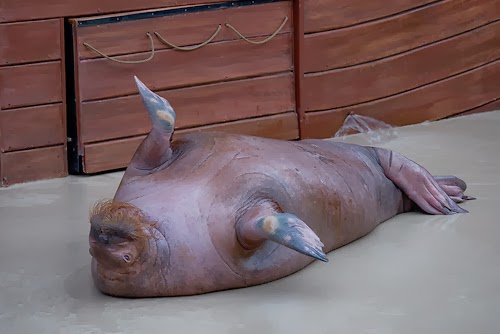
“Now that is the Sexiest Walrus Alive!”

“Look at the tail on that mouse!”

“What a fox!”

Well, of course they’re not. The so-called “lesser” animals would never waste time they could be spending ensuring their own survival seeking out the most attractive coyotes west of the Mississippi, especially when they were never actually going to sleep with them.

So why do people do it? Why do we rank our fellow humans? Why do we obsess over Most Beautiful or Most Handsome?

I don’t know the answer, myself. I can’t really even guess. I’m personally inclined to believe it’s got something to do with having too much time on our hands. Because in the animal kingdom, true leisure is very rare. Even playtime is generally believed to constitute training or preparation for the “real” world. But what useful purpose does choosing the Most Beautiful People in the world serve? It can’t be meaningless; there must be some point to this worldwide yet relatively new phenomenon. There were very few celebrities in the 19th century, after all, and the few there were weren’t especially attractive.

But perhaps there is some evolutionary reasoning behind the beauty contest. Maybe it’s not about objectively evaluating someone’s good looks, or choosing the person with whom you’d most like to have sex. Maybe what it’s actually about is offering up a model for the rest of us to emulate; an example for us ordinary women. See, here, they tell us, look at what qualities of femininity Scarlett Johansson possesses. If you can imitate them, then you will be sought after by all of the other men who agree that these characteristics, taken together, constitute “sexy” and your odds of having quality offspring will increase. In effect, maybe we’re supposed to learn by example; perhaps it is a training exercise of sorts.

But then what’s in it for the men (I mean, beyond the obvious)? Maybe if you’re a man, there’s a biological benefit to having an ideal imaginary mate in mind so you can measure your real-world potential mates against her. Or perhaps male humans are designed in such a way that they aren’t entirely sure of themselves when it comes to selecting mates, and maybe having the consensus of other men as to what constitutes a good woman boosts a man’s confidence that he’s made a sound choice.

Or who knows? Maybe it simply boils down to the fact that most mammals, male and female alike, like shiny things.

It does make one wonder how other animals would behave if they enjoyed as much leisure time as modern-day humans. Of course, there already are a few other species that experience lives of even greater leisure than ours. Our pets. Yes, the dogs and cats and goldfish of the world have plenty of hours in which to mull over the mysteries of science and the meaning of pop culture. They can spend the whole day daydreaming up a romance between themselves and the tabby cat next door or the bitch down the street if they choose. I wonder if they do…

2518e-sexiestwalrusalive

The Sexiest Walrus Alive?