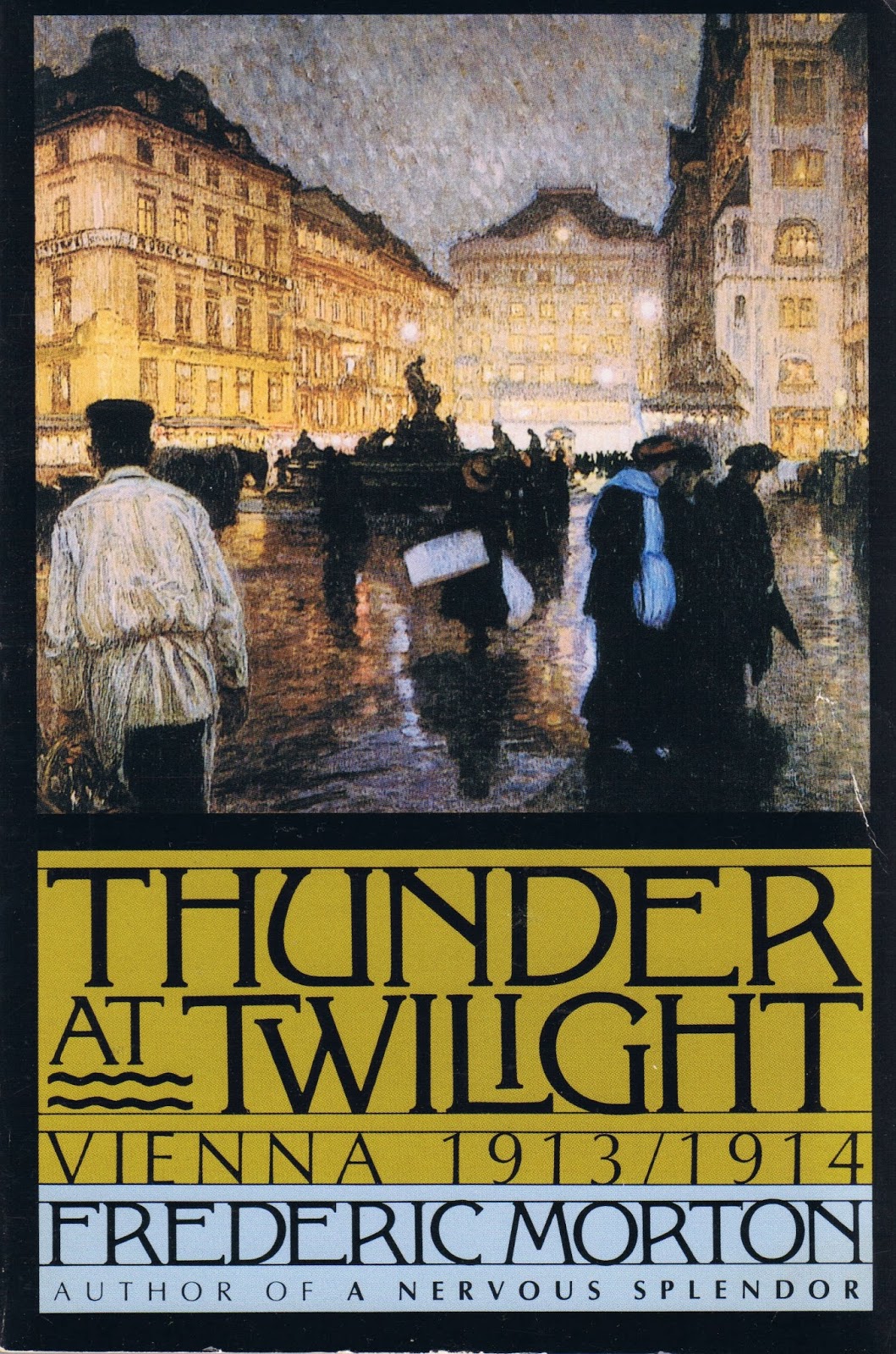
Book Review: Thunder at Twilight: Vienna 1913/1914

Morton, Frederic, Thunder at Twilight: Vienna 1913/1914, Charles Scribner’s Sons: New York, 1989.

Thunder at Twilight offers a detailed history – really almost an exposé – of the conditions of Viennese life that preceded the assassination of Archduke Franz Ferdinand, which, as we all know, indirectly led to the First World War. The book is extraordinarily well-researched; the author even goes so far as to relay to us the weather on days of particular importance, and to describe which writers and operas were popular at the time. In other words, it creates a very large picture of Viennese society – a society on the verge of cataclysm – by revealing the minutest details of everyday life in a city in turmoil, and, by extension, a Europe in turmoil.   

What’s particularly interesting and most unique about this book is the way it examines its chosen moment in history by tracing the thoughts and interactions of a variety of important figures of its time. Thus not only are we offered insight into the life of Emperor Franz Joseph, and of the Archduke’s eventual assassins, but also of Adolf Hitler, who was then residing in Vienna as an unknown painter, and Leon Trotsky, who had made of Vienna a temporary home, and even Josef Stalin, who visited the city during these crucial years. Even the story of Sigmund Freud is deftly interwoven into this fascinating mix of individual histories, thus providing a perspective on the psychoanalytical as well as the political thought of the that era.

It is perhaps because of this unusual presentation that Morton manages to strike us with particularly fresh observations on the very essence of Viennese life. He remarks, for example, that Freud’s theory of the id-ego-superego parallels the structure of the old Viennese government. By focusing on slights on the Archduke’s wife, a mere Duchess who is not permitted royal privileges in accord with the aristocratic distinctions of the time, he effectively illustrates the rigidity of the turn-of-the-century Viennese class system. He notes the power and prevalence of “thunderbolt” imagery in contemporary politics, and imagines the storm that follows as a means of clearing away the stifling air of industrialization. And, ultimately, he concludes that the Great War was a reaction, not to the political assassination alone, but to the changes effected by modernization; to “progress unmoored from God.” Thus he departs somewhat from the oft-heard presumption that World War I was a result of rabid European nationalism; rather he claims that this nationalism was engendered by a vague and even continent-wide dissatisfaction of the people of Europe with their economic and social lives.

All in all, it’s a fascinating book, and well worth the read. I did find the style of writing a bit cheesy at times, and the characterizations of Vienna (of which Morton is a native) occasionally a little harsh. But it also lends a wonderful reality to one’s perception of the situation in Europe a hundred years ago, a climate that resulted in the worst war the world had then known. By looking at the years 1913/1914 through Viennese eyes, the reader can clearly see, can even possibly hope to analyze, the events, both direct and indirect, that led to that war. And this is perhaps the first step towards an understanding of the genesis of all wars.


Moving In, Moving Out, Moving On: A Memoir

My short memoir “Moving In, Moving Out, Moving On” has been published in Foliate Oak Literary Magazine:

http://www.foliateoak.com/lori-schafer.html

Although this piece now forms a part of my memoir On Hearing of My Mother’s Death Six Years After It Happened, I was originally prompted to write it for the 2012 Ladies Home Journal personal essay contest. The theme was “The Day that Changed My Life.” Boy, was that tough. Very few of my life’s big changes can be traced to one day. The day I nearly drowned a few years ago was a contender, but I don’t think I was ready to write about that yet. The day I ran away from home would have been an obvious choice, but it didn’t make for much of a story. But then there was this day, the day I became aware that my mother was mentally ill, and that, I thought, had possibilities. Still, I suppose it would be a stretch to say that that particular day changed my life; rather, it was more that it marked a turning point in my theretofore comparatively carefree teenage existence.

It’s an interesting idea, though, isn’t it? Every day, people are faced with calamitous events that, in a flash, change their lives forever: accidents, natural disasters, illnesses, deaths in the family. You can’t even prepare for those kinds of changes because, unlike the string of fairly predictable events that make up the majority of modern life – going off to college, finding a job, getting married, having children, retiring – you don’t know they’re coming. Perhaps that’s why these kinds of stories fascinate us; there’s something wonderful in the way people respond to unexpected challenges, sometimes even something heroic. And while none of us wants to suffer a sudden catastrophe, maybe deep down we all hope that we would have the strength and courage to handle one if it came our way.


My Short-Short “Poisoned” in The Journal of Microliterature – Thanks to an Editor’s Wonderful Feedback

My flash fiction story “Poisoned” has been published in The Journal of Microliterature:

http://www.microliterature.org/poisoned-by-lori-Schafer

This was a very tricky piece to put together. It was actually inspired by an incident that occurred in the course of my mother’s psychosis. One day she took me to the hospital, complaining of chest and abdominal pains. I was naturally concerned, but I also recall being hopeful that having a doctor examine her would lead to the (I thought) inevitable revelation that she’d lost her marbles. No such luck. But anyway, they took her complaints seriously, because although she was in fairly good health, at forty-one she wasn’t exactly young anymore, and was a smoker besides, so there was legitimate reason to believe there could be a problem with her heart. They gave her the requisite battery of tests, but couldn’t find anything wrong. Now, as an adult, I can pretty easily guess what they must have told her – that she’d had an anxiety attack, which she probably had – but at the time I had no idea such a thing even existed. In fact, I wondered more if perhaps it was all in her head; she was imagining a lot of strange things in those days. Then the doctor left the room and the interrogation began. And that’s when I began to be afraid that she’d somehow manage to pin the blame for her mysterious illness on me.

The first version I wrote of this piece was mostly reflective of that – my terror over being falsely accused and probably convicted of poisoning my own mother with some substance of which no one could prove or disprove the existence. I sent my story off to Microliterature, and a few weeks later I received a response from the editor that basically said (politely) that I had ruined an otherwise good piece by changing the tone halfway through. He was absolutely right. The story ended in hysterics, with the husband being dragged away by the police, which, while it carried the plot in an interesting direction, utterly wrecked the dreadful calm of the first half of the story. He did, however, say that if I ever did a rewrite, I should feel free to resubmit.

So I rewrote it. I changed the second half of the piece entirely, including the ending, making it more about the relationship between the husband and wife than about the consequences of the wife’s accusation. And I was careful to maintain the tone of the first half of the piece throughout, which worked worlds better than the original version. And here you see the results. How grateful I am to that editor! With one brief sentence he nailed what was wrong with that piece and clued me in as to how to change it from a so-so story into a well-done one. I realize, of course, that few editors have the time to address the defects in the submissions they receive. But I hope that those who do make the effort are aware of how much we writers truly appreciate their feedback, and of what an impact a few choice words can make on the quality of a writer’s work.

Addendum: After this story was published, I also composed an alternate version, a nonfiction piece also entitled Poisoned, which is written in the first person and is featured in my memoir On Hearing of My Mother’s Death Six Years After It Happened. It received an Honorable Mention in The Avalon Literary Review‘s Spring 2014 Quarterly Contest and may be downloaded as a FREE eBook at your favorite  eBook retailer; I have also posted it here for those who are curious to compare the two versions.  Needless to say, I was very careful to maintain a consistent tone throughout!

Guest Blog Post: Selling the Dollhouse up at Wow! Women on Writing

http://muffin.wow-womenonwriting.com/2013/11/friday-speak-out-selling-dollhouse.html

I have a guest blog post up today at “The Muffin,” the blog of Wow! Women on Writing. This is the first time I’ve done a guest post, but I definitely like the idea of doing more.

Who’s the Sexiest, and Why Do We Care?

It’s been a few weeks now since I saw the big news. I’m sure most of you have been thinking about it nonstop since then, too, but for those of you who haven’t, I’ll reiterate.

Scarlet Johansson has been named Esquire Magazine’s Sexiest Woman Alive for the second year in a row.

Okay, headlines like these are the reason I changed my home page to Science Daily. Even if I were a man, I can’t imagine caring who the Sexiest Woman Alive is. Unless, perhaps, she lived on my block, frequented the same grocery store, and was inclined to laugh at my stupid jokes, leading me to believe I actually had a shot. But then I wouldn’t need a magazine to tell me how hot my neighbor is.

But it got me to thinking. Are other animals having these discussions?

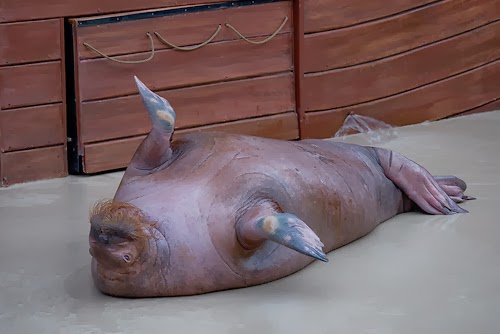
“Now that is the Sexiest Walrus Alive!”

“Look at the tail on that mouse!”

“What a fox!”

Well, of course they’re not. The so-called “lesser” animals would never waste time they could be spending ensuring their own survival seeking out the most attractive coyotes west of the Mississippi, especially when they were never actually going to sleep with them.

So why do people do it? Why do we rank our fellow humans? Why do we obsess over Most Beautiful or Most Handsome?

I don’t know the answer, myself. I can’t really even guess. I’m personally inclined to believe it’s got something to do with having too much time on our hands. Because in the animal kingdom, true leisure is very rare. Even playtime is generally believed to constitute training or preparation for the “real” world. But what useful purpose does choosing the Most Beautiful People in the world serve? It can’t be meaningless; there must be some point to this worldwide yet relatively new phenomenon. There were very few celebrities in the 19th century, after all, and the few there were weren’t especially attractive.

But perhaps there is some evolutionary reasoning behind the beauty contest. Maybe it’s not about objectively evaluating someone’s good looks, or choosing the person with whom you’d most like to have sex. Maybe what it’s actually about is offering up a model for the rest of us to emulate; an example for us ordinary women. See, here, they tell us, look at what qualities of femininity Scarlett Johansson possesses. If you can imitate them, then you will be sought after by all of the other men who agree that these characteristics, taken together, constitute “sexy” and your odds of having quality offspring will increase. In effect, maybe we’re supposed to learn by example; perhaps it is a training exercise of sorts.

But then what’s in it for the men (I mean, beyond the obvious)? Maybe if you’re a man, there’s a biological benefit to having an ideal imaginary mate in mind so you can measure your real-world potential mates against her. Or perhaps male humans are designed in such a way that they aren’t entirely sure of themselves when it comes to selecting mates, and maybe having the consensus of other men as to what constitutes a good woman boosts a man’s confidence that he’s made a sound choice.

Or who knows? Maybe it simply boils down to the fact that most mammals, male and female alike, like shiny things.

It does make one wonder how other animals would behave if they enjoyed as much leisure time as modern-day humans. Of course, there already are a few other species that experience lives of even greater leisure than ours. Our pets. Yes, the dogs and cats and goldfish of the world have plenty of hours in which to mull over the mysteries of science and the meaning of pop culture. They can spend the whole day daydreaming up a romance between themselves and the tabby cat next door or the bitch down the street if they choose. I wonder if they do…

2518e-sexiestwalrusalive

The Sexiest Walrus Alive?


On Books: Valley of the Dolls

On Books: Susann, Jacqueline, Valley of the Dolls, Bantam Books: New York, 1967.

I decided to read this book after chancing across the movie version on television and realizing, to my surprise, that it was not a horror story, as I’d always thought it was. (I suspect that as a child I got it confused with a book written by V.C. Andrews, of whom my older sister was very fond.)

I’m not going to bore you with the plot points – it’s an engaging if overdone exploration of the high-pressure and sometimes cutthroat world of show business – but I do want to point out that it was hardly the first story of its kind, and certainly not the best. Think The Bad and the Beautiful, Sweet Smell of Success, and, of course, the masterful All About Eve. Indeed, when you look back on the number of motion pictures that revolved around the stresses of Hollywood ladder-climbing in the middle of the last century it makes you realize that this was actually a fairly new phenomenon at the time, wasn’t it? The big stars of Broadway or film experienced fame on an entirely different level than the entertainers of the nineteenth century or before. While it may be argued that, owing to technological advances and the invention of social media, modern performers are subject to even greater stresses, this is a quantitative rather than a qualitative change. And indeed, one only has to glance at the headlines to realize that the entertainers of today have just as many issues with drugs and backstabbing as those of Hollywood in its infancy.

In any case, plot aside, what was really striking about the novel is what jerks the men are, and what idiots the women are. In fact, the jerkier the men, the more idiotic the women become. No, strike that. The women are idiotic in their own right, too, independent of the men. And sometimes the women are jerks, and the men are idiots. Really, what man would ever go on about how he loves a woman for herself, and then in the next breath declare that he loves her for her breasts? What woman would ever decide to give up on having children because she’s reached the ripe old age of thirty? I mean, I know we’re talking about fifty years ago here, but biology hasn’t changed that much. And the attitude towards women, especially coming from a female writer, is just unbelievable. At one point one of the main characters gains a lot of weight, and everyone – men, women, and she herself – refer to her as a useless “sack of blubber.” To paraphrase, “He can’t be in love with her; she’s a pig!” Trust me, if you read the book, it’s clear that this was not ironically intended.

Finally, the sexuality that made the book so sensational at the time is horrible, just horrible. It makes you wonder if the author ever had a satisfying, or indeed, even a vaguely pleasant sexual experience in her life. The women hardly ever want or enjoy intercourse, but that’s okay, says the novel, because they get their satisfaction from “pleasing their man.” Ugh! If this is the kind of example of liberation that women were given back in the sixties, it gives me new respect for my mother’s generation. How heroically well-adjusted they were, it seems to me now.

It’s so offensive that it’s actually worth reading, if only to get a sense of the cultural context. I promise, you will be eternally grateful that these days you can get a wrinkle without wanting to kill yourself. That you can have enough self-respect not to have to lay down like a doormat to “hold on” to your man. And that men nowadays don’t expect you to.  

“Found Money” in Burningword Literary Journal

My short-short “Found Money” has been published in Burningword Literary Journal:

http://burningword.com/2013/10/found-money/

Like many of my flash fiction pieces, Found Money is based on events from my own life; it’s even featured in my memoir On Hearing of My Mother’s Death Six Years After It Happened. And, like some of my other autobiographical pieces, at first I wasn’t sure if it really worked well as a fictional story. It actually started out as a considerably longer piece, seven hundred words or so, but somehow I just couldn’t get the middle section right. It sketched out the background of what had happened in the weeks before I found the money, which was itself a story worth telling – in fact, I eventually expanded it and turned it into a separate section of my memoir without fictionalizing it. But to someone who didn’t know the original story was taken from true events, I think the longer version came across as overly dramatic, or at least overdone. After it was rejected by a couple of journals, I took another look at it and decided to cut out the middle altogether. This shorter version I think works much better.

What’s conspicuously and intentionally absent from this piece is any kind of emotion. I don’t think you can afford to have feelings when you’re quite literally starving, and during most of this period in my life, it’s safe to say that the emotional part of my mind was effectively switched off. But I cried when I found that money. Oh, how I cried.

I will never forget the people in that restaurant, either. They only spoke to one another in Chinese, so I have no idea what they said about me, if anything at all. But they went out of their way to be kind to someone who was obviously homeless, and probably very dirty and smelly, and that touched me deeply.

That day marked a turning point in my young life. Not because I found five dollars; a loaf of bread and a small jar of peanut butter later, it was gone. The more important thing I found on the sidewalk that day was something I hadn’t even realized I’d lost. Hope.

* * *

“Found Money” is one of the stories featured in my autobiographical short story and essay collection Stories from My Memory-Shelf: Fiction and Essays from My Past (only $0.99 Kindle, $5.99 paperback). To learn more about it, please visit the book’s webpage or subscribe to my newsletter.

Found Money

On Science: Preventing Pedophilia?

http://www.sciencedaily.com/releases/2013/10/131002131438.htm

Recently I’ve been thinking a lot about biology and how it relates to human affairs. I think there’s a tendency among humans to believe that we are somehow special, unique in the animal kingdom, and perhaps in some ways we are. But there’s no doubt in my mind that however complex our brains, our bodies must still operate via the same mechanisms as those of the “lesser” animals – with chemical reactions, nerve signals, and so on. And the more I learn about what’s transpiring in the world of science, the more I suspect that psychology, as it is currently understood, no longer offers the best explanation for human behavior. Or, rather, that a person’s psychological makeup is not derived in any spiritual or subconscious way by the inner workings of the mysterious concept that we call “mind,” but by biological forces operating outside the level of our consciousness. In fact, the more I think about it, the more I suspect that human affairs are more biological than we give them credit for, and this study I read on Science Dailyseems to me a case in point.
 
The scientists found that juvenile mice secrete a pheromone in their tears that drastically reduces the sexual behavior of adult mice towards them, a “protective” shield, if you will, against mating activity from full-grown males. There are obvious reasons why, biologically speaking, it would be foolish for adult mice to try to mate with prepubescent mice, even supposing that mice are not subject to the same social strictures as humans.

But that got me to thinking. Clearly humans don’t have the same olfactory systems as mice. They do, however, have similarly well-founded biological objections to adult-juvenile pairings. Isn’t it therefore logical to suppose that people also have some as-yet-undiscovered mechanism that precludes adults from desiring intercourse with children? And if this is the case, wouldn’t it also be logical to propose that pedophiles, rather than being victims of psychological unbalance or damage, might instead be genetically defective – unable to perceive the signals that make the rest of us sick to our stomachs at the very thought of what gives them pleasure? And if this were true, is it even possible that pedophilia might turn out to be a treatable condition after all?

Of course, there’s a huge difference between people and mice. The study concludes that the pheromone makes it possible for the mice to discriminate in favor of full-grown partners. It doesn’t, however, offer any evidence that, in the absence of the pheromone, the mice will actually prefer juveniles, which I believe is what most human pedophiles do. For humans, therefore, it can’t simply be a matter of not receiving the “hands-off” signal when it comes to children. Is there another force at work here that we simply don’t understand? A chemical signal, perhaps, that the young exude and that is sexually irresistible to adults who are susceptible to it? It’s not so far-fetched. Look at new-baby smell – it’s clearly one of the many “cuteness” factors that make people want to take care of the little buggers. And think of how different the world could be if there were no sexual predators; if it were possible to simply shut off whatever triggers that lust within them. This, to me, would be an avenue worthy of scientific exploration.

Human sexuality is incredibly complex. And, as we’re learning more and more, so is the sexuality of other animals. People are into all kinds of crazy sexual behaviors that seem to have nothing to do with reproduction. But maybe that isn’t the case at all. Maybe we, as humans, simply haven’t yet figured out the “why” of those things we call pleasurable; maybe, at bottom, there’s some biological sense to them after all.

Author Commentary: Baby and Me

My humorous flash fiction piece “Baby and Me” has been published on Every Day Fiction:

http://www.everydayfiction.com/baby-and-me-by-lori-schafer/

This was the first story I published following my fifteen-year creative hiatus. I’ll admit I was very surprised when I finished it. It’s funny, I thought. That seemed strange. I’m not funny; I’ve never been funny. And then Every Day Fiction published it and their readers thought it was funny, too. Well, what do you know?

I’ve been asked if this was based on true events. The answer is, Not really. I’m at an age where I’m surrounded by a lot of marriage and baby talk and that’s what prompted me to write this piece: the horror of watching other people grow up all around me while I’m still struggling with the disbelief that we can possibly be old enough to be creating a new generation already.

Many people, including the editors at EDF, were very surprised by the ending. I thought that was funny because to me, there would have been no story without the ending. Or, rather, it would have been an incredibly dull and formulaic story if it had come to the expected conclusion. I myself was most surprised by how tolerant people were of the anti-offspring stance of this piece; I expected a bit more indignant horror. It’s good to know that readers can be entertained by a story even if they don’t agree with its premise. Just as I can be amused by the new parents and children springing up all around me.

Author Commentary: Two Fathers

I originally wrote this piece in an effort to create an ultra-short of 150 words or less. I don’t recall what prompted it, but somehow I got to thinking of my biological father and the very few memories I have of him, which, interestingly enough, taken all together, come out to about 150 words!

The second segment is about the father of the best friend I had from the time I was four or five until we moved to a different town when I was twelve. In the hundreds of times I visited my friend’s house – which was just across the street from ours – I don’t believe I actually saw the man more than a dozen times, and never once in all those years did he speak to me. Of course, most of the time he was busy working his butt off to support their five children, and there was no doubt that he loved his family very much. But as a kid all I was cognizant of was the fear.

I wrote another segment of this piece about my “main” stepfather – that’s the one I had the longest – but I didn’t really care for the way it turned out so I omitted it. I’m still not sure if I should have included it after all. It certainly would have put a different spin on the piece as a whole, because it was a fairly flattering portrayal of a man who, without being anyone’s biological father, was nonetheless the best father I ever had. Except that in the end, when the marriage dissolves, the stepdad moves away and is never heard from again, and my intent was to make the story evocative rather than melancholy. And at bottom, I think it makes for a better “vignette” without coming to such a resounding conclusion, and that’s what Vine Leaves does best.